Results by title
4 books match the query 'Effect of imprisonment on'

For the Children?
Protecting Innocence in a Carceral StateErica R. Meiners
University of Minnesota Press, 2016
“Childhood has never been available to all.” In her opening chapter of For the Children?, Erica R. Meiners stakes the claim that childhood is a racial category often unavailable to communities of color. According to Meiners, this is glaringly evident in the U.S. criminal justice system, where the differentiation between child and adult often equates to access to stark disparities. And what is constructed as child protection often does not benefit many young people or their communities. Placing the child at the heart of the targeted criminalization debate, For the Children? considers how perceptions of innocence, the safe child, and the future operate in service of the prison industrial complex.
The United States has the largest prison population in the world, with incarceration and policing being key economic tools to maintain white supremacist ideologies. Meiners examines the school-to-prison pipeline and the broader prison industrial complex in the United States, arguing that unpacking child protection is vital to reducing the nation’s reliance on its criminal justice system as well as building authentic modes of public safety. Rethinking the meanings and beliefs attached to the child represent a significant and intimate thread of the work to dismantle facets of the U.S. carceral state.
Taking an interdisciplinary approach and building from a scholarly and activist platform, For the Children? engages fresh questions in the struggle to build sustainable and flourishing worlds without prisons.

Homeboys Forever
The Lifetime Consequences of Gang MembershipAvelardo Valdez
University of Chicago Press, 2026
Violence, addiction, imprisonment . . . we don’t have to look hard to see the negative consequences of gang involvement. But what does it look like to spend a life—from adolescence to adulthood—in gangs? Sociologist Avelardo Valdez and his research team have been following the lives of Mexican American men in San Antonio, Texas, over a remarkable twenty years, watching and listening as they navigate adolescent delinquency and gang involvement, advance into a life of crime, and—sometimes—attempt to break from gang life and build lives in conventional society.
When gang affiliation exploded in the 1990s, adolescent street gang membership surged in the Mexican American community of Westside San Antonio. Valdez was quick to begin investigating how young men embedded in a system with little support for lasting change turned to gang violence, drug use, and other risky behaviors. The honesty of these men’s accounts draws our attention to the economic, political, and sociocultural context of impoverished communities in San Antonio. Being constantly written off as troublemakers and criminals eroded the self-respect that these young men once had. They were once lithe, active, and full of self-confidence, but after a lifetime of constant harassment and entanglements with the legal system, they now have a perpetual look of exhaustion and defeat.
Encouraging readers to question who is at fault when young men become involved in gangs and other delinquent behaviors, Homeboys Forever is a humanizing account of marginalized youth who struggle to overcome the systemic inequities that have led to a lifetime of heartbreaking consequences.
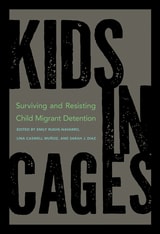
Kids in Cages
Surviving and Resisting Child Migrant DetentionEdited by Emily Ruehs-Navarro, Lina Caswell Muñoz, and Sarah J. Diaz
University of Arizona Press, 2024
In recent years, the plight of immigrant children has been in the national spotlight. A primary issue of concern is the experience of child migrants in detention by the U.S. government.
The authors in this volume approach the topic of child migrant detention from a range of perspectives. Some authors, particularly those who provide a legal perspective, chronicle the harms of detention, arguing that despite governmental assurances of child protection, detention is fundamentally a state-sanctioned form of violence. The social scientists in the volume have worked closely with detained youth themselves; in these chapters, authors highlight the ways in which youth survive detention, often through everyday acts of resistance and through the formation of temporary relationships. Practitioners including psychologists, activists, and faith leaders look at forms of resistance to detention. From retheorizing psychological interventions for detained youth to forming hospitality homes that act as alternatives to detention, these practitioners highlight ways forward for advocates of youth. At the heart of these narratives lies a crucial debate: the tension between harm-reduction strategies and abolition.
This interdisciplinary work brings together voices from the legal realm, the academic world, and the on-the-ground experiences of activists and practitioners.
Contributors
Stella Akello
Jessica Alaniz
Aireen Grace Andal
Samuel Arroyo
Corey Brost
Lina Caswell Muñoz
Marisa Chumil
Patricia Crowley
Iman Dadras
Sarah J. Diaz
Sandra Espinoza
Jacqueline Florian
Michael Gosch
Darlene Gramigna
Lisa Jacobs
Katherine Kaufka Walts
Corinne Kentor
Jenn M. Lilly
Kathlyn Mulcahy
Jennifer Nagda
Vida Opoku
Silvia Rodriguez Vega
Emily Ruehs-Navarro
Herlin Soto-Matute
Luis Edward Tenorio
Jajah Wu

Way Down in the Hole
Race, Intimacy, and the Reproduction of Racial Ideologies in Solitary ConfinementAngela J. Hattery
Rutgers University Press, 2023
Way Down the Hole Video 1 (https://youtu.be/UuAB63fhge0)
Way Down the Hole Video 2 (https://youtu.be/TwEuw1cTrcQ)
Way Down the Hole Video 3 (https://youtu.be/bOcBv_UnHIs)
Way Down the Hole Video 4 (https://youtu.be/cx_l1S8D77c)