Results by title
5 books match the query 'Eighteenth - Century England'
BASTARDS AND FOUNDLINGS
ILLEGITIMACY IN EIGHTEENTH-CENTURY ENGLANDLisa Zunshine
The Ohio State University Press, 2005
In this compelling interdisciplinary study of what has been called the "century of illegitimacy," Lisa Zunshine seeks to uncover the multiplicity of cultural meanings of illegitimacy in the English Enlightenment. Bastards and Foundlings pits the official legal views on illegitimacy against the actual everyday practices that frequently circumvented the law; it reconstructs the history of social institutions called upon to regulate illegitimacy, such as the London Foundling Hospital; and it examines a wide array of novels and plays written in response to the same concerns that informed the emergence and functioning of such institutions. By recreating the context of the national preoccupation with bastardy, with a special emphasis on the gender of the fictional bastard/foundling, Zunshine offers new readings of "canonical" texts, such as Steele's The Conscious Lovers, Defoe's Moll Flanders, Fielding's Tom Jones, Moore's The Foundling, Colman's The English Merchant, Richardson's Clarissa and Sir Charles Grandison, Burney's Evelina, Smith's Emmeline, Edgewort's Belinda, and Austen's Emma, as well as of less well-known works, such as Haywood's The Fortunate Foundlings, Shebbeare's The Marriage Act, Bennett's The Beggar Girl and Her Benefactors, and Robinson's The Natural Daughter.
[more]
Giving Birth in Eighteenth-Century England
Sarah Fox
University of London Press, 2022
A history of childbirth in the eighteenth century as told by women.
This fascinating new book radically rewrites all that we know about eighteenth-century childbirth by placing women’s voices at the center of the story. Examining childbirth from the perspective of the birthing woman, this research offers new perspectives on the history of the family, the social history of medicine, community and neighborhood studies, and the study of women’s lives in eighteenth-century England.
From “quickening” through to “confinement,” “giving caudle,” delivery, and “lying-in,” birth was once a complex ritual that involved entire communities. Drawing on an extensive and under-researched body of materials, such as letters, diaries, and recipe books, this book offers critical new perspectives on the history of the family, community, and the lives of women in the coming age of modern medicine. It unpacks the rituals of contemporary childbirth—from foods traditionally eaten before and after birth, birthing clothing, and how a woman’s relationship with her family, husband, friends, and neighbors changed during and after pregnancy. In this important and deeply moving study, we are invited onto a detailed and emotional journey through motherhood in an age of immense socio-cultural and intellectual change.
[more]
Imagining Monsters
Miscreations of the Self in Eighteenth-Century EnglandDennis Todd
University of Chicago Press, 1995
In 1726, an illiterate woman from Surrey named Mary Toft announced that she had given birth to seventeen rabbits. Deceiving respected physicians and citizens alike, she created a hoax that held England spellbound for months. In Imagining Monsters, Dennis Todd tells the story of this bizarre incident and shows how it illuminates eighteenth-century beliefs about the power of imagination and the problems of personal identity.
Mary Toft's outrageous claim was accepted because of a common belief that the imagination of a pregnant woman could deform her fetus, creating a monster within her. Drawing on largely unexamined material from medicine, embryology, philosophy, and popular "monster" exhibitions, Todd shows that such ideas about monstrous births expressed a fear central to scientific, literary, and philosophical thinking: that the imagination could transgress the barrier between mind and body.
In his analysis of the Toft case, Todd exposes deep anxieties about the threat this transgressive imagination posed to the idea of the self as stable, coherent, and autonomous. Major works of Pope and Swift reveal that they, too, were concerned with these issues, and Imagining Monsters provides detailed discussions of Gulliver's Travels and The Dunciad illustrating how these writers used images of monstrosity to explore the problematic nature of human identity. It also includes a provocative analysis of Pope's later work that takes into account his physical deformity and his need to defend himself in a society that linked a deformed body with a deformed character.
[more]
Imagining the Penitentiary
Fiction and the Architecture of Mind in Eighteenth-Century EnglandJohn Bender
University of Chicago Press, 1987
This brilliant and insightful contribution to cultural studies investigates the role of literature—particularly the novel—and visual arts in the development of institutions. Arguing the attitudes expressed in narrative literature and art between 1719 and 1779 helped bring about the change from traditional prisons to penitentiaries, John Bender offers studies of Robinson Crusoe, Moll Flanders, The Beggar's Opera, Hogarth's Progresses, Jonathan Wild, and Amelia as well as illustrations from prison literature, art, and architecture in support of his thesis.
[more]
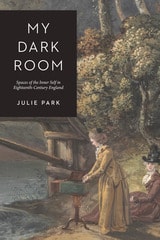
My Dark Room
Spaces of the Inner Self in Eighteenth-Century EnglandJulie Park
University of Chicago Press, 2023
Examines spaces of inner life in eighteenth-century England to shed new light on interiority in literature and visual and material culture.
In what kinds of spaces do we become most aware of the thoughts in our own heads? In My Dark Room, Julie Park explores places of solitude and enclosure that gave eighteenth-century subjects closer access to their inner worlds: grottos, writing closets, landscape follies, and the camera obscura, that beguiling “dark room” inside which the outside world in all its motion and color is projected. The camera obscura and its dreamlike projections within it served as a paradigm for the everyday spaces, whether in built environments or in imaginative writing, that generated the fleeting states of interiority eighteenth-century subjects were compelled to experience and inhabit.
My Dark Room illuminates the spatial and physical dimensions of inner life in the long eighteenth century by synthesizing material analyses of diverse media, from optical devices and landscape architecture to women’s intimate dress, with close readings of literary texts not traditionally considered together, among them Andrew Marvell’s country house poem Upon Appleton House, Margaret Cavendish’s experimental epistolary work Sociable Letters, Alexander Pope’s heroic verse epistle Eloisa to Abelard, and Samuel Richardson’s novel Pamela. Park also analyzes letters and diaries, architectural plans, prints, drawings, paintings, and more, drawing our attention to the lively interactions between spaces and psyches in private environments. Park’s innovative method of “spatial formalism” reveals how physical settings enable psychic interiors to achieve vitality in lives both real and imagined.
[more]