Results by title
12 books match the query 'Pieces'
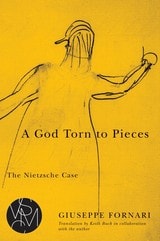
A God Torn to Pieces
The Nietzsche CaseGiuseppe Fornari
Michigan State University Press, 2013
Giuseppe Fornari’s groundbreaking inquiry shows that Friedrich Nietzsche’s neglected importance as a religious thinker and his “untimeliness” place him at the forefront of modern thought. Capable of exploiting his own failures as a cognitive tool to discover what other philosophers never wanted to see, Nietzsche ultimately drove himself to mental collapse. Fornari analyzes the tragic reports of Nietzsche’s madness and seeks out the cause of this self-destructive destiny, which, he argues, began earlier than his rivalry with the composer and polemicist Richard Wagner, dating back to the premature loss of Nietzsche’s father. Dramatic experience enabled Nietzsche to detect a more general tendency of European culture, leading to his archaeological and prophetic discovery of the death of God, which he understood as a primordial assassination from which all humankind took its origin. Fornari concludes that Nietzsche’s fatal rebellion against a Christian awareness, which he identified as the greatest threat to his plan, led him to become one and the same not only with Dionysus but also with the crucified Christ. His effort, Fornari argues, was a dramatic way to recognize the silent, inner meaning of Christ’s figure, and perhaps to be forgiven.

Bits and Pieces
Screening Animal Life and DeathSarah O'Brien
University of Michigan Press, 2023
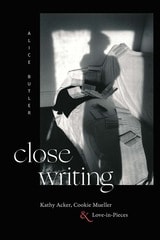
Close Writing
Kathy Acker, Cookie Mueller, and Love-in-PiecesAlice Butler
Duke University Press, 2026
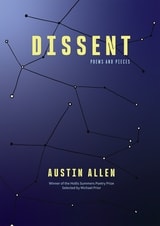
Dissent
Poems and PiecesAustin Allen
Ohio University Press, 2027
Winner of the Hollis Summers Poetry Prize, selected by Michael Prior
Dissent, the third book of poems by Austin Allen, explores division, resistance, and exile in a variety of settings, from nineteenth-century New England to distant solar systems. Here readers will find snapshots of warring planets and pandemic-era France, revelations from government servers and Frank Capra’s Bedford Falls, and a testimonial from a fringe religious sect in the New Mexico desert.
The poems capture the dignity of eccentricity and the uncertainties of protest (“I speak out. I feel that I must. / I hear my own spiel with disgust”). Featured along the way are many lively dissenters and outsiders: Yoko Ono, a reclusive mathematician, a brain in a jar. Futuristic scenarios mingle with personal elegies and love lyrics—efforts to preserve bonds and memories threatened by an age of schisms.
Avoiding allegiance to any one school or style, the collection serves up apocalyptic limericks, a “high-octane blockbuster sonnet,” a catalog of items cleared out of a parent’s home, and instruction pieces in the style of Ono’s Grapefruit. Whether depicting a visionary mailman or happy thieves on Christmas, Dissent probes the unorthodox corners of a world where poetry itself can feel heretical.
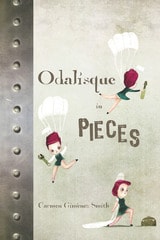
Odalisque in Pieces
Carmen Giménez Smith
University of Arizona Press, 2009
In these poems we encounter such strange beauties as a girl assembling and disassembling, a moth trapped in a glass of water, new-age fairy godmothers, and a lark who sings for the milkman. Yet we are also made aware of how these beauties reflect the speaker’s troubles—her effort to employ, in the words of one of her most memorable poems, “Only the invisible post where she writes the encounters / with air’s lusters. Only the imagined hour / with which she’s made a fragile craft.”
Vivid and charged with an inner light, these are poems that linger and expand in the mind and memory.

Pick Up the Pieces
Excursions in Seventies MusicJohn Corbett
University of Chicago Press, 2019
Rock. Disco. Pop. Soul. Jazz. Folk. Funk. The music scene of the 1970s was as varied as it was exhilarating, but the decade’s diversity of sound has never been captured in one book before now. Pick Up the Pieces gives a panoramic view of the era’s music and culture through seventy-eight essays that allow readers to dip in and out of the decade at random or immerse themselves completely in Corbett’s chronological journey.
An inviting mix of skilled music criticism and cultural observation, Pick Up the Pieces is also a coming-of-age story, tracking the author’s absorption in music as he grows from age seven to seventeen. Along with entertaining personal observations and stories, Corbett includes little-known insights into musicians from Pink Floyd, Joni Mitchell, James Brown, and Fleetwood Mac to the Residents, Devo, Gal Costa, and Julius Hemphill.
A master DJ on the page, Corbett takes us through the curated playlist that is Pick Up the Pieces with captivating melody of language and powerful enthusiasm for the era. This funny, energetic book will have readers longing nostalgically for a decade long past.

Pieces of Sound
German Experimental RadioDaniel Gilfillan
University of Minnesota Press, 2009
A cultural history of German radio broadcasting from the 1920s to today
Since the rise of film and television, radio has continued to evolve, with satellite radio and podcasts as its latest incarnations. Any understanding of the development of radio, like its visual counterparts, depends on closely examining the artistic ventures that preceded commercial acceptance.
In Pieces of Sound, Daniel Gilfillan offers a cultural history that explores these major aspects of the medium by focusing on German radio broadcasting, providing a context that sees beyond programming to consider regulations, cultural politics, and social standardization. Gilfillan showcases the work of radio pioneers and artists over the past century, including Brecht’s work with the form, and how radio was employed before and after World War II. He traces how German radio broadcasters experimented with networked media not only to expand the artistic and communicative possibilities of radio, but also to inform perceptions about the advantages and direction of newer telecommunications media like Internet broadcasting and pirate radio, which artists are using today to engage with a medium that is increasingly under corporate control. Gilfillan astutely observes how claims made for the Internet today echo those made for radio in its infancy and puts forth a broad and incisive historical analysis of German cultural broadcasting.
Sacred Relics
Pieces of the Past in Nineteenth-Century AmericaTeresa Barnett
University of Chicago Press, 2013
In Sacred Relics, Teresa Barnett explores the history of private collections of items like these, illuminating how Americans view the past. She traces the relic-collecting tradition back to eighteenth-century England, then on to articles belonging to the founding fathers and through the mass collecting of artifacts that followed the Civil War. Ultimately, Barnett shows how we can trace our own historical collecting from the nineteenth century’s assemblages of the material possessions of great men and women.
Simone in Pieces
Janet Burroway
University of Wisconsin Press, 2025

The Bone Doctor's Concerto
Music, Surgery, and the Pieces in BetweenAlvin H. Crawford, MD
Ohio University Press, 2023
Published by the University of Cincinnati Press
Born in Memphis, Tennessee in 1939, Dr. Alvin Crawford grew up and attended medical school in a segregated world. Beginning with his early life in Orange Mound—a self-contained community for freed slaves established in the 1890s—Crawford’s autobiography describes his flirtation with a music degree and time spent playing in jazz bands through the segregated South. In 1960, Crawford began his ground-breaking medical career with his entrance into the University of Tennessee College of Medicine, becoming the school’s first African American student. After completing his medical training and traveling the world as a surgeon for the Navy, Crawford found himself in Cincinnati, where he established the Comprehensive Pediatric Orthopedic Clinic at Cincinnati Children’s Hospital, the first in the region.
Underlying this story are the systemic and very personal incidents of racism Crawford experienced throughout his career. His autobiography is a personal account of segregation, integration, ambition, hard work, and taking risks.
The Music of James Tenney
Volume 2: A Handbook to the PiecesRobert Wannamaker
University of Illinois Press, 2021
Robert Wannamaker's monumental two-volume study explores the influential music and ideas of American composer, theorist, writer, performer, and educator James Tenney. Delving into the whole of Tenney's far-ranging oeuvre, Wannamaker offers close, aurally grounded analyses of works linked to the artist's revolutionary theories of musical form, timbre, and harmonic perception.
Written as a reference work, Volume 2, A Handbook to the Pieces, presents detailed entries on Tenney's significant post-1959 experimental works (excepting pieces covered in volume 1). Wannamaker includes technical information, an analysis of intentions and goals, graphs and musical examples, historical and biographical context, and thoughts from Tenney and others on specific works. Throughout, he discusses the striking compositional ideas found in Tenney's music and, where appropriate, traces an idea's appearance from one piece to the next to reveal the evolution of the composer's art and thought.
A landmark in experimental music scholarship, The Music of James Tenney is a first-of-its-kind consideration of the experimental music titan and his work.
War in Pieces
"War on Terror" Media and the Fracturing of American IdentityRenée Laurel Pastel
Rutgers University Press, 2027
War in Pieces considers media representations of the first phase of the “War on Terror,” set between 2001 and 2013. The book argues that the central figures around which narratives of the conflicts cohered—the war journalist, the active-duty service member, the veteran, and the military family—served to mask the loss of the myth of a unified American national identity and embodied the negotiation of cultural anxieties. Offering a theory of narrative figuration that draws into conversation repetitions and differences across media forms (fiction and nonfiction films, television shows, and online videos), this book breaks down how these figures contributed to a continued sense of unified national identity even as different audiences came away with divergent understandings. This book frames these questions in terms of how US media packaged the “War on Terror” for future cultural memory even as the conflicts continued.