Results by title
6 books match the query 'Election law'
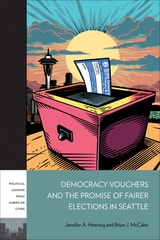
Democracy Vouchers and the Promise of Fairer Elections in Seattle
Jennifer A. Heerwig and Brian J. McCabe
Temple University Press, 2024
In 2017, Seattle inaugurated a new way for citizens to be involved in democracy: they introduced publicly financed vouchers for voters to donate to local candidates. The innovative plan is designed to level the playing field in campaign financing. Through the vouchers, residents allocate dollars to candidates of their choice in local elections, putting political money directly in the hands of voters. The intent is to increase political participation and ameliorate the long-standing representational inequalities of private donations.
Democracy Vouchers and the Promise of Fairer Elections in Seattle critically evaluates the success and impact of this program. Jennifer Heerwig and Brian J. McCabe emphasize how local elections now attract a much wider and more diverse field of both donors and candidates. They also consider external threats to the program, from litigation about the constitutionality of a voucher program to the rise of independent expenditures.
Offering important lessons on how other cities can adopt a similar program, this compelling case study also highlights the obstacles that will likely arise in its implementation.
[more]
Improper Influence
Campaign Finance Law, Political Interest Groups, and the Problem of EqualityThomas Gais
University of Michigan Press, 1998
Why is there still so much dissatisfaction with the role of special interest groups in financing American election campaigns, even though no aspect of interest group politics has been so thoroughly regu-lated and constrained? This book argues that part of the answer lies in the laws themselves, which prevent many hard-to-organize citizen groups from forming effective political action committees (PACs), while actually helping business groups organize PACs.
Thomas L. Gais points out that many laws that regulate group involvement in elections ignore the real difficulties of political mobilization, and he concludes that PACs and the campaign finance laws reflect a fundamental discrepancy between grassroots ideals and the ways in which broadly based groups actually get organized.
". . . . of fundamental scholarly and practical importance. The implications for 'reform' are controversial, flatly contradicting other recent reform proposals . . . . I fully expect that Improper Influence will be one of the most significant books on campaign finance to be published in the 1990s." --Michael Munger, Public Choice
"It is rare to find a book that affords a truly fresh perspective on the role of special interest groups in the financing of U.S. elections. It is also uncommon to find a theoretically rigorous essay confronting a topic usually grounded in empirical terms. . . . Improper Influence scores high on both counts and deserves close attention from students of collective action, campaign finance law, and the U.S. political process more generally." --American Political Science Review
Thomas L. Gais is Senior Fellow, The Nelson A. Rockefeller Institute of Government, State University of New York.
[more]
Reconstructing Reconstruction
The Supreme Court and the Production of Historical TruthPamela Brandwein
Duke University Press, 1999
Was slavery over when slaves gained formal emancipation? Was it over when the social, economic, and political situation for African Americans no longer mimicked the conditions of slavery? If the Thirteenth Amendment abolished it in 1865, why did most of the disputed points during the Reconstruction debates of 1866–75 concern issues of slavery? In this book Pamela Brandwein examines the post–Civil War struggle between competing political and legal interpretations of slavery and Reconstruction to reveal how accepted historical truth was established.
Delving into the circumstances, assumptions, and rhetoric that shaped the “official” story of Reconstruction, Brandwein describes precisely how a dominant interpretation of events ultimately emerged and what its implications have been for twentieth-century judicial decisions, particularly for Supreme Court rulings on civil rights. While analyzing interpretive disputes about slavery, Brandwein offers a detailed rescoring of post–Civil War legislative and constitutional history, including analysis of the original understanding of the Fourteenth Amendment. She identifies the perspectives on Reconstruction that were endorsed or rejected by the Supreme Court. Explaining what it meant—theoretically and practically—to resolve Reconstruction debates with a particular definition of slavery, Brandwein recounts how the Northern Democratic definition of “ending” slavery was not the only definition, just the one that prevailed. Using a familiar historical moment to do new interpretive work, she outlines a sociology of constitutional law, showing how subjective narrative construction can solidify into opaque institutional memory.
Delving into the circumstances, assumptions, and rhetoric that shaped the “official” story of Reconstruction, Brandwein describes precisely how a dominant interpretation of events ultimately emerged and what its implications have been for twentieth-century judicial decisions, particularly for Supreme Court rulings on civil rights. While analyzing interpretive disputes about slavery, Brandwein offers a detailed rescoring of post–Civil War legislative and constitutional history, including analysis of the original understanding of the Fourteenth Amendment. She identifies the perspectives on Reconstruction that were endorsed or rejected by the Supreme Court. Explaining what it meant—theoretically and practically—to resolve Reconstruction debates with a particular definition of slavery, Brandwein recounts how the Northern Democratic definition of “ending” slavery was not the only definition, just the one that prevailed. Using a familiar historical moment to do new interpretive work, she outlines a sociology of constitutional law, showing how subjective narrative construction can solidify into opaque institutional memory.
[more]
Representation Rights and the Burger Years
Nancy Maveety
University of Michigan Press, 1991
In Representation Rights and the Burger Years, political scientist Nancy Maveety tackles the constitutional meaning of "fair and effective" representation rights and evaluates the specific contributions that the Supreme Court made to this definition during the Burger era.
The Court of Chief Justice Warren Burger has been described as one that made no distinctive jurisprudential contributions. It has been dismissed as a court overshadowed by both its predecessor and its successor. By contrast, Maveety argues that the Burger Court in fact revolutionized constitutional understandings of political representation, expanding, in particular, the judicial scrutiny of political institutions. Moving beyond the "one person, one vote" reapportionment initiated by the Warren Court, it opened the way for the articulation of group-based constitutional representation rights.
This group-based approach to representation questions broadened groups' constitutional claims to equal political influence. Yet, as Maveety perceptively shows, this broader interpretation of "representable interests" was grounded in mainstream American conceptions of political representation. The great value of Maveety's study is the presentation of a "typology of group representation," which explains and validates the Burger Court's work on representation rights. This typology, drawn from American history, political theory, and political practice, offers a new approach for evaluating the precedental record of the Burger years and a sophisticated framework for understanding the interaction between constitutional law and politics.
[more]
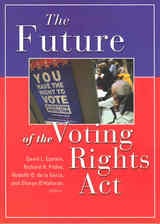
The Future of the Voting Rights Act
David Epstein
Russell Sage Foundation, 2006
The Voting Rights Act (VRA) stands among the great achievements of American democracy. Originally adopted in 1965, the Act extended full political citizenship to African-American voters in the United States nearly 100 years after the Fifteenth Amendment first gave them the vote. While Section 2 of the VRA is a nationwide, permanent ban on discriminatory election practices, Section 5, which is set to expire in 2007, targets only certain parts of the country, requiring that legislative bodies in these areas—mostly southern states with a history of discriminatory practices—get permission from the federal government before they can implement any change that affects voting. In The Future of the Voting Rights Act, David Epstein, Rodolfo de la Garza, Sharyn O'Halloran, and Richard Pildes bring together leading historians, political scientists, and legal scholars to assess the role Section 5 should play in America's future. The contributors offer varied perspectives on the debate. Samuel Issacharoff questions whether Section 5 remains necessary, citing the now substantial presence of blacks in legislative positions and the increasingly partisan enforcement of the law by the Department of Justice (DOJ). While David Epstein and Sharyn O'Halloran are concerned about political misuse of Section 5, they argue that it can only improve minority voting power—even with a partisan DOJ—and therefore continues to serve a valuable purpose. Other contributors argue that the achievements of Section 5 with respect to blacks should not obscure shortcomings in the protection of other groups. Laughlin McDonald argues that widespread and systematic voting discrimination against Native Americans requires that Section 5 protections be expanded to more counties in the west. Rodolfo de la Garza and Louis DeSipio point out that the growth of the Latino population in previously homogenous areas and the continued under-representation of Latinos in government call for an expanded Section 5 that accounts for changing demographics. As its expiration date approaches, it is vital to examine the role that Section 5 still plays in maintaining a healthy democracy. Combining historical perspective, legal scholarship, and the insight of the social sciences, The Future of the Voting Rights Act is a crucial read for anyone interested in one of this year's most important policy debates and in the future of civil rights in America.
[more]
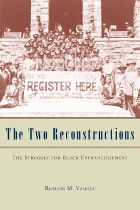
The Two Reconstructions
The Struggle for Black EnfranchisementRichard M. Valelly
University of Chicago Press, 2004
A groundbreaking history of the Reconstruction and the Civil Rights Eras that reveals the importance of biracial coalitions
The Reconstruction era marked a huge political leap for African Americans, who rapidly went from the status of slaves to voters and officeholders. Yet this hard-won progress lasted only a few decades. Ultimately a "second reconstruction"—associated with the civil rights movement and the Voting Rights Act—became necessary.
How did the first reconstruction fail so utterly, setting the stage for the complete disenfranchisement of Southern black voters, and why did the second succeed? These are among the questions Richard M. Valelly answers in this fascinating history. The fate of black enfranchisement, he argues, has been closely intertwined with the strengths and constraints of our political institutions. Valelly shows how effective biracial coalitions have been the key to success and incisively traces how and why political parties and the national courts either rewarded or discouraged the formation of coalitions.
Revamping our understanding of American race relations, The Two Reconstructions brilliantly explains a puzzle that lies at the heart of America’s development as a political democracy.
[more]