Results by title

14 books match the query 'Electromagnetic waves'

cover of Approximate Boundary Conditions in Electromagnetics

Approximate Boundary Conditions in Electromagnetics

T.B.A. Senior

The Institution of Engineering and Technology, 1995
Non-metallic materials and composites are now commonplace in modern vehicle construction, and the need to compute scattering and other electromagnetic phenomena in the presence of material structures has led to the development of new simulation techniques.
[more]
cover of Asymptotic and Hybrid Methods in Electromagnetics

Asymptotic and Hybrid Methods in Electromagnetics

F. Molinet

The Institution of Engineering and Technology, 2005

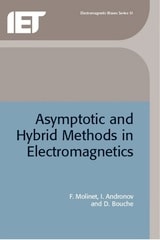
There have been significant developments in the field of numerical methods for diffraction problems in recent years, and as a result, it is now possible to perform computations with more than ten million unknowns. However, the importance of asymptotic methods should not be overlooked. Not only do they provide considerable physical insight into diffraction mechanisms, and can therefore aid the design of electromagnetic devices such as radar targets and antennas, some objects are still too large in terms of wavelengths to fall in the realm of numerical methods. Furthermore, very low Radar Cross Section objects are often difficult to compute using multiple methods. Finally, objects that are very large in terms of wavelength, but with complicated details, are still a challenge both for asymptotic and numerical methods. The best, but now widely explored, solution for these problems is to combine various methods in so called hybrid methods.
[more]
cover of Complex Space Source Theory of Spatially Localized Electromagnetic Waves

Complex Space Source Theory of Spatially Localized Electromagnetic Waves

S.R. Seshadri

The Institution of Engineering and Technology, 2014

This book begins with an essential background discussion of the many applications and drawbacks for paraxial beams, which is required in the treatment of the complex space theory of spatially localized electromagnetic waves. The author highlights that there is a need obtain exact full-wave solutions that reduce to the paraxial beams in the appropriate limit. Complex Space Source Theory of Spatially Localized Electromagnetic Waves treats the exact full-wave generalizations of all the basic types of paraxial beam solutions. These are developed by the use of Fourier and Bessel transform techniques and the complex space source theory of spatially localized electromagnetic waves is integrated as a branch of Fourier optics. Two major steps in the theory are described as: 1) the systematic derivation of the appropriate virtual source in the complex space that produces the required full wave from the paraxial beam solution and 2) the determination of the actual secondary source in the physical space that is equivalent to the virtual source in the complex space.
[more]
cover of Electromagnetic Mixing Formulas and Applications

Electromagnetic Mixing Formulas and Applications

Ari Sihvola

The Institution of Engineering and Technology, 1999

The book discusses homogenisation principles and mixing rules for the determination of the macroscopic dielectric and magnetic properties of different types of media. The effects of structure and anisotropy are discussed in detail, as well as mixtures involving chiral and nonlinear materials. High frequency scattering phenomena and dispersive properties are also discussed.
[more]
cover of Electromagnetic Waves and Antennas for Biomedical Applications

Electromagnetic Waves and Antennas for Biomedical Applications

Lulu Wang

The Institution of Engineering and Technology, 2022

Electromagnetic waves have long been used in medical settings for diagnostic purposes, such as for the detection of cancerous tissues, stroke events or cardiovascular risk, as the behaviour of the waves upon meeting their target gives pertinent information for diagnostic and imaging purposes.
[more]
cover of Geometrical Theory of Diffraction

Geometrical Theory of Diffraction

V.A. Borovikov

The Institution of Engineering and Technology, 1994

The geometrical theory of diffraction (GTD) is an efficient method of analysis and design of wave fields. It is widely used in antenna synthesis in microwave, millimetre and infra-red bands, in circuit engineering and laser system design. It is a convenient tool for tackling the problems of wave propagation and scattering at bodies of complex shape. The method combines the simplicity and physical transparency of geometrical optics with high computational accuracy over a wide dynamic range of quantities analysed. The advantage of GTD is particularly pronounced in applications where the wavelength is small compared with the typical size of scatterers, i.e. in situations where the known analytical techniques - variational calculus and numerical analysis - are no longer applicable.
[more]
cover of Geometrical Theory of Diffraction for Electromagnetic Waves

Geometrical Theory of Diffraction for Electromagnetic Waves

Graeme L. James

The Institution of Engineering and Technology, 1986

The continuous development of the Geometrical Theory of Diffraction (GTD), from its conception in the 1950s, has now established it as a leading analytical technique in the prediction of high-frequency electromagnetic radiation and scattering phenomena. Consequently, there is an increasing demand for research workers and students in electromagnetic waves to be familiar with this technique. In this book they will find a thorough and clear exposition of the GTD formulation for vector fields. It begins by describing the foundations of the theory in canonical problems and then proceeds to develop the method to treat a variety of circumstances. Where applicable, the relationship between GTD and other high-frequency methods, such as aperture field and the physical optics approximation, is stressed throughout the text. The purpose of the book, apart from expounding the GTD method, is to present useful formulations that can be readily applied to solve practical engineering problems. To this end, the final chapter supplies some fully worked examples to demonstrate the practical application of the GTD techniques developed in the earlier chapters.
[more]
cover of Open Electromagnetic Waveguides

Open Electromagnetic Waveguides

T. Rozzi

The Institution of Engineering and Technology, 1997

Electromagnetic waves are guided by open structures in a variety of applications at radio, microwave, millimetric and optical frequencies. Examples range from the propogation of radiowaves down the shaft of an oil rig to that of light through an optical fibre. As the guide is open, radiation may also be present, for example from a microstrip-fed patch or a slot antenna. These twin aspects of waveguiding and radiation are in fact closely interwoven and this book is the first to deal with the two by means of a single mathematical formalism.
[more]
cover of Propagation, Scattering and Diffraction of Electromagnetic Waves

Propagation, Scattering and Diffraction of Electromagnetic Waves

A.S. Ilyinski

The Institution of Engineering and Technology, 1993
This book describes new, highly effective, rigorous analysis methods for electromagnetic wave problems. Examples of their application to the mathematical modelling of micros trip lines, corrugated flexible waveguides, horn antennas, complex-shaped cavity resonators and periodic structures are considered.
[more]
cover of Scattering of Wedges and Cones with Impedance Boundary Conditions

Scattering of Wedges and Cones with Impedance Boundary Conditions

Mikhail A. Lyalinov

The Institution of Engineering and Technology, 2013

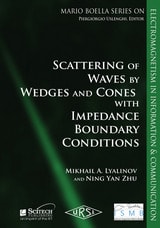
This book is a systematic and detailed exposition of different analytical techniques used in studying two of the canonical problems, the wave scattering by wedges or cones with impedance boundary conditions. It is the first reference on novel, highly efficient analytical-numerical approaches for wave diffraction by impedance wedges or cones. This text includes calculations of the diffraction or excitation coefficients, including their uniform versions, for the diffracted waves from the edge of the wedge or from the vertex of the cone; study of the far-field behavior in diffraction by impedance wedges or cones, reflected waves, space waves from the singular points of the boundary (from edges or tips), and surface waves; and the applicability of the reported solution procedures and formulae to existing software packages designed for solving real-world high-frequency problems encountered in antenna, wave propagation, and radar cross section. This book is for researchers in wave phenomena physics, radio, optics and acoustics engineers, applied mathematicians and specialists in mathematical physics and specialists in quantum scattering of many particles.
[more]
cover of The Finite-Difference Time-Domain Method for Electromagnetics with MATLAB® Simulations

The Finite-Difference Time-Domain Method for Electromagnetics with MATLAB® Simulations

Atef Z. Elsherbeni

The Institution of Engineering and Technology, 2016

This book introduces the powerful Finite-Difference Time-Domain method to students and interested researchers and readers. An effective introduction is accomplished using a step-by-step process that builds competence and confidence in developing complete working codes for the design and analysis of various antennas and microwave devices. This book will serve graduate students, researchers, and those in industry and government who are using other electromagnetics tools and methods for the sake of performing independent numerical confirmation. No previous experience with finite-difference methods is assumed of readers.
[more]
cover of The Wiener-Hopf Method in Electromagnetics

The Wiener-Hopf Method in Electromagnetics

Vito G. Daniele

The Institution of Engineering and Technology, 2014
This advanced research monograph is devoted to the Wiener-Hopf technique, a function-theoretic method that has found applications in a variety of fields, most notably in analytical studies of diffraction and scattering of waves. It provides a comprehensive treatment of the subject and covers the latest developments, illustrates the wide range of possible applications for this method, and includes an extensive outline of the most powerful analytical tool for the solution of diffraction problems.
[more]
cover of Theory of Edge Diffraction in Electromagnetics: Origination and validation of the physical theory of diffraction

Theory of Edge Diffraction in Electromagnetics

Origination and validation of the physical theory of diffraction

P.Ya. Ufimtsev

The Institution of Engineering and Technology, 2009

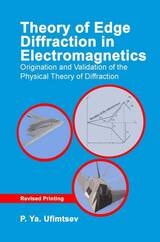
This book is an essential resource for researchers involved in designing antennas and RCS calculations. It is also useful for students studying high frequency diffraction techniques. It contains basic original ideas of the Physical Theory of Diffraction (PTD), examples of its practical application, and its validation by the mathematical theory of diffraction. The derived analytic expressions are convenient for numerical calculations and clearly illustrate the physical structure of the scattered field. The text's key topics include: Theory of diffraction at black bodies introduces the Shadow Radiation, a fundamental component of the scattered field; RCS of finite bodies of revolution-cones, paraboloids, etc.; models of construction elements for aircraft and missiles; scheme for measurement of that part of a scattered field which is radiated by the diffraction (so-called nonuniform) currents induced on scattering objects; development of the parabolic equation method for investigation of edge-diffraction; and a new exact and asymptotic solutions in the strip diffraction problems, including scattering at an open resonator.
[more]
cover of Theory of Nonuniform Waveguides: The cross-section method

Theory of Nonuniform Waveguides

The cross-section method

B.Z. Katsenelenbaum

The Institution of Engineering and Technology, 1998

The cross-section method is an analytical tool used in the design of components required for low-loss, highly efficient transmission of electromagnetic waves in nonuniform waveguides. When the waveguide dimensions are large compared with the wavelength, a fully three-dimensional analysis employing modern numerical methods based on finite element, finite difference, finite integration or transmission line matrix formalisms is practically impossible and the cross-section method is the only feasible analysis technique.
[more]