Results by title
8 books match the query 'Electronic circuit design'
Analog Circuit Design
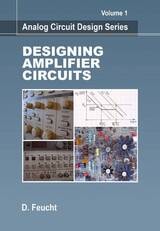
Designing Amplifier Circuits, Volume 1D. Feucht
The Institution of Engineering and Technology, 2010
This book presents the basic principles of transistor circuit analysis, basic per-stage building blocks, and feedback. The content is restricted to quasi-static (low-frequency) considerations, to emphasize basic topological principles. The reader will be able to analyze and design multi-stage amplifiers with feedback, including calculation and specification of gain, input and output resistances, including the effects of transistor output resistance. Of note is the presentation of feedback analysis, a subject rarely covered by other books, with insights and from angles that will reduce to analysis by inspection for readers. Some circuit transformations outlined within are especially helpful in reducing circuits to simpler forms for analysis. They are usefully applied in considering transistor circuits for which collector-emitter (or drain-source) resistance is not negligible, another often omitted topic which this book details.
[more]
Analog Circuit Design
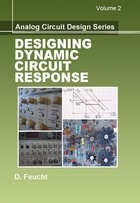
Designing Dynamic Circuit Response, Volume 2D. Feucht
The Institution of Engineering and Technology, 2010
This second volume, Analog Circuit Design: Designing Dynamic Circuit Response, builds upon the first volume (Analog Circuit Design: Designing Amplifier Circuits) by extending coverage to include reactances and their time- and frequency-related behavioral consequences. Retaining a design-oriented analysis, this volume begins with circuit fundamentals involving capacitance and inductance and lays down the approach using s-domain analysis. Additional concepts and perspectives fill in the blanks left by textbooks in regards to circuit design. It simplifies dynamic circuit analysis by using the graphical methods of reactance plots. Methods of compensating amplifiers, including feedback amplifiers, are kept as simple as possible using reactance plots and s-domain transfer functions that mainly require algebraic skill.
[more]
Analog Circuit Design
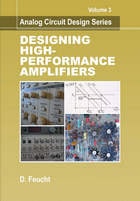
Designing High-Performance Amplifiers, Volume 3D. Feucht
The Institution of Engineering and Technology, 2010
The third volume, Analog Circuit Design: Designing High-Performance Amplifiers, applies the concepts from the first two volumes. It is an advanced treatment of amplifier design/analysis emphasizing both wideband and precision amplification. Topics include bandwidth extension, noise and distortion, effects of components, instrumentation and isolation, amplifiers, autocalibration, thermal effects, current-feedback amplifiers, multi-path schemes, feed forward, fT multipliers, buffers, voltage translators, Giulbert gain cells and multipliers.
[more]
Analog Circuit Design
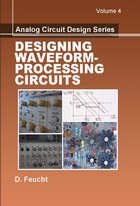
Designing Waveform-Processing Circuits, Volume 4D. Feucht
The Institution of Engineering and Technology, 2010
The fourth volume in the set, Analog Circuit Design: Designing Waveform-Processing Circuits, builds on the previous 3 volumes and presents a variety of analog non-amplifier circuits, including voltage references, current sources, filters, hysteresis switches and oscilloscope trigger and sweep circuitry, function generation, absolute-value circuits, and peak detectors. Digitizing (ADCs and DACs) and sampling (including some switched-capacitor) circuits are explained, with theory required for design. Sampling theory is developed from both a frequency and time-domain viewpoint, with emphasis upon application to design.
[more]

Analogue IC Design
The current-mode approachC. Toumazou
The Institution of Engineering and Technology, 1993
State-of-the-art analogue integrated circuit design is receiving a tremendous boost from the development and application of current-mode approaches, which are rapidly superseding traditional voltage-mode techniques. This activity is linked to important advances in integrated circuit technologies, such as the 'true' complementary bipolar process; CMOS VLSI technology, which allows realisation of high-performance mixed analogue and digital circuits; and gallium arsenide processing, which has matured to a point where it can be used effectively in high-speed analogue circuit and system design. In this book, all three technologies are represented, with key building blocks, circuit designs and applications. Many very important, but recent, techniques are presented, including switched-current techniques for high-precision filtering and A/D and D/A conversion, current-based amplifying techniques, and neural networks. Translinear principles, current mirrors, and the current conveyor are also covered. This book draws together contributions from the world's most eminent analogue IC designers to provide, for the first time, a comprehensive text devoted to this important and exciting new area of analogue electronics.
[more]
High-frequency Circuit Engineering
F. Nibler
The Institution of Engineering and Technology, 1996
This book is aimed at both practising and postgraduate engineers who are interested in the particular problems of high-frequency circuit design. It covers network parameters and how to work with them, various approaches to the use of conductors, and it introduces a large number of circuits using active devices (transistors).
[more]
Modern Filter Design
Active RC and switched capacitorMohammed S. Ghausi
The Institution of Engineering and Technology, 2003
A comprehensive tutorial on active filter design analysis and design procedures. This book covers: Basic systems classifications together with filter transmission and approximations; Operational amplifiers, including bipolar and MOS integrators; Definitions of sensitivity and statistical sensitivity measures; Continuous-time second-order active sections; Higher-order filter design; Switched capacitor filters.
[more]
Small Signal Microwave Amplifier Design
Theodore Grosch
The Institution of Engineering and Technology, 1999
This book explains techniques and examples for designing stable amplifiers for high-frequency applications, in which the signal is small and the amplifier circuit is linear. An in-depth discussion of linear network theory provides the foundation needed to develop actual designs. Examples throughout the book will show you how to apply the knowledge gained in each chapter leading to the complex design of low noise amplifiers. Exercises at the end of each chapter will help students to practice their skills. The solutions to these design problems are available in an accompanying solutions booklet (Small Signal Microwave Amplifier Design: Solutions).
[more]