Results by title
5 books match the query 'Elephant'
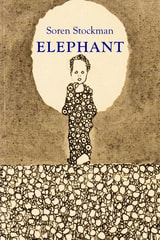
Elephant
Soren Stockman
Four Way Books, 2022
"A serious young man, / I had trouble saying yes / to the bright, clear days," Soren Stockman's Elephant begins. The poems that follow move through despair, self-destruction, and disassociation to arrive, finally, at that elusive affirmation. Accompanied throughout by the imagined presence of Joseph Merrick, the 20th Century entertainer and medical patient popularly depicted as "The Elephant Man," Stockman's speaker interrogates how storytellers have co-opted Merrick's identity and obscured his voice and inner life. In this projected communion, Stockman tries to encounter the man who was rather than the role molded from his experiences. What does it mean to perform as another? What allows us to love ourselves, and what makes it hard? This debut collection is a path out of loneliness, beyond private absences, to the true self and what it harbors in its heart. Here, at the center of things, we succumb to the succor of existence, given to the light: "What a blessing to love the world / and then finally be born."
[more]
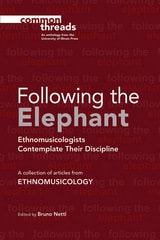
Following the Elephant
Ethnomusicologists Contemplate Their DisciplineEdited by Bruno Nettl: A collection of articles from Ethnomusicology
University of Illinois Press, 2017
In Following the Elephant, Bruno Nettl edits articles drawn from fifty years of the pioneering journal Ethnomusicology. The roster of acclaimed scholars hail from across generations, using other works in the collection as launching points for dialogues on the history and accomplishments of the field. Nettl divides the collection into three sections. In the first, authors survey ethnomusicology from perspectives that include thoughts on defining and conceptualizing the field and its concepts. The second section offers milestones in the literature that critique major works. The authors look at what separates ethnomusicology from other forms of music research and discuss foundational issues. The final section presents scholars considering ethnomusicology--including recent trends--from the perspective of specific, but abiding, strands of thought. Contributors: Charlotte J. Frisbie, Mieczylaw Kolinski, Gerhard Kubik, George List, Alan P. Merriam, Bruno Nettl, David Pruett, Adelaida Reyes, Timothy Rice, Jesse D. Ruskin, Kay Kaufman Shelemay, Gabriel Solis, Jeff Todd Titon, J. Lawrence Witzleben, and Deborah Wong
[more]
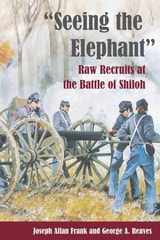
Seeing the Elephant
RAW RECRUITS AT THE BATTLE OF SHILOHJoseph Allan Frank and George A. Reaves
University of Illinois Press, 1989
One of the bloodiest battles in the Civil War, the two-day engagement near Shiloh, Tennessee, in April 1862 left more than 23,000 casualties. Fighting alongside seasoned veterans were more than 160 newly recruited regiments and other soldiers who had yet to encounter serious action. In the phrase of the time, these men came to Shiloh to “see the elephant.”
Drawing on the letters, diaries, and other reminiscences of these raw recruits on both sides of the conflict, “Seeing the Elephant” gives a vivid and valuable primary account of the terrible struggle.
From the wide range of voices included in this volume emerges a nuanced picture of the psychology and motivations of the novice soldiers and the ways in which their attitudes toward the war were affected by their experiences at Shiloh.
[more]
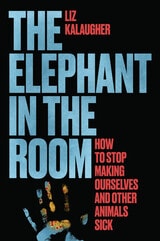
The Elephant in the Room
How to Stop Making Ourselves and Other Animals SickLiz Kalaugher
University of Chicago Press, 2025
A healthier future starts with seeing the human causes of wildlife diseases.
When new diseases spread, news reports often focus on wildlife culprits—rodents, monkeys and mpox; bats and COVID-19; waterfowl and avian flu; or mosquitoes and Zika. But, in this urgent and engaging book, we see it often works the other way around—humans have caused diseases in other animals countless times, through travel and transport, the changes we impose on our environment, and global warming. With science journalist Liz Kalaugher as our guide, we meet the wildlife we have harmed and the experts now studying the crosscurrents between humans, other animals, and health.
Herds of buffalo in Kenya, cloned ferrets in Colorado, and frogs shipped worldwide as living pregnancy tests for humans, all help Kalaugher dive into the murky backstories behind wildlife epidemics past and present. We learn that military conflict likely contributed to the spread of rinderpest, or cattle plague, throughout Africa, devastating pastoral communities. That crowded poultry farms may create virulent new forms of bird flu that spill back into the wild. And that West Nile virus—which affects not only birds and humans, but other animals, including horses, skunks, and squirrels—is spreading as global temperatures rise.
Expanding today’s discussions of environmental protection to include illness and its impact, Kalaugher both sounds the alarm and explores ways to stop the emergence and spread of wildlife diseases. These solutions start with a simple lesson: when we protect other animals, we protect ourselves.
[more]
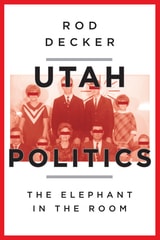
Utah Politics
The Elephant in the RoomRod Decker
Signature Books, 2019
From the tempestuous fight for statehood to the evolution of Utah voters from Democrats to Republicans, Rod Decker analyzes the intersection of politics and faith in the complex political culture of modern Utah. Beginning with the state’s roots as a communal theocracy, Utah Politics deftly examines how Mormon morality influenced and continues to shape conflicts on both the local and federal levels. Whether determining the role nuclear fallout played in causing cancer epidemics throughout the state or the influence of Mormon lobbyists, Decker demonstrates how the rose that blossomed in the desert was sometimes fertilized by conspiracy, debate, and political machination.
Some themes reoccur: governors become popular by fighting federal oversight— signaling a lingering distrust that Washington could alter the Mormon way of life—and liberals use the court system to circumvent conservative legislatures who see public morality as a defining feature of government. Through this lens, issues both deceptively innocuous and deeply complex underscore Utah’s dance with religious freedom and civil liberty.
Some themes reoccur: governors become popular by fighting federal oversight— signaling a lingering distrust that Washington could alter the Mormon way of life—and liberals use the court system to circumvent conservative legislatures who see public morality as a defining feature of government. Through this lens, issues both deceptively innocuous and deeply complex underscore Utah’s dance with religious freedom and civil liberty.
[more]