Results by title
8 books match the query 'Ellison, Ralph'
Aberrations In Black
Toward a Queer of Color CritiqueRoderick A. Ferguson
University of Minnesota Press, 2003
A hard-hitting look at the regulation of sexual difference and its role in circumscribing African American culture
The sociology of race relations in America typically describes an intersection of poverty, race, and economic discrimination. But what is missing from the picture—sexual difference—can be as instructive as what is present. In this ambitious work, Roderick A. Ferguson reveals how the discourses of sexuality are used to articulate theories of racial difference in the field of sociology. He shows how canonical sociology—Gunnar Myrdal, Ernest Burgess, Robert Park, Daniel Patrick Moynihan, and William Julius Wilson—has measured African Americans’s unsuitability for a liberal capitalist order in terms of their adherence to the norms of a heterosexual and patriarchal nuclear family model. In short, to the extent that African Americans’s culture and behavior deviated from those norms, they would not achieve economic and racial equality.
Aberrations in Black tells the story of canonical sociology’s regulation of sexual difference as part of its general regulation of African American culture. Ferguson places this story within other stories—the narrative of capital’s emergence and development, the histories of Marxism and revolutionary nationalism, and the novels that depict the gendered and sexual idiosyncrasies of African American culture—works by Richard Wright, Ralph Ellison, James Baldwin, Audre Lorde, and Toni Morrison. In turn, this book tries to present another story—one in which people who presumably manifest the dysfunctions of capitalism are reconsidered as indictments of the norms of state, capital, and social science. Ferguson includes the first-ever discussion of a new archival discovery—a never-published chapter of Invisible Man that deals with a gay character in a way that complicates and illuminates Ellison’s project.
Unique in the way it situates critiques of race, gender, and sexuality within analyses of cultural, economic, and epistemological formations, Ferguson’s work introduces a new mode of discourse—which Ferguson calls queer of color analysis—that helps to lay bare the mutual distortions of racial, economic, and sexual portrayals within sociology.
Invisible Criticism
Ralph Ellison and the American CanonAlan Nadel
University of Iowa Press, 1991
In 1952 Ralph Ellison won the National Book Award for his Kafkaesque and claustrophobic novel about the life of a nameless young black man in New York City. Although Invisible Man has remained the only novel that Ellison published in his lifetime, it is generally regarded as one of the most important works of fiction in our century.
This new reading of a classic work examines Ellison's relation to and critique of the American literary canon by demonstrating that the pattern of allusions in Invisible Man forms a literary-critical subtext which challenges the accepted readings of such major American authors as Emerson, Melville, and Twain.
Modeling his argument on Foucault's analysis of the asylum, Nadel analyzes the institution of the South to show how it moved blacks from "enslavement" to "slavery" to "invisibility"—all in the interest of maintaining an organization of power based on racial caste. He then demonstrates the ways Ellison wrote in the modernist/surreal tradition to trace symbolically the history of blacks in America as they moved not only from the nineteenth century to the twentieth, and from the rural South to the urban North, but as they moved (sometimes unnoticed) through American fiction.
It is on this latter movement that Nadel focuses his criticism, first demonstrating theoretically that allusions can impel reconsideration of the alluded-to text and thus function as a form of literary criticism, and then reading the specific criticism implied by Ellison's allusions to Emerson's essays and Lewis Mumford's The Golden Days, as well as to "Benito Cereno" and The Adventures of Huckleberry Finn. Nadel also considers Ellison's allusions to Whitman, Eliot, Joyce, and the New Testament.
Invisible Criticism will be of interest not only to students of American and Afro-American literature but also to those concerned about issues of literary theory, particularly in the areas of intertextual relationships, canonicity, and rehistoricism.
Jazz Country
Ralph Ellison in AmericaHorace A. Porter
University of Iowa Press, 2001
Ralph Ellison and the Genius of America
Timothy Parrish
University of Massachusetts Press, 2012
Ralph Ellison has long been admired as the author of one of the most important American novels of the twentieth century, Invisible Man. Yet he has also been dismissed by some critics as a writer who only published one major work of fiction and a black intellectual out of touch with his times. In this book, Timothy Parrish offers a fundamentally different assessment of Ellison's legacy, describing him as the most important American writer since William Faulkner and someone whose political and cultural achievements have not been fully recognized.
Embracing jazz artist Wynton Marsalis's characterization of Ellison as the unacknowledged “political theorist” of the civil rights movement, Parrish argues that the defining event of Ellison's career was not Invisible Man but the 1954 Supreme Court decision that set his country on the road to racial integration. In Parrish's view, no other American intellectual, black or white, better grasped the cultural implications of the new era than Ellison did; no other major American writer has been so misunderstood.
Drawing on Ellison's recently published “unfinished” novel, newly released archival materials, and unpublished correspondence, Parrish provides a sustained reconsideration of the writer's crucial friendships with Richard Wright, Robert Penn Warren, and C. Vann Woodward to show how his life was dedicated to creating an American society in which all could participate equally. By resituating Ellison's career in the historical context of its making, Parrish challenges the premises that distorted the writer's reception in his own lifetime to make the case for Ellison as the essential visionary of post–Civil War America.
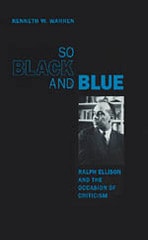
So Black and Blue
Ralph Ellison and the Occasion of CriticismKenneth W. Warren
University of Chicago Press, 2003
What would it mean to read Invisible Man as a document of Jim Crow America? Using Ralph Ellison's classic novel and many of his essays as starting points, Kenneth W. Warren illuminates the peculiar interrelation of politics, culture, and social scientific inquiry that arose during the post-Reconstruction era and persisted through the Civil Rights movement. Warren argues that Ellison's novel expresses the problem of who or what could represent and speak for the Negro in an age of limited political representation.
So Black and Blue shows that Ellison's successful transformation of these limits into possibilities has also, paradoxically, cast a shadow on the postsegregation world. What can be the direction of African American culture once the limits that have shaped it are stricken down? Here Warren takes up the recent, ongoing, and often contradictory veneration of Ellison's artistry by black writers and intellectuals to reveal the impoverished terms often used in discussions about the political and cultural future of African Americans. Ultimately, by showing what it would mean to take seriously the idea of American novels as creatures of their moment, Warren questions whether there can be anything that deserves the label of classic American literature.
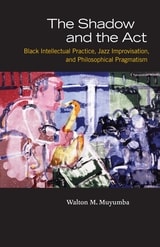
The Shadow and the Act
Black Intellectual Practice, Jazz Improvisation, and Philosophical PragmatismWalton M. Muyumba
University of Chicago Press, 2009
Though often thought of as rivals, Ralph Ellison, James Baldwin, and Amiri Baraka shared a range of interests, especially a passion for music. Jazz, in particular, was a decisive influence on their thinking, and, as The Shadow and the Act reveals, they drew on their insights into the creative process of improvisation to analyze race and politics in the civil rights era. In this inspired study, Walton M. Muyumba situates them as a jazz trio, demonstrating how Ellison, Baraka, and Baldwin’s individual works form a series of calls and responses with each other.
Muyumba connects their writings on jazz to the philosophical tradition of pragmatism, particularly its support for more freedom for individuals and more democratic societies. He examines the way they responded to and elaborated on that lineage, showing how they significantly broadened it by addressing the African American experience, especially its aesthetics. Ultimately, Muyumba contends, the trio enacted pragmatist principles by effectively communicating the social and political benefits of African Americans fully entering society, thereby compelling America to move closer to its democratic ideals.
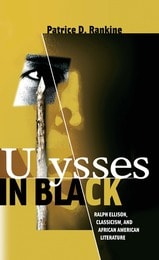
Ulysses in Black
Ralph Ellison, Classicism, and African American LiteraturePatrice D. Rankine
University of Wisconsin Press, 2008
In this groundbreaking work, Patrice D. Rankine asserts that the classics need not be a mark of Eurocentrism, as they have long been considered. Instead, the classical tradition can be part of a self-conscious, prideful approach to African American culture, esthetics, and identity. Ulysses in Black demonstrates that, similar to their white counterparts, African American authors have been students of classical languages, literature, and mythologies by such writers as Homer, Euripides, and Seneca.
Ulysses in Black closely analyzes classical themes (the nature of love and its relationship to the social, Dionysus in myth as a parallel to the black protagonist in the American scene, misplaced Ulyssean manhood) as seen in the works of such African American writers as Ralph Ellison, Toni Morrison, and Countee Cullen. Rankine finds that the merging of a black esthetic with the classics—contrary to expectations throughout American culture—has often been a radical addressing of concerns including violence against blacks, racism, and oppression. Ultimately, this unique study of black classicism becomes an exploration of America’s broader cultural integrity, one that is inclusive and historic.
Outstanding Academic Title, Choice Magazine
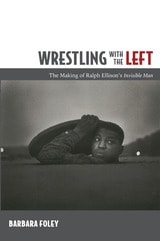
Wrestling with the Left
The Making of Ralph Ellison’s Invisible ManBarbara Foley
Duke University Press, 2010