78 books match the query 'Emergence' and 4 start with a
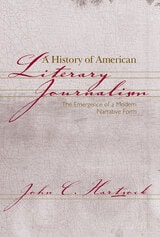
cover of A History of American Literary Journalism: The Emergence of a Modern Narrative Form

A History of American Literary Journalism

The Emergence of a Modern Narrative Form

John C. Hartsock

University of Massachusetts Press, 2000

During the 1960s, such works as Truman Capote's In Cold Blood and Joan Didion's Slouching Towards Bethlehem were cited as examples of the “new journalism.” True stories that read like novels, they combined the journalist's task of factual reporting with the art of fictional narration. 

Yet as John C. Hartsock shows in this revealing study, the roots of this distinctive form of writing—whether called new journalism, literary journalism, or creative nonfiction—can be traced at least as far back as the late nineteenth century. In the decades following the American Civil War, Stephen Crane, Lafcadio Hearn, and other journalists challenged the notion, then just emerging, that the reporter's job was to offer a concise statement of the “objective truth.” Drawing on the techniques of the realistic novel, these writers developed a new narrative style of reporting aimed at lessening the distance between observer and observed, subject and object.

By the 1890s, Hartsock argues, literary journalism had achieved critical recognition as a new form of writing, different not only from “objective” reporting but also from the sensationalistic “yellow press” and at times the socially engaged “muckrakers.” In the twentieth century, the form has continued to evolve and maintain its vitality, despite being marginalized by the academic establishment.

A former journalist who covered Capitol Hill for UPI and reported on the collapse of the Soviet Union for the San Francisco Examiner, Hartsock brings a fresh and informed perspective to the issues he examines. The result is a concise introduction to the genesis and development of a significant literary genre.

[more]
cover of A Spy in the Enemy's Country: The Emergence of Modern Black Literature

A Spy in the Enemy's Country

The Emergence of Modern Black Literature

Donald A. Petesch

University of Iowa Press, 1991
This dynamic study provides a rich intellectual and historical background for understanding the works of black American writers in the late nineteenth and early twentieth centuries. Beginning with a look at early slave narratives, Donald Petesch examines how these writings reflect the conditions imposed upon their authors and goes on to explore the shifting and often contradictory black/white consciousness that was emerging in the twentieth century. Moving into the Harlem Renaissance, Petesch considers the implications of the historical and social contexts for a number of black authors.
This closely focused look at a group of writers who represent both the emergence of modern black literature and the Harlem Renaissance, coupled with the keen examination of the historical and social conditions that shaped them, will be valuable reading for all students of black literature and history, intellectual history, and popular culture.
[more]
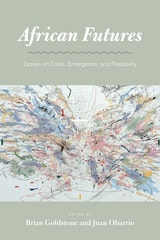
cover of African Futures: Essays on Crisis, Emergence, and Possibility

African Futures

Essays on Crisis, Emergence, and Possibility

Edited by Brian Goldstone and Juan Obarrio

University of Chicago Press, 2017

Civil wars, corporate exploitation, AIDS, and Ebola—but also democracy, burgeoning cities, and unprecedented communication and mobility: the future of Africa has never been more uncertain. Indeed, that future is one of the most complex issues in contemporary anthropology, as evidenced by the incredible wealth of ideas offered in this landmark volume. A consortium comprised of some of the most important scholars of Africa today, this book surveys an intellectual landscape of opposed perspectives in order to think within the contradictions that characterize this central question: Where is Africa headed?
           
The experts in this book address Africa’s future as it is embedded within various social and cultural forms emerging on the continent today: the reconfiguration of the urban, the efflorescence of signs and wonders and gospels of prosperity, the assorted techniques of legality and illegality, lotteries and Ponzi schemes, apocalyptic visions, a yearning for exile, and many other phenomena. Bringing together social, political, religious, and economic viewpoints, the book reveals not one but multiple prospects for the future of Africa. In doing so, it offers a pathbreaking model of pluralistic and open-ended thinking and a powerful tool for addressing the vexing uncertainties that underlie so many futures around the world.  
 
[more]
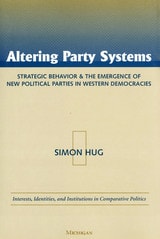
cover of Altering Party Systems: Strategic Behavior and the Emergence of New Political Parties in Western Democracies

Altering Party Systems

Strategic Behavior and the Emergence of New Political Parties in Western Democracies

Simon Hug

University of Michigan Press, 2001

New political parties have regularly appeared in developed democracies around the world. In some countries issues focusing on the environment, immigration, economic decline, and regional concerns have been brought to the forefront by new political parties. In other countries these issues have been addressed by established parties, and new issue-driven parties have failed to form. Most current research is unable to explain why under certain circumstances new issues or neglected old ones lead to the formation of new parties. Based on a novel theoretical framework, this study demonstrates the crucial interplay between established parties and possible newcomers to explain the emergence of new political parties.
Deriving stable hypotheses from a simple theoretical model, the book proceeds to a study of party formation in twenty-two developed democracies. New or neglected issues still appear as a driving force in explaining the emergence of new parties, but their effect is partially mediated by institutional factors, such as access to the ballot, public support for parties, and the electoral system. The hypotheses in part support existing theoretical work, but in part present new insights. The theoretical model also pinpoints problems of research design that are hardly addressed in the comparative literature on new political parties. These insights from the theoretical model lead to empirical tests that improve on those employed in the literature and allow for a much-enhanced understanding of the formation and the success of new parties.
Simon Hug is Lecturer in Political Science, University of Geneva.
[more]