Results by title
9 books match the query 'Emerson, Caryl'
Bakhtin in Contexts
Across the DisciplinesAmy Mandelker
Northwestern University Press, 1995
Dostoevsky and Romantic Realism
A Study of Dostoevsky in Relation to Balzac, Dickens, and GogolDonald Fanger
Northwestern University Press, 1998
Rethinking Bakhtin
Extensions and ChallengesGary Saul Morson and Caryl Emerson
Northwestern University Press, 1989
Speech Genres and Other Late Essays
By M.M. Bakhtin
University of Texas Press, 1986
Speech Genres and Other Late Essays presents six short works from Bakhtin's Esthetics of Creative Discourse, published in Moscow in 1979. This is the last of Bakhtin's extant manuscripts published in the Soviet Union. All but one of these essays (the one on the Bildungsroman) were written in Bakhtin's later years and thus they bear the stamp of a thinker who has accumulated a huge storehouse of factual material, to which he has devoted a lifetime of analysis, reflection, and reconsideration.
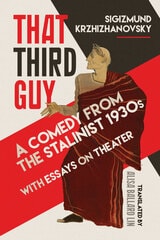
That Third Guy
A Comedy from the Stalinist 1930s with Essays on TheaterSigizmund Krzhizhanovsky, Translated and edited by Alisa Ballard Lin, Foreword by Caryl Emerson
University of Wisconsin Press, 2018
The volume also features selections from Krzhizhanovsky's compelling and idiosyncratic essays on Shakespeare, Pushkin, Shaw, and the philosophy of theater. Professionally, he worked with director Alexander Tairov at the Moscow Kamerny Theater, and his original philosophy of the stage bears comparison with the great theater theorists of the twentieth century. In these writings, he reflects on the space and time of the theater, the resonance of language onstage, the experience of the actor, and the relationship between the theater and the everyday. Commentary by Alisa Ballard Lin and Caryl Emerson contextualizes Krzhizhanovsky's writings.
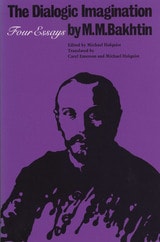
The Dialogic Imagination
Four EssaysBy M. M. Bakhtin
University of Texas Press, 1982
These essays reveal Mikhail Bakhtin (1895-1975)—known in the West largely through his studies of Rabelais and Dostoevsky—as a philosopher of language, a cultural historian, and a major theoretician of the novel. The Dialogic Imagination presents, in superb English translation, four selections from Voprosy literatury i estetiki (Problems of literature and esthetics), published in Moscow in 1975. The volume also contains a lengthy introduction to Bakhtin and his thought and a glossary of terminology.
Bakhtin uses the category "novel" in a highly idiosyncratic way, claiming for it vastly larger territory than has been traditionally accepted. For him, the novel is not so much a genre as it is a force, "novelness," which he discusses in "From the Prehistory of Novelistic Discourse." Two essays, "Epic and Novel" and "Forms of Time and of the Chronotope in the Novel," deal with literary history in Bakhtin's own unorthodox way. In the final essay, he discusses literature and language in general, which he sees as stratified, constantly changing systems of subgenres, dialects, and fragmented "languages" in battle with one another.
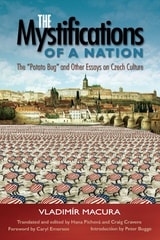
The Mystifications of a Nation
"The Potato Bug" and Other Essays on Czech CultureVladimír Macura
University of Wisconsin Press, 2010
A keen observer of culture, Czech writer Vladimír Macura (1945–99) devoted a lifetime to illuminating the myths that defined his nation. The Mystifications of a Nation, the first book-length translation of Macura’s work in English, offers essays deftly analyzing a variety of cultural phenomena that originate, Macura argues, in the “big bang” of the nineteenth-century Czech National Revival, with its celebration of a uniquely Czech identity.
In reflections on two centuries of Czech history, he ponders the symbolism in daily life. Bridges, for example—once a force of civilization connecting diverse peoples—became a sign of destruction in World War I. Turning to the Soviet and post-Soviet eras, Macura probes a range of richly symbolic practices, from the naming of the Prague metro system, to the mass gymnastic displays of the Communist period, to post–Velvet Revolution preoccupations with the national anthem. In “The Potato Bug,” he muses on one of the stranger moments in the Cold War—the claim that the United States was deliberately dropping insects from airplanes to wreak havoc on the crops of Czechoslovakia.
While attending to the distinctively Czech elements of such phenomena, Macura reveals the larger patterns of Soviet-brand socialism. “We were its cocreators,” he declares, “and its analysis touches us as a scalpel turned on its own body.” Writing with erudition, irony, and wit, Macura turns the scalpel on the authoritarian state around him, demythologizing its mythology.
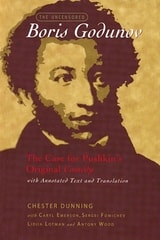
The Uncensored Boris Godunov
The Case for Pushkin's Original ComedyChester Dunning with Caryl Emerson, Sergei Fomichev, Lidiia Lotman, and Antony Wood
University of Wisconsin Press, 2007
Includes the original Russian text and, for the first time, an English translation of that version.
“Antony Wood’s translation is fluent and idiomatic; analyses by Dunning et al. are incisive; and the ‘case’ they make is skillfully argued. . . . Highly recommended.”—Choice
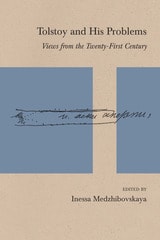
Tolstoy and His Problems
Views from the Twenty-First CenturyEdited by Inessa Medzhibovskaya
Northwestern University Press, 2019
In the broadest sense—with essays on a variety of issues that occupied Tolstoy, such as nihilism, mysticism, social theory, religion, Judaism, education, opera, and Shakespeare—the volume offers a fresh evaluation of Tolstoy's program to reform the ways we live, work, commune with nature and art, practice spirituality, exchange ideas and knowledge, become educated, and speak and think about history and social change.