Results by title
9 books match the query 'Emigrant remittances'

American Value
Migrants, Money, and Meaning in El Salvador and the United StatesDavid Pedersen
University of Chicago Press, 2012
Crossing Borders
Changing Social Identities in Southern MexicoKimberly M. Grimes
University of Arizona Press, 1998
Giving Back
Filipino America and the Politics of Diaspora GivingL. Joyce Zapanta Mariano
Temple University Press, 2021
Many Filipino Americans feel obligated to give charitably to their families, their communities, or social development projects and organizations back home. Their contributions provide relief to poor or vulnerable Filipinos, and address the forces that maintain poverty, vulnerability, and exploitative relationships in the Philippines. This philanthropy is a result of both economic globalization and the migration of Filipino professionals to the United States. But it is also central to the moral economies of Filipino migration, immigration, and diasporic return. Giving-related practices and concerns—and the bonds maintained through giving—infuse what it means to be Filipino in America.
Giving Back shows how integral this system is for understanding Filipino diaspora formation. Joyce Mariano “follows the money” to investigate the cultural, social, economic, and political conditions of diaspora giving. She takes an interdisciplinary approach to reveal how power operates through this charity and the ways the global economic and cultural dimensions of this practice reinforce racial subordination and neocolonialism. Giving Back explores how this charity can stabilize overlapping systems of inequality as well as the contradictions of corporate social responsibility programs in diaspora.
Immigration and the Work Force
Economic Consequences for the United States and Source AreasEdited by George J. Borjas and Richard B. Freeman
University of Chicago Press, 1992
This timely study is unique in presenting new data sets on the labor force, wage rates, and demographic conditions of both the U.S. and source-area economies through the 1980s. The contributors analyze the economic effects of immigration on the United States and selected source areas, with a focus on Puerto Rico and El Salvador. They examine the education and job performance of foreign-born workers; assimilation, fertility, and wage rates; and the impact of remittances by immigrants to family members on the overall gross domestic product of source areas.
A revealing and original examination of a topic of growing importance, this book will stand as a guide for further research on immigration and on the economies of developing countries.
Mexican Migration to the United States
Perspectives From Both Sides of the BorderEdited by Harriett D. Romo and Olivia Mogollon-Lopez
University of Texas Press, 2016
Borderlands migration has been the subject of considerable study, but the authorship has usually reflected a north-of-the-border perspective only. Gathering a transnational group of prominent researchers, including leading Mexican scholars whose work is not readily available in the United States and academics from US universities, Mexican Migration to the United States brings together an array of often-overlooked viewpoints, reflecting the interconnectedness of immigration policy.
This collection’s research, principally empirical, reveals significant aspects of labor markets, family life, and educational processes. Presenting recent data and accessible explanations of complex histories, the essays capture the evolving legal frameworks and economic implications of Mexico-US migrations at the national and municipal levels, as well as the experiences of receiving communities in the United States. The volume includes illuminating reports on populations ranging from undocumented young adults to elite Mexican women immigrants, health-care rights, Mexico’s incorporation of return migration, the impact of Deferred Action for Childhood Arrivals on higher education, and the experiences of young children returning to Mexican schools after living in the United States. Reflecting a multidisciplinary approach, the list of contributors includes anthropologists, demographers, economists, educators, policy analysts, and sociologists.
Underscoring the fact that Mexican migration to the United States is unique and complex, this timely work exemplifies the cross-border collaboration crucial to the development of immigration policies that serve people in both countries.
Parcels
Memories of Salvadoran MigrationMike Anastario
Rutgers University Press, 2019
Remittance as Belonging
Global Migration, Transnationalism, and the Quest for HomeHasan Mahmud
Rutgers University Press, 2025
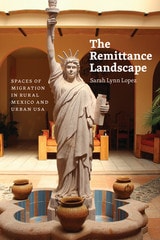
The Remittance Landscape
Spaces of Migration in Rural Mexico and Urban USASarah Lynn Lopez
University of Chicago Press, 2014
Lopez not only identifies a clear correspondence between the flow of remittances and the recent building boom in rural Mexico but also proposes that this construction boom itself motivates migration and changes social and cultural life for migrants and their families. At the same time, migrants are changing the landscapes of cities in the United States: for example, Chicago and Los Angeles are home to buildings explicitly created as headquarters for Mexican workers from several Mexican states such as Jalisco, Michoacán, and Zacatecas. Through careful ethnographic and architectural analysis, and fieldwork on both sides of the border, Lopez brings migrant hometowns to life and positions them within the larger debates about immigration.

Transit States
Labour, Migration and Citizenship in the GulfOmar AlShehabi
Pluto Press, 2014
The cheap and transitory labour power these workers provide has created the prodigious and extraordinary development boom across the region, and neighbouring countries are almost fully dependent on the labour markets of the Gulf to employ their working populations. For these reasons, the Gulf takes a central place in contemporary debates around migration and labour in the global economy.
This book attempts to bring together and explore these issues. The relationship between ‘citizen’ and ‘non-citizen’ holds immense significance for understanding the construction of class, gender, city and state in the Gulf, however too often these questions are occluded in too scholarly or overly-popular accounts of the region. Bringing together experts on the Gulf, Transit States confronts the precarious working conditions of migrants in a accessible, yet in-depth manner.