Results by title
15 books match the query 'Employee rights'
Alt-Labor and the New Politics of Workers' Rights
Daniel J. Galvin
Russell Sage Foundation, 2024
Alt-labor groups have long offered their members services and organizing opportunities to contest their unfair treatment on the job. But many groups have grown frustrated by the limited impact of these traditional strategies and have turned to public policy to scale up their work. They have successfully led campaigns to combat wage theft, raise the minimum wage, improve working conditions, strengthen immigrants’ rights, and more. These successes present something of a puzzle: relative to their larger, wealthier, and better-connected opponents, alt-labor groups are small, poor, and weak. Their members are primarily low-wage immigrant workers and workers of color who are often socially, economically, and politically marginalized. With few exceptions, the groups lack large dues-paying memberships and are dependent on philanthropic foundations and other unpredictable sources of funding. How, given their myriad challenges, have alt-labor groups managed to make gains for their members?
Galvin reveals that alt-labor groups are leveraging their deep roots in local communities, their unique position in the labor movement, and the flexibility of their organizational forms to build their collective power and extend their reach. A growing number of groups have also become more politically engaged and have set out to alter their political environments by cultivating more engaged citizens, influencing candidate selection processes, and expanding government capacities. These efforts seek to enhance alt-labor groups’ probabilities of success in the near term while incrementally shifting the balance of power over the long term.
Alt-Labor and the New Politics of Workers’ Rights comprehensively details alt-labor’s turn to policy and politics, provides compelling insights into the dilemmas the groups now face, and illuminates how their efforts have both invigorated and complicated the American labor movement.
Are Worker Rights Human Rights?
Richard P. McIntyre
University of Michigan Press, 2008
"In a much-needed intervention, Ric McIntyre recasts the debate about globalization and labor rights and speeds us to the heart of the matter: the battle between transnational corporations who distance themselves from responsibility for the fate of workers, and labor activists who seek to reestablish bonds of accountability and moral obligation. The stakes in this struggle are enormous, and Dr. McIntyre provides crucial insight into the economic and political dynamics that define it."
---Scott Nova, Executive Director, Worker Rights Consortium, Washington, DC
"This book presents an insightful, powerful corrective to the contemporary debate over worker rights. McIntyre identifies the limitations of thinking of worker rights as individualized human rights and challenges us instead to examine how rights are defined through conventional thinking and class interest. The product is rich and compelling: McIntyre's investigation demands of us that we be far more attentive to the contradictory effects of ‘rights talk.' I recommend this book enthusiastically to all those who advocate for a just economic order the world over."
---George DeMartino, Associate Professor of Political Economy, the Josef Korbel School of International Studies, University of Denver
"An important contribution to the interdisciplinary study of labor. McIntyre's book will challenge the debate over labor rights on all fronts."
---Michael Hillard, Professor of Economics, University of Southern Maine
"A timely examination of our modern 'sweating system' . . . essential reading for all workers who hope for greater dignity in the workplace and greater fairness in society."
---Janet Knoedler, Associate Professor of Economics, Bucknell University
"Ric McIntyre convincingly shows how local actions, regulations changes, and international norms can combine to establish collective rights for workers."
---Gilles Raveaud, Assistant Professor in Economics, University of Saint-Denis, France, and cofounder of the "post-autistic economics movement"
"An important, timely, and needed contribution to our understanding of worker rights."
---Patrick McHugh, Associate Professor of Management, George Washington University
"Workers of the world, unite!" Karl Marx's famous call to action still promises an effective means of winning human rights in the modern global economy, according to economist Richard P. McIntyre. Currently, the human rights movement insists upon a person's right to life, freedom, and material necessities. In democratic, industrial nations such as the United States, the movement focuses more specifically on a person's civil rights and equal opportunity.
The movement's victories since WWII have come at a cost, however. The emphasis on individual rights erodes collective rights---the rights that disadvantaged peoples need to assert their most basic human rights. This is particularly true for workers, McIntyre argues. By reintroducing Marxian and Institutional analysis, he reveals the class relations and power structures that determine the position of workers in the global economy. The best hope for achieving workers' rights, he concludes, lies in grassroots labor organizations that claim the right of association and collective bargaining.
At last, an economist offers a vision for human rights that takes both moral questions and class relations seriously.
Richard P. McIntyre is Director of the University Honors Program and Professor of Economics at the University of Rhode Island.
Beyond the Boycott
Labor Rights, Human Rights, and Transnational ActivismGay W. Seidman
Russell Sage Foundation, 2007
Challenging the Chip
Labor Rights and Environmental Justice in the Global Electronics Industryedited by Ted Smith, David A. Sonnenfeld and David Naguib Pellow, foreword by Jim Hightower
Temple University Press, 2006
For a Just and Better World
Engendering Anarchism in the Mexican Borderlands, 1900-1938Sonia Hernandez
University of Illinois Press, 2021
A vivid look at a radical activist and her times, For a Just and Better World illuminates the lives and work of Mexican women battling for labor rights and gender equality in the early twentieth century.
Free Labor
Workfare and the Contested Language of NeoliberalismJohn Krinsky
University of Chicago Press, 2008
At times the fight over workfare unfolded as an argument over who had the authority to define these terms, and in Free Labor, John Krinsky focuses on changes in the language and organization of the political coalitions on either side of the debate. Krinsky’s broadly interdisciplinary analysis draws from interviews, official documents, and media reports to pursue new directions in the study of the cultural and cognitive aspects of political activism. Free Labor will instigate a lively dialogue among students of culture, labor and social movements, welfare policy, and urban political economy.
Hell's Not Far Off
Bruce Crawford and the Appalachian LeftJosh Howard
West Virginia University Press, 2024
A biography of Bruce Crawford, a southwest Virginia journalist-writer of the radical tradition and one of the first to interpret Appalachian labor history.
Hell’s Not Far Off is a grounded, politically engaged study of the Appalachian journalist and political critic Bruce Crawford, a scourge of coal and railway interests. Crawford fought injustices wherever he saw them at major risk to his own life and became an early interpreter of Appalachian labor history.
His writings and actions from the 1920s to the 1960s helped shape southwest Virginia and West Virginia. Through Crawford’s Weekly, a newspaper active from 1920 to 1935, Crawford challenged the Ku Klux Klan, lynch mobs, and the private police forces of coal barons. The wounds received for these efforts were the closing of his paper and a bullet to his leg during a Harlan County strike in the 1930s. In his work after journalism, he led the West Virginia branch of the Federal Writers’ Project during the political standoff over the contents of the state’s official guidebook.
In Hell’s Not Far Off, Josh Howard resurrects strands of a radical tradition centered especially on matters of labor, environment, and race, drawing attention to that tradition’s ongoing salience: “Present-day Appalachia’s fights were [Crawford’s], and his fights are still ours.”
Hog Wild
The Battle for Workers' Rights at the World's Largest SlaughterhouseLynn Waltz
University of Iowa Press, 2018
Author and journalist Lynn Waltz reveals how these aggressive tactics went unchecked for years until Sherri Buffkin, a higher-up manager at Smithfield, blew the lid off the company’s corrupt practices. Through meticulous reporting, in-depth interviews with key players, and a mind for labor and environmental histories, Waltz weaves a fascinating tale of the nearly two-decade struggle that eventually brought justice to the workers and accountability to the food giant, pitting the world’s largest slaughterhouse against the world’s largest meatpacking union.
Following in a long tradition of books that expose the horrors of the meatpacking industry—from Upton Sinclair’s The Jungle to Eric Schlosser’s Fast Food Nation—Hog Wild uncovers rampant corporate environmental hooliganism, labor exploitation, and union-busting by one of the nation’s largest meat producers. Waltz’s eye-opening examination sheds new light on the challenges workers face not just in meatpacking, but everywhere workers have lost their power to collectively bargain with powerful corporations.

Just Transitions
Social Justice in the Shift Towards a Low-Carbon WorldEdouard Morena
Pluto Press, 2019
Just Transition emerged as a framework developed within the trade union movement to encompass a range of social interventions needed to secure workers' and frontline communities' jobs and livelihoods as economies shift to sustainable production. Just Transitions draws on a range of perspectives from the global North and South to interrogate the overlaps, synergies and tensions between various understandings of the Just Transition approach. As the concept is entering the mainstream, has it lost its radical edge, and if so, can it be recovered?
Written by academics and activists from around the globe, this unique edited collection is the first book entirely devoted to Just Transition.

Just Transitions
Social Justice in the Shift Towards a Low-Carbon WorldEdouard Morena
Pluto Press, 2022
Just Transition emerged as a framework developed within the trade union movement to encompass a range of social interventions needed to secure workers' and frontline communities' jobs and livelihoods as economies shift to sustainable production. Just Transitions draws on a range of perspectives from the global North and South to interrogate the overlaps, synergies and tensions between various understandings of the Just Transition approach. As the concept is entering the mainstream, has it lost its radical edge, and if so, can it be recovered?
Written by academics and activists from around the globe, this unique edited collection is the first book entirely devoted to Just Transition.
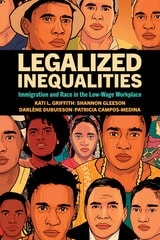
Legalized Inequalities
Immigration and Race in the Low-wage WorkplaceKati L. Griffith
Russell Sage Foundation, 2025
Drawing on interviews with over three hundred low-wage Haitian and Central American workers and worker advocates, Griffith, Gleeson, Dubuisson, and Campos-Medina reveal how U.S. policies produce and sustain job instability and insecurity. Together, contemporary U.S. labor and employment law, immigration policy, and enduring racial inequality work in tandem to keep workers’ wages low, lock them into substandard working conditions, and minimize opportunities to push for change. Workplace regulations meant to protect workers are weak and underenforced, privileging employers over workers. At-will employment policies, which allow employers to terminate employees without cause, discourage workers from bargaining for better jobs or holding employers accountable for even the most egregious mistreatment. Federal immigration policy further disempowers workers by deputizing employers to act as immigration enforcement agents through immigration status verification requirements. Undocumented workers often believe they must endure maltreatment or risk deportation. Anti-immigrant sentiment—encouraged by U.S. policy—impacts workers across all status groups. Additionally, despite a proliferation of civil rights legislation, racial disparities remain in the workplace. Workers of color are often paid less, forced to complete more dangerous and demeaning tasks, and subjected to racial harassment.
While these workers face formidable barriers to fighting for their rights, they are not entirely powerless. Some low-wage workers filed formal complaints with government agencies. Others, on their own or collectively, confronted their employers to demand fair and dignified treatment. Some even quit in protest of their poor working conditions. The authors argue that reforming labor and employment law, immigration law, and Civil Rights law is necessary to reshape the low-wage workplace. They suggest increasing funding for workers’ rights enforcement agencies, removing the mandate for employers to verify a worker’s immigration status, and making it easier to prove that employment discrimination has occurred, among other policy proposals, to help empower and protect low-wage immigrant workers of color.
Legalized Inequalities not only highlights the crushing consequences of U.S. policy on low-wage immigrant workers of color but showcases their resilience in the face of these obstacles.
Strategizing against Sweatshops
The Global Economy, Student Activism, and Worker EmpowermentMatthew S. Williams
Temple University Press, 2020
For the past few decades, the U.S. anti-sweatshop movement was bolstered by actions from American college students. United Students Against Sweatshops (USAS) effectively advanced the cause of workers’ rights in sweatshops around the world. Strategizing against Sweatshops chronicles the evolution of student activism and presents an innovative model of how college campuses are a critical site for the advancement of global social justice.
Matthew Williams shows how USAS targeted apparel companies outsourcing production to sweatshop factories with weak or non-existent unions. USAS did so by developing a campaign that would support workers organizing by leveraging their college’s partnerships with global apparel firms like Nike and Adidas to abide by pro-labor codes of conduct.
Strategizing against Sweatshops exemplifies how organizations and actors cooperate across a movement to formulate a coherent strategy responsive to the conditions in their social environment. Williams also provides a model of political opportunity structure to show how social context shapes the chances of a movement’s success—and how movements can change that political opportunity structure in turn. Ultimately, he shows why progressive student activism remains important.
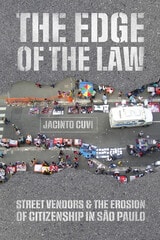
The Edge of the Law
Street Vendors and the Erosion of Citizenship in São PauloJacinto Cuvi
University of Chicago Press, 2025
With a little initiative and very little startup money, an outgoing individual might sell you a number of delights and conveniences familiar to city dwellers—from cold water bottles while you’re sitting in traffic to a popsicle from a cart on a summer afternoon in the park. Such vendors form a significant share of the workforce in São Paulo, Brazil, but their ubiquity belies perpetual struggle. Some have the right to practice their trade; others do not. All of them strive to make it—or stay afloat.
In The Edge of the Law, sociologist Jacinto Cuvi introduces us to the world of street vendors and teases out the relationship between the construction of legality and the experience of citizenship. As São Paulo’s city government undertakes a large-scale plan to cancel street vending licenses and evict street vendors, Cuvi reveals how the rights of informal workers can be revoked or withheld and how the lines can be redrawn between work that is “legal” and work that takes place under constant fear of law enforcement. Alongside the mechanics of disenfranchisement, Cuvi captures the lived experience of criminalization, dissecting the distribution of (shallow) rights among vendors who continually reinvent strategies to eke out a living while dealing with the constraints and pressures of informal citizenship at the edge of the law.

Thyra J. Edwards
Black Activist in the Global Freedom StruggleGregg Andrews
University of Missouri Press, 2011
Edwards, granddaughter of runaway slaves, grew up in Jim Crow–era Houston and started her career there as a teacher. She moved to Gary, Indiana, and Chicago as a social worker, then to New York as a journalist, and later became involved with the Communist Party, attracted by its stance on race and labor. She was mentored by famed civil rights leader A. Philip Randolph, who became her special friend and led her to pursue her education. She obtained scholarships to college, and after several years of study in the U.S. and then in Denmark, she became a women’s labor organizer and a union publicist.
In the 1930s and 1940s, she wrote about international events for black newspapers, traveling to Europe, Mexico, and the Soviet Union and presenting an anti-imperialist critique of world affairs to her readers. Edwards’s involvement with the Loyalists in the Spanish Civil War, her work in a Jewish refugee settlement in Italy, and her activities with U.S. communists drew the attention of the FBI. She was harassed by government intelligence organizations until she died at the age of just fifty-five. Edwards contributed as much to the radical foundations of the modern civil rights movements as any other woman of her time.
This fascinating new biography details Thyra Edwards’s lifelong journey and myriad achievements, describing both her personal and professional sides and the many ways they intertwined. Gregg Andrews used Edwards’s official FBI file—along with her personal papers, published articles, and civil rights manuscript collections—to present a complete portrait of this noteworthy activist. An engaging volume for the historian as well as the general reader, Thyra J. Edwards explores the complete domestic and international impact of her life and actions.
Work, Race, and the Emergence of Radical Right Corporatism in Imperial Germany
Dennis Sweeney
University of Michigan Press, 2010
---Andrew Zimmerman, George Washington University