Results by title
104 books match the query 'Employees' and 8 start with a

A Matter of Time
Alex Capus
Haus Publishing, 2009
A Nation at Work
The Heldrich Guide to the American WorkforceVan Horn, Carl E
Rutgers University Press, 2003
A Nation at Work addresses the fundamental economic, demographic, policy, and business facts about how the workforce and workplace are changing in the early twenty-first century. Illustrated with over thirty-five graphs, Part I covers essential topics about the American workforce and workers. Part II gathers essays and speeches from the nation's outstanding journalists and workplace analysts. The book incorporates facts and data, including invaluable tables and listings for useful Internet sites, books, and organizations.
Comprehensive in scope, A Nation at Work will help readers reach a better understanding about their own work and the world of work around them.
A Union for Appalachian Healthcare Workers
The Radical Roots and Hard Fights of Local 1199John Hennen
West Virginia University Press, 2021
The union of hospital workers usually referred to as the 1199 sits at the intersection of three of the most important topics in US history: organized labor, health care, and civil rights. John Hennen’s book explores the union’s history in Appalachia, a region that is generally associated with extractive industries but has seen health care grow as a share of the overall economy.
With a multiracial, largely female, and notably militant membership, 1199 was at labor’s vanguard in the 1970s, and Hennen traces its efforts in hospitals, nursing homes, and healthcare centers in West Virginia, eastern Kentucky, and Appalachian Ohio. He places these stories of mainly low-wage women workers within the framework of shake-ups in the late industrial and early postindustrial United States, relying in part on the words of Local 1199 workers and organizers themselves. Both a sophisticated account of an overlooked aspect of Appalachia’s labor history and a key piece of context for Americans’ current concern with the status of “essential workers,” Hennen’s book is a timely contribution to the fields of history and Appalachian studies and to the study of social movements.

Abortion at Work
Ideology and Practice in a Feminist ClinicSimonds, Wendy
Rutgers University Press, 1996
These are the questions that drive Wendy Simonds' Abortion at Work. Simonds documents the ways in which workers at a feminist clinic construct compelling feminist visions, and also watch their ideals fall short in practice. Simonds interprets these women's narratives to get at how abortion works on feminism, and to show what feminism can gain by rethinking abortion utilizing these activists' terms. In thoroughly engaging prose, Simonds frames her analysis with a moving account of her own personal understanding of the issues.
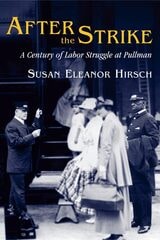
After the Strike
A Century of Labor Struggle at PullmanSusan Eleanor Hirsch
University of Illinois Press, 2003
The 1894 Pullman strike and the rise of the Brotherhood of Sleeping Car Porters played major roles in the century-long development of union organizing and labor-management relations in the Pullman Company. Susan Eleanor Hirsch connects the stories of Pullman car builders and porters to answer critical questions like: what created job segregation by race and gender? What role did such segregation play in shaping the labor movement?
Hirsch illuminates the relationship between labor organizing and the racial and sexual discrimination practiced by both employers and unions. Because the Pullman Company ran the sleeping-car service for American railroads and was a major manufacturer of railcars, its workers were involved in virtually every wave of union organizing from the 1890s to the 1940s.
In exploring the years of struggle by the men and women of the Pullman Company, After the Strike reveals the factors that determined the limited success and narrow vision of most American unions.
Air Transport Labor Relations
Robert W. Kaps
Southern Illinois University Press, 1997
Robert W. Kaps examines air transport labor law in the United States as well as the underlying legislative and policy directives established by the federal government. The body of legislation governing labor relations in the private sector of the U.S. economy consists of two separate and distinct acts: the Railway Labor Act (RLA), which governs labor relations in the railroad and airline industries, and the National Labor Relations Act (NLRA), which governs labor relations in all other industrial sectors.
Although the NLRA closely follows the pattern established by the RLA, Kaps notes that the two laws are distinguishable in several important areas. Labor contracts negotiated under the RLA continue in perpetuity, for example, whereas all other labor contracts expire at a specified date. Other important areas of difference relate to the collective bargaining process itself, the procedures for the arbitration of disputes and grievances, and the spheres of authority and jurisdiction to consider such matters as unfair labor practices.
Congress established a special labor law for railroad and airline workers for several reasons. Because of transportation’s critical importance to the economy, an essential goal of public policy has been to ensure that both passenger and freight transportation services continue without interruption. Production can cease—at least temporarily—in most other industries without causing significant harm to the economy. When transportation stops, however, production stops. Thus Congress saw fit to enact a statute that contained provisions to ensure that labor strife would not halt rail services. Primarily because of the importance of air mail transportation, the Railway Labor Act of 1926 was extended to the airline industry in 1936.
The first section of this book introduces labor policy and presents a history of the labor movement in the United States. Discussing early labor legislation, Kaps focuses on unfair labor practices and subsequent major labor statutes.
The second section provides readers with a comparison of labor provisions that apply to the railroad and airline industries as well as to the remainder of the economy.
The final section centers on the evolution of labor in the airline industry. The author pays particular attention to recent events affecting labor in commercial aviation, particularly the effect of airline deregulation on airline labor.

Always an Academic Immigrant
A Collective MemoirDafna Lemish
Rutgers University Press, 2025
Always an Academic Immigrant is a collective memoir that gives voice to eighty-one academics who immigrated from thirty-seven countries for a career in an institution of higher education, in either the United States or one of ten other countries. Through in-depth interviews and observations from her own experiences as an immigrant scholar, Dafna Lemish shares the highs and the lows that academic immigrants feel as they search for both a country and an institution they can call home. She discovers the formative events that led these scholars to pursue careers outside their native lands and details the challenges they faced adapting to unspoken expectations in their new countries and workplaces. Ultimately, this book reveals the strategies that immigrant professors use to bridge their native and adoptive cultures while highlighting the vital contributions they have made to academia as scholars, teachers, and leaders.

Antidiscrimination Law and Minority Employment
Recruitment Practices and Regulatory ConstraintsFarrell Bloch
University of Chicago Press, 1994