Results by title
11 books match the query 'Entertaining'
Dinner in Camelot
The Night America's Greatest Scientists, Writers, and Scholars Partied at the Kennedy White HouseJoseph A. Esposito
University Press of New England, 2018
Eating Together
Food, Friendship and InequalityAlice P. Julier
University of Illinois Press, 2013
Entertaining the Nation
American Drama in the Eighteenth and Nineteenth CenturiesTice L. Miller
Southern Illinois University Press, 2007
In this survey of eighteenth- and nineteenth-century American drama, Tice L. Miller examines American plays written before a canon was established in American dramatic literature and provides analyses central to the culture that produced them. Entertaining the Nation: American Drama in the Eighteenth and Nineteenth Centuries evaluates plays in the early years of the republic, reveals shifts in taste from the classical to the contemporary in the 1840s and 1850s, and considers the increasing influence of realism at the end of the nineteenth century.
Miller explores the relationship between American drama and societal issues during this period. While never completely shedding its English roots, says Miller, the American drama addressed issues important on this side of the Atlantic such as egalitarianism, republicanism, immigration, slavery, the West, Wall Street, and the Civil War.
In considering the theme of egalitarianism, the volume notes Alexis de Tocqueville’s observation in 1831 that equality was more important to Americans than liberty. Also addressed is the Yankee character, which became a staple in American comedy for much of the nineteenth century.
Miller analyzes several English plays and notes how David Garrick’s reforms in London were carried over to the colonies. Garrick faced an increasingly middle-class public, offers Miller, and had to make adjustments to plays and to his repertory to draw an audience.
The volumealso looks at the shift in drama that paralleled the one in political power from the aristocrats who founded the nation to Jacksonian democrats. Miller traces how the proliferation of newspapers developed a demand for plays that reflected contemporary society and details how playwrights scrambled to put those symbols of the outside world on stage to appeal to the public. Steamships and trains, slavery and adaptations of Uncle Tom’s Cabin, and French influences are presented as popular subjects during that time.
Entertaining the Nation effectively outlines the civilizing force of drama in the establishment and development of the nation, ameliorating differences among the various theatergoing classes, and provides a microcosm of the changes on and off the stage in America during these two centuries.

Entertaining the Third Reich
Illusions of Wholeness in Nazi CinemaLinda Schulte-Sasse
Duke University Press, 1996
Drawing on theoretical work, particularly that of Lacan and Zizek, Schulte-Sasse shows how films such as Jew Süsss and The Great King construct fantasies of social harmony, often through distorted versions of familiar stories from eighteenth-century German literature, history, and philosophy. Schulte-Sasse observes, for example, that Nazi films, with their valorization of bourgeois culture and use of familiar narrative models, display a curious affinity with the world of Enlightenment culture that the politics of National Socialism would seem to contradict.
Schulte-Sasse argues that film served National Socialism less because of its ideological homogeneity than because of the appeal and familiarity of its underlying literary paradigms and because the medium itself guarantees a pleasurable illusion of wholeness. Entertaining the Third Reich will be of interest to a wide range of scholars, including those engaged in the study of cinema, popular culture, Nazism and Nazi art, the workings of fascist culture, and the history of modern ideology.
How to Dine in Style
The Art of Entertaining, 1920J. Rey
Bodleian Library Publishing, 2013
By turns a collection of practical advice and a catalog of eccentricities, The Whole Art of Dining, republished by the Bodleian Library as How to Dine in Style, contained everything the would-be socialite needed to know in order to elevate food to high art, from tricks for putting together a proper French menu or throwing a garden party to practical tips on serving wines in the correct order and at the right temperature. Throughout the book are stories of astonishing excess, such as the search for ever-more-elaborate themes and venues, and the more daring of the book’s devotees might have been tempted to emulate efforts like those of the intrepid hostess whose mountaineering-themed dinner party had guests rappel to the rooftop of her Chicago home or American millionaire George A. Kessler, whose infamous “Gondola Party” flooded— for the first and only time—the central courtyard of the Savoy.
A captivating glimpse into the golden age of fine dining, this book will be consumed with interest by discerning diners and fans of the Roaring Twenties—and it may even inspire readers to try their hand at throwing a stylish soiree of their own.
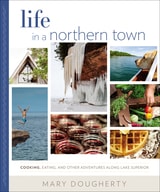
Life in a Northern Town
Cooking, Eating, and Other Adventures along Lake SuperiorMary Dougherty
Wisconsin Historical Society Press, 2017
—from the Introduction
In 2007, Mary Dougherty and her family moved from St. Paul to the tiny Bayfield Peninsula, surrounded by the waters of Lake Superior and Chequamegon Bay in far northwestern Wisconsin. There they set out to live their lives against a backdrop of waterfalls, beaches, farm stands, and a quintessential small town of 487 people. Through recipes, stories, and photos, this book explores what it means to nourish a family and a community. As Mary Dougherty incorporates what is grown and raised in northern Wisconsin into her family’s favorite dishes, she continues a cultural tradition begun by immigrants hundreds of years ago. The result is a one-of-a-kind collection of globally and regionally inspired recipes featuring local cheeses, meats, and produce from the farmers in and around Bayfield—pho made with beef bones from a farm in Mellen, Indian meatballs with curry powder made in Washburn, chowder with corn and potatoes from a farm stand in Ashland. As she knits herself into the Bayfield community, Dougherty comes to more fully grasp the intricate relationship between food and community.
Nightwork
Sexuality, Pleasure, and Corporate Masculinity in a Tokyo Hostess ClubAnne Allison
University of Chicago Press, 1994
Allison describes in detail a typical company outing to such a club—what the men do, how they interact with the hostesses, the role the hostess is expected to play, and the extent to which all of this involves "play" rather than "work." Unlike previous books on Japanese nightlife, Allison's ethnography of one specific hostess club (here referred to as Bijo) views the general phenomenon from the eyes of a woman, hostess, and feminist anthropologist.
Observing that clubs like Bijo further a kind of masculinity dependent on the gestures and labors of women, Allison seeks to uncover connections between such behavior and other social, economic, sexual, and gendered relations. She argues that Japanese corporate nightlife enables and institutionalizes a particular form of ritualized male dominance: in paying for this entertainment, Japanese corporations not only give their male workers a self-image as phallic man, but also develop relationships to work that are unconditional and unbreakable. This is a book that will appeal to anyone interested in gender roles or in contemporary Japanese society.
Opulent Nosh
A Cookbook for Audacious AppetitesKen Albala
University of Alabama Press, 0
Foodie-scholar extraordinaire Ken Albala offers adventurous cooks a treasury of innovative recipes to transform noshing
Table Talk
Building Democracy One Meal at a TimeJanet A. Flammang
University of Illinois Press, 2016
The civic virtues of a seat at the table
Etiquette books insist that we never discuss politics during a meal. In Table Talk, Janet A. Flammang offers a polite rebuttal, presenting vivid firsthand accounts of people's lives at the table to show how mealtimes can teach us the conversational give-and-take foundational to democracy. Delving into the ground rules about listening, sharing, and respect that we obey when we break bread, Flammang shows how conversations and table activities represent occasions for developing our civil selves. If there are cultural differences over practices--who should speak, what behavior is acceptable, what topics are off limits, how to resolve conflict--our exposure to the making, enforcement, and breaking of these rules offers a daily dose of political awareness and growth. Political table talk provides a forum to practice the conversational skills upon which civil society depends. It also ignites the feelings of respect, trust, and empathy that undergird the idea of a common good that is fundamental to the democratic process.
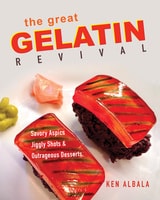
The Great Gelatin Revival
Savory Aspics, Jiggly Shots, and Outrageous DessertsKen Albala
University of Illinois Press, 2023
A lighthearted manifesto for the new age of aspics, The Great Gelatin Revival rattles our very understanding of what food can be.
The Texas Cookbook
From Barbecue to Banquet-- an Informal View of Dining and Entertaining the Texas WayMary Faulk Koock
University of North Texas Press, 1965