Results by title
14 books match the query 'Environmental law'
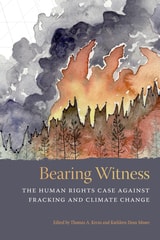
Bearing Witness
The Human Rights Case Against Fracking and Climate ChangeThomas A. Kerns
Oregon State University Press, 2021
On May 14, 2018, a respected international human-rights court, the Rome-based Permanent Peoples’ Tribunal, began a week-long hearing on the impacts of fracking and climate change on human and Earth rights. In its advisory opinion, the Tribunal ruled that fracking systematically violates substantive and procedural human rights; that governments are complicit in the rights violations; and that to protect human rights and the climate, the practice of fracking should be banned.
The case makes history. It revokes the social license of extreme-extraction industries by connecting environmental destruction to human-rights violations. It affirms that climate change, and the extraction techniques that fuel it, directly violate deeply and broadly accepted moral norms encoded in the Universal Declaration of Human Rights.
Bearing Witness maps a promising new direction in the ongoing struggle to protect the planet from climate chaos. It tells the story of this landmark case through carefully curated court materials, including searing eye-witness testimony, groundbreaking legal testimony, and the Tribunal’s advisory opinion. Essays by leading climate writers such as Winona LaDuke, Robin Wall Kimmerer, and Sandra Steingraber and legal experts such as John Knox, Mary Wood, and Anna Grear give context to the controversy. Framing essays by the editors, experts on climate ethics and human rights, demonstrate that a human-rights focus is a powerful, transformative new tool to address the climate crisis.
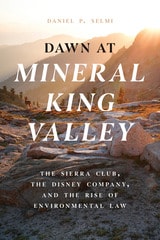
Dawn at Mineral King Valley
The Sierra Club, the Disney Company, and the Rise of Environmental LawDaniel P. Selmi
University of Chicago Press, 2022
In our current age of climate change–induced panic, it’s hard to imagine a time when private groups were not actively enforcing environmental protection laws in the courts. It wasn’t until 1972, however, that a David and Goliath–esque Supreme Court showdown involving the Sierra Club and Disney set a revolutionary legal precedent for the era of environmental activism we live in today.
Set against the backdrop of the environmental movement that swept the country in the late 1960s and early 1970s, Dawn at Mineral King Valley tells the surprising story of how the US Forest Service, the Disney company, and the Sierra Club each struggled to adapt to the new, rapidly changing political landscape of environmental consciousness in postwar America. Proposed in 1965 and approved by the federal government in 1969, Disney’s vast development plan would have irreversibly altered the practically untouched Mineral King Valley, a magnificently beautiful alpine area in the Sierra Nevada mountains. At first, the plan met with unanimous approval from elected officials, government administrators, and the press—it seemed inevitable that this expanse of wild natural land would be radically changed and turned over to a private corporation. Then the scrappy Sierra Club forcefully pushed back with a lawsuit that ultimately propelled the modern environmental era by allowing interest groups to bring litigation against environmentally destructive projects.
An expert on environmental law and appellate advocacy, Daniel P. Selmi uses his authoritative narrative voice to recount the complete history of this revolutionary legal battle and the ramifications that continue today, almost 50 years later.
Dawn at Mineral King Valley
The Sierra Club, the Disney Company, and the Rise of Environmental LawDaniel P. Selmi
University of Chicago Press, 2022
This is an auto-narrated audiobook edition of this book.
The story behind the historic Mineral King Valley case, which reveals how the Sierra Club battled Disney’s ski resort development and launched a new environmental era in America.
In our current age of climate change–induced panic, it’s hard to imagine a time when private groups were not actively enforcing environmental protection laws in the courts. It wasn’t until 1972, however, that a David and Goliath–esque Supreme Court showdown involving the Sierra Club and Disney set a revolutionary legal precedent for the era of environmental activism we live in today.
Set against the backdrop of the environmental movement that swept the country in the late 1960s and early 1970s, Dawn at Mineral King Valley tells the surprising story of how the US Forest Service, the Disney company, and the Sierra Club each struggled to adapt to the new, rapidly changing political landscape of environmental consciousness in postwar America. Proposed in 1965 and approved by the federal government in 1969, Disney’s vast development plan would have irreversibly altered the practically untouched Mineral King Valley, a magnificently beautiful alpine area in the Sierra Nevada mountains. At first, the plan met with unanimous approval from elected officials, government administrators, and the press—it seemed inevitable that this expanse of wild natural land would be radically changed and turned over to a private corporation. Then the scrappy Sierra Club forcefully pushed back with a lawsuit that ultimately propelled the modern environmental era by allowing interest groups to bring litigation against environmentally destructive projects.
An expert on environmental law and appellate advocacy, Daniel P. Selmi uses his authoritative narrative voice to recount the complete history of this revolutionary legal battle and the ramifications that continue today, almost 50 years later.
Environmental Change
Rosemary O'Leary
Temple University Press, 1995
Environmental Change examines the impact of hundreds of federal court decisions on the policies and administration of the EPA since its inception in 1970. Having surveyed over 2,000 federal court decisions, Rosemary O'Leary presents case studies of five important policy areas: water quality, pesticides, toxic substances, air quality, and hazardous wastes.
Compliance with court orders, O'Leary discovered, has become one of the EPA's top priorities, at times overshadowing congressional mandates and the authority of EPA administrators.
For an agency often caught between the White House and Congressional agendas, the competing interests of industry and environmental groups, and turf battles with other federal agencies, O'Leary argues, judicial decision making is crucial in the public policy process.
Environmental Change offers valuable information in the fields of public policy and environmental law.
Environmental Law for Biologists
Tristan Kimbrell
University of Chicago Press, 2016
With Environmental Law for Biologists, ecologist and lawyer Tristan Kimbrell bridges this gap in legal knowledge. Complete with a concise introduction to environmental law and an appendix describing the most important federal and international statutes and treaties discussed, the book is divided into four broad parts: laws that focus on individual species, like invasive species policies, the Endangered Species Act, and international treaties such as CITES; laws that focus on land, from federal public lands to agricultural regulations and urban planning; laws that focus on water, such as the Clean Water Act; and laws that focus on air, such as the Clean Air Act and international measures meant to mitigate global climate change. Written for working biologists and students alike, this book will be a catalyst for both more effective policy and enhanced research, offering hope for the manifold frictions between science and the law.
Law and the Environment
A Multidisciplinary ReaderRobert Percival
Temple University Press, 1997
Law and the Environment: A Multidisciplinary Reader brings together for the first time some of the most important original work on environmental policy by scientists, ecologists, philosophers, historians, economists, and legal scholars. Each of the book's four parts provides a different focus on the nature and scope of environmental problems and attempts to use public policy to address these concerns. Part I examines how ecology, economics, and ethics analyze environmental problems and why they support collective action to respond to them. Part II examines the history and present state of environmental law, from early attempts to engage the government to current debate over the effectiveness of environmental policy. Part III explores the process by which environmental law gets translated into regulatory policy. Part IV considers the future of environmental law at a time when international environmental concerns have become a major force in global diplomacy and international trade agreements.
In drawing together a wide variety of perspectives on these issues, Robert V. Percival and Dorothy C. Alevizatos offer a comprehensive examination of how society has responded to the difficult challenges posed by environmental problems. The selections provide a rich introduction to the complexities of environmental policy disputes.
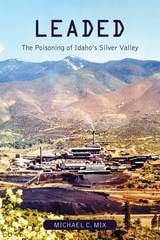
Leaded
The Poisoning of Idaho's Silver ValleyMichael C. Mix
Oregon State University Press, 2016
During the first half of the 20th century, industrial mining operations caused severe environmental damage to area waterways and lands from releases of lead and other toxic metals, and sulfur gases. Despite the obvious devastation, no effective federal laws regulating mining and smelting operations were passed until the 1970s, due to the influence of the mine and lead industry in state and federal politics, and scientific uncertainties about pollution effects. Harmful human health effects were evident soon after the smelter opened in 1917, when Bunker Hill workers suffered from lead poisoning, but no federal laws regulating workplace lead were passed until the 1970s.
In 1974, lead smelter emissions from Bunker Hill caused the largest epidemic of childhood lead poisoning in U.S. history. That landmark event ultimately led to the EPA mandating federal air lead standards in 1978 and, at the same time, NIOSH passed national standards reducing occupational lead exposures. Bunker Hill could not meet the new standards; consequently, the company closed in 1981, leaving behind a contaminated geographic area that was classified as the largest Superfund site in the United States in 1983.
Leaded is a deeply researched account of one of the greatest environmental disasters in our history. It belongs on the bookshelf of every student of environmental history, western history, mining history, environmental ethics, and environmental law.
Linking Human Rights and the Environment
Edited by Romina Picolotti and Jorge Daniel Taillant
University of Arizona Press, 2003
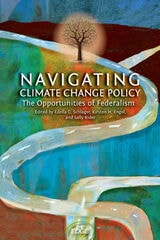
Navigating Climate Change Policy
The Opportunities of FederalismEdella C. Schlager
University of Arizona Press, 2011
Federalism—the system of government in which power is divided among a national government and state and regional governments—is well-suited to address the challenges of climate change because it permits distinctive policy responses at a variety of scales. The chapters in this book explore questions such as what are appropriate relationships between states, tribes, and the federal government as each actively pursues climate-change policies? How much leeway should states have in designing and implementing climate-change policies, and how extensively should the federal government exercise its preemption powers to constrain state activity? What climate-change strategies are states best suited to pursue, and what role, if any, will regional state-based collaborations and associations play? This book examines these questions from a variety of perspectives, blending legal and policy analyses to provide thought-provoking coverage of how governments in a federal system cooperate, coordinate, and accommodate one another to address this global problem.
Navigating Climate Change Policy is an essential resource for policymakers and judges at all levels of government who deal with questions of climate governance. It will also serve as an important addition to the curriculum on climate change and environmental policy in graduate and undergraduate courses and will be of interest to anyone concerned with how the government addresses environmental issues.
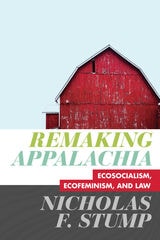
Remaking Appalachia
Ecosocialism, Ecofeminism, and LawNicholas F. Stump
West Virginia University Press, 2021
Environmental law has failed spectacularly to protect Appalachia from the ravages of liberal capitalism, and from extractive industries in particular. Remaking Appalachia chronicles such failures, but also puts forth hopeful paths for truly radical change.
Remaking Appalachia begins with an account of how, over a century ago, laws governing environmental and related issues proved fruitless against the rising power of coal and other industries. Key legal regimes were, in fact, explicitly developed to support favored industrial growth. Aided by law, industry succeeded in maximizing profits not just through profound exploitation of Appalachia’s environment but also through subordination along lines of class, gender, and race. After chronicling such failures and those of liberal development strategies in the region, Stump explores true system change beyond law “reform.” Ecofeminism and ecosocialism undergird this discussion, which involves bottom-up approaches to transcending capitalism that are coordinated from local to global scales.

The Environmental Justice
William O. Douglass and American ConservationAdam M. Sowards
Oregon State University Press, 2009
The Making of Environmental Law
Richard J. Lazarus
University of Chicago Press, 2004
In The Making of Environmental Law, Richard J. Lazarus offers a new interpretation of the past three decades of this area of the law, examining the legal, political, cultural, and scientific factors that have shaped—and sometimes hindered—the creation of pollution controls and natural resource management laws. He argues that in the future, environmental law must forge a more nuanced understanding of the uncertainties and trade-offs, as well as the better-organized political opposition that currently dominates the federal government. Lazarus is especially well equipped to tell this story, given his active involvement in many of the most significant moments in the history of environmental law as a litigator for the Justice Department's Environment and Natural Resources Division, an assistant to the Solicitor General, and a member of advisory boards of the U.S. Environmental Protection Agency, the World Wildlife Fund, and the Environmental Defense Fund.
Ranging widely in his analysis, Lazarus not only explains why modern environmental law emerged when it did and how it has evolved, but also points to the ambiguities in our current situation. As the field of environmental law "grays" with middle age, Lazarus's discussions of its history, the lessons learned from past legal reforms, and the challenges facing future lawmakers are both timely and invigorating.
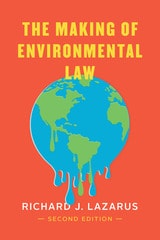
The Making of Environmental Law
Richard J. Lazarus
University of Chicago Press, 2022
How did environmental law first emerge in the United States? Why has it evolved in the ways that it has? And what are the unique challenges inherent to environmental lawmaking in general and in the United States in particular?
Since its first edition, The Making of Environmental Law has been foundational to our understanding of these questions. For the second edition, Richard J. Lazarus returns to his landmark book and takes stock of developments over the last two decades. Drawing on many years of experience on the frontlines of legal and policy battles, Lazarus provides a theoretical overview of the challenges that environmental protection poses for lawmaking, related to both the distinctive features of US lawmaking institutions and the spatial and temporal dimensions of ecological change. The book explains why environmental law emerged in the manner and form that it did in the 1970s and traces how it developed over sequent decades through key laws and controversies. New chapters, composing more than half of the second edition, examine a host of recent developments. These include how Congress dropped out of environmental lawmaking in the early twenty-first century; the shifting role of the judiciary; long-overdue efforts to provide environmental justice to disadvantaged communities; and the destabilization of environmental law that has resulted from the election of Presidents with dramatically clashing environmental policies.
As the nation’s partisan divide has grown deeper and the challenge of climate change has dramatically raised the perceived stakes for opposing interests, environmental law is facing its greatest challenges yet. This book is essential reading for understanding where we have been and what challenges and opportunities lie ahead.
Who Really Makes Environmental Policy?
Creating and Implementing Environmental Rules and RegulationsEdited by Sara R. Rinfret
Temple University Press, 2021
The United States Congress appears to be in perpetual gridlock on environmental policy, notes Sara Rinfret, editor of the significant collection, Who Really Makes Environmental Policy? As she and her contributors explain, however, most environmental policy is not made in the halls of Congress. Instead, it is created by agency experts in federal environmental agencies and it is implemented at the state level. These individuals have been delegated the authority to interpret vague congressional legislation and write rules—and these rules carry the same weight as congressional law.
Who Really Makes Environmental Policy? brings together top scholars to provide an explanation of rulemaking processes and regulatory policy, and to show why this context is important for U.S. environmental policy. Illustrative case studies about oil and gas regulations in Colorado and the regulation of coal ash disposal in southeastern states apply theory to practice. Ultimately, the essays in this volume advance our understanding of how U.S. environmental policy is made and why understanding regulatory policy matters for its future.