Results by title
9 books match the query 'Environmental literature'
Ecosublime
Environmental Awe and Terror from New World to OddworldLee Rozelle
University of Alabama Press, 2006
Explores 19th-century, modern, postmodern, and millennial texts as they portray the changing ecological face of America
Lee Rozelle probes the metaphor of environmental catastrophe in American literature of the last 150 years. In each instance, Rozelle finds evidence that the ecosublime--nature experienced as an instance of wonder and fear--profoundly reflects spiritual and political responses to the natural world, America’s increasingly anti-ecological trajectory, and the ascendance of a post-natural landscape.
In the 19th century, Rozelle argues, Isabella Bird and Edgar Allan Poe represented the western wilderness as culturally constructed and idealized landscapes. Gardens, forests, and frontiers are conceptual frameworks that either misrepresent or uphold ecological space. Modernists like Nathanael West and William Carlos Williams, on the other hand, portray urban space as either wastelands or mythical urban gardens. A chapter on Charles W. Chesnutt and Rebecca Harding Davis analyzes a new breed of literary eco-advocate, educating and shocking mainstream readers through depictions of ecological disaster. A later chapter probes the writings of Edward Abbey and the Unabomber Manifesto to delve into the sublime dimensions of environmental activism, monkey-wrenching, and eco-terrorism.
Environment and Narrative
New Directions in EconarratologyEdited by Erin James and Eric Morel
The Ohio State University Press, 2020
To explore the methodological possibilities within “econarratology,” the contributors evaluate the mechanics of how narratives convey environmental understanding via building blocks such as the organization of time and space, characterization, focalization, description, and narration. They also query how readers emotionally and cognitively engage with such representations and how the process of encountering different environments in narratives stands to affect real-world attitudes and behaviors. By positioning narratives as important repositories of values, political and ethical ideas, and behaviors that determine how we engage with our ecological homes, the authors in this volume suggest that to change the way that we interact with the environment requires not only new stories but also a better understanding of the ones that have long been in circulation.
Foundations of Stream and River Ecology
A Guide to the Classic LiteratureEdited by Wyatt F. Cross, Jonathan P. Benstead, Amy M. Marcarelli, and Ryan A. Sponseller
University of Chicago Press, 2024
The study of streams and rivers combines ecology, chemistry, hydrology, and geology to reveal the factors that control the biological diversity and functioning of these unique ecosystems. Although stream ecology is a relatively young discipline, foundational papers published over the past half century have shaped our current understanding of these ecosystems and have informed our efforts to manage and protect them. Organized by topics such as the physical template, community structure, food webs, ecosystem energetics, and nutrient dynamics, the chapters of this book offer summaries of the key literature, historical and contextual information, and insightful discussions of how past research has influenced present studies and may shape future work.
Getting Over the Color Green
Contemporary Environmental Literature of the SouthwestScott Slovic
University of Arizona Press, 2001
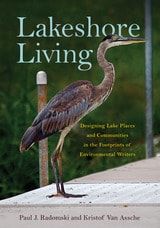
Lakeshore Living
Designing Lake Places and Communities in the Footprints of Environmental WritersPaul J. Radomski
Michigan State University Press, 2014
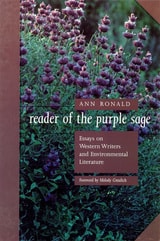
Reader Of The Purple Sage
Essays On Western Writers And Environmental LiteratureAnn Ronald
University of Nevada Press, 2003
Literary scholar Ann Ronald gathers her most notable published essays about Nevada, environmental writing, and Western American literature in one volume. These essays reflect Ronald’s wide-ranging interests. Here are deeply informed, critical essays on writers as diverse as Zane Gray, Edward Abbey, Wallace Stegner, and Terry Tempest Williams, as well as the Tonopah Ladies—a group of literary women who found their voices in the unlikely setting of a mining boomtown—and on such varied topics as the image of Reno in nineteenth- and twentieth-century fiction. Included are several recent essays in which Ronald thoughtfully discusses the burgeoning field of environmental writing, some of its principal themes and concerns, and its best-known practitioners.
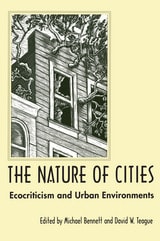
The Nature of Cities
Ecocriticism and Urban EnvironmentsMichael Bennett
University of Arizona Press, 1999
The editors—both raised in small towns but now living in major urban areas—are especially concerned with the sociopolitical construction of all environments, both natural and manmade. Following an opening interview with Andrew Ross exploring the general parameters of urban ecocriticism, they present essays that explore urban nature writing, city parks, urban "wilderness," ecofeminism and the city, and urban space. The volume includes contributions on topics as wide-ranging as the urban poetry of English writers from Donne to Gay, the manufactured wildness of a gambling casino, and the marketing of cosmetics to urban women by idealizing Third World "naturalness." These essays seek to reconceive nature and its cultural representations in ways that contribute to understanding the contemporary cityscape. They explore the theoretical issues that arise when one attempts to adopt and adapt an environmental perspective for analyzing urban life.
The Nature of Cities offers the ecological component often missing from cultural analyses of the city and the urban perspective often lacking in environmental approaches to contemporary culture. By bridging the historical gap between environmentalism, cultural studies, and urban experience, the book makes a statement of lasting importance to the development of the ecocritical movement.
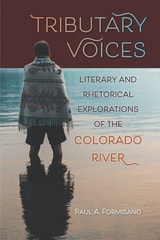
Tributary Voices
Literary and Rhetorical Exploration of the Colorado RiverPaul A. Formisano
University of Nevada Press, 2022
Through literary, rhetorical, and historical analysis of some of the Colorado River’s lesser-known stakeholders, Tributary Voices considers a more comprehensive approach to river management on the eve of the one-hundredth anniversary of the signing of the Colorado River Compact, which governs the allocation of water rights to the seven states in the region. Ranging from the early twentieth century to the present, Tributary Voices examines nature writing, women’s narratives, critiques of dam development, the Latina/o communities’ appeals for river restoration, American Indian authors’ and tribal nations’ claims of water sovereignty, and teachings about environmental stewardship and provident living. This innovative study models an interdisciplinary approach to water governance and reinvigorates our imagination in achieving a more sustainable water ethic.
What's Nature Worth
Terre Satterfield
University of Utah Press, 2004