Results by title

30 books match the query 'Aquinas'
cover of A Brief Life of Aquinas: The Theologian in His Context

A Brief Life of Aquinas

The Theologian in His Context

Jean-Pierre Torrell

Catholic University of America Press, 2024
Jean-Pierre Torrell, OP, who has already written the most highly-regarded contemporary two-volume introduction to the life and works of Saint Thomas, has composed a shorter book that captures the essence of the career of the Angelic Doctor for a more general audience. Torrell follows a biographical outline of the saint, although he also includes brief accounts of what the author takes to be the most important features of Aquinas's teachings. Part biography, part travelogue, part theology, Jean-Pierre Torrell, OP’s A Brief Life of Thomas Aquinas is a multi-faceted look at the life and the writings of Saint Thomas Aquinas. Torrell’s hope is that his biography of the doctor communis intertwined with his theological examination of Aquinas’s writings will enable the reader to understand the person behind the writer and the writer behind the person. Aquinas’s life, Torrell claims, can shed light on his work with respect not only to their number, or to the varied topics he writes about, but to their content as well. It would be inaccurate to view Aquinas hiding behind a mountain of books in the cells he occupied in the various houses he inhabited around the Dominican world. He taught, he preached, he debated, he faced a number of conflicts of ideas that were not of his own making, but out of which would come some of his best-known writings. Torrell’s unique approach makes accessible one of the greatest minds of our tradition and the richness of the legacy he left the Church.
[more]
cover of Aquinas and Analogy

Aquinas and Analogy

Ralph McInerny

Catholic University of America Press, 1996
The basic distinctions McInerny introduces, his criticism of the central piece in the literature, Cajetan's De nominum analogia, the applications he makes to problems such as that of the nature of metaphysics or of logic, his knowledge of contemporary debates on related topics, combine to make his contribution unique
[more]
cover of Aquinas and Sartre: On Freedom, Personal Identity, and the Possibility of Happiness

Aquinas and Sartre

On Freedom, Personal Identity, and the Possibility of Happiness

Stephen Wang

Catholic University of America Press, 2009
Thomas Aquinas and Jean-Paul Sartre are usually identified with completely different philosophical traditions: intellectualism and voluntarism. In this original study, Stephen Wang shows, instead, that there are some profound similarities in their understanding of freedom and human identity.
[more]
cover of Aquinas and the Cry of Rachel

Aquinas and the Cry of Rachel

John F.X. Knasas

Catholic University of America Press, 2013

In Aquinas and the Cry of Rachel , John F. X. Knasas explores Thomas Aquinas's philosophical thinking about evil, and brings the results into discussion with the contemporary theodicies - philosophies of the problem of evil. It examines the relation of the human person and human nature to nature as a whole.


Generally speaking, possible philosophical accounts for evil are two kinds: cosmological or personal. The cosmological account has evils rebounding to the perfection of creation. The personal account would have evils suffered rebounding to the good of the sufferer. Knasas argues that for Aquinas no philosophical resolution of these two kinds of accounts
is possible. This argument is based upon Aquinas's understanding of the human as an intellector of analogical being. Such an understanding establishes two truths. First, the human is by nature only a principal part of the created whole. Second, there is the philosophically discernible possibility of supernatural elevation by the creator.


Hence, as far as philosophy can discern, evil may have a natural explanation or it may have a supernatural one. The Thomistic philosopher has no answer as to why evil exists because that philosopher discerns too many possible ones. In that respect, Aquinas's thinking on evil is similar to his thinking about the philosophical knowledge of the biblical
truth of the world's creation in time. Such a creation is one metaphysical possibility among others. Some authors that Aquinas and the Cry of Rachel considers are: Anthony Flew and Albert Camus, Jacques Maritain and Charles Journet, William Rowe, Marily McCord Adams, William Hasker, John Hick, David Ray Griffin, David Hume, Diogenes Allen, J. L. Mackie, Alvin Plantinga, Richard Swinburne, Bruce Reichenbach,
Brian Davies, and Eleonore Stump.
[more]
cover of Aquinas and the Early Chinese Masters: Chinese Philosophy and Catholic Theology

Aquinas and the Early Chinese Masters

Chinese Philosophy and Catholic Theology

Joshua Brown

Catholic University of America Press, 2025
Aquinas and the Early Chinese Masters lays intellectual foundations for the integration of Chinese philosophy into Catholic theology. Although Catholic theology in Chinese contexts has drawn upon Chinese philosophical concepts, few have attempted to develop a rigorous, systematic approach to testing what in the Chinese philosophical traditions can be fruitful or unfruitful for Catholic theological expression. This book attempts to model such an approach by engaging classical Chinese philosophy with the mind and spirit of St. Thomas Aquinas, who read Aristotle and other pagan philosophers with both charitable appreciation and a firm, critical eye. It applies this Thomistic lens through concrete comparative engagements with three main representatives of early Chinese philosophy: Mencius (Mengzi孟子), Xunzi荀子, and Mozi墨子. In each chapter, the book presents Aquinas’ thought as an evaluative frame for perceiving how Chinese philosophical commitments and concepts do or do not seem fit for adoption into Catholic theological science. Following the general structure of the Summa theologiae, the book is comprised of six chapters touching on the doctrine of God, morality, and Christology. The first two chapters engage Confucian master Mengzi’s notion of Heaven (Tian天), and then the Mohist doctrine of Heaven’s Will (Tian zhi天志). Chapter three provides a Thomistic assessment of the two main positions in the classical Confucian debate on the goodness of man’s moral nature (renxing人性). Chapter four compares Aquinas’ account of charity and Mozi’s doctrine of “universal love” (jian ai兼愛). Chapter 5 offers a Thomistic assessment of the possibility of understanding Christ in terms of Xunzi’s “sage” (shengren聖人). Finally, Chapter 6 explores Christ as a moral teacher by putting Aquinas’ reading of Matt 8:21-22 into conversation with Confucian ethics of filial virtue.
[more]
cover of Aquinas and the Platonist Tradition

Aquinas and the Platonist Tradition

Fran O'Rourke

Catholic University of America Press, 2026
Aquinas and the Platonist Tradition studies a variety of central topics to illustrate the pervasive influence of Platonism and Neoplatonism in the philosophy of St Thomas. The overall thesis is that Aquinas combined the transcendent impulse of Platonism with the natural sensibility of Aristotle; his deepest metaphysical intuitions are unmistakably Platonist. While Aquinas followed Aristotle in epistemology, his deeper insights were more in tune with Plato. Adopting Aristotle’s method, he provided a more secure foundation for positions that was more characteristic of Plato. Fran O'Rourke notes the fundamental unity of Plato and Aristotle fashioned by Aquinas at a deeper level. The opening chapter deals in broad strokes with themes common to Plato and St Thomas. Direct influence is not always evident (Aquinas had limited knowledge of Plato’s writings), rather a shared interest in profound philosophical questions, approached separately on converging paths. Subsequent chapters deal in detail with particular questions, relying frequently on indirect Neoplatonic sources and interpretations, in particular St Augustine, Pseudo-Dionysius, and the author of the Liber de Causis. Central topics include the immortality of the soul, the nature of beauty, the status of evil, the names of God, Aquinas’ debt to Pseudo-Dionysius in the understanding of being/existence (esse) as intensive power (virtus essendi), the knowledge of transcendent reality, and the nature and ontological status of angels. O'Rourke's method is to begin each topic with a close reading of relevant texts from the entire corpus thomisticum. There followed a comparison and contrast with earlier authors and references to later influences. Each essay concludes with an evaluation, frequently criticizing the arguments involved. The studies are not merely historical, but aim to show the abiding philosophical relevance of the Platonist and Thomistic thought. There is a dearth of extended studies of the Platonist/Neoplatonist heritage of Aquinas. Many books refer in a general way to these influences, but none in an extended or systematic manner. While this book is a collection of diverse essays, it has nevertheless a comprehensive unity. It presents many new insights regarding the fundamental significance of Platonist/Neoplatonist aspects of Aquinas’ thought.
[more]
cover of Aquinas and the Theology of the Body

Aquinas and the Theology of the Body

Thomas Petri

Catholic University of America Press, 2016
Pope John Paul's Theology of the Body catecheses has garnered tremendous popularity in theological and catechetical circles. Students of the Theology of the Body have generally interpreted it as innovative not only in its presentation of the Church's teaching on marriage and sexuality, but also as radically advancing that teaching. Aquinas and the Theology of the Body offers a somewhat different interpretation. Fr. Thomas Petri argues that the philosophy and theology of Thomas Aquinas substantially contributed to John Paul's intellectual formation, which he never abandoned. A correct interpretation of the Theology of the Body requires, therefore, a thorough understanding of Thomistic anthropology and theology, which has been mostly lacking in commentaries on the pope's important contributions on the subject of marriage and sexuality.
[more]
cover of Aquinas on Crime

Aquinas on Crime

Charles P. Nemeth

St. Augustine's Press, 2008

Not much escapes the intellect and imagination of the Angelic Doctor, St. Thomas Aquinas. Whether it be love, children, education, moral reasoning, happiness or the proper dispositions for human existence, St. Thomas seems an expert in all of it. Crime and criminal conduct are no exceptions to this general tendency with him. Not only does he have much to say about it, what he relates is perpetually fresh and surely the bedrock of what is now taken for granted. In this short treatise, the focus targets St. Thomas’s criminal codification – his law of crimes.

Indeed the magnanimity of his crimes code is a subject matter not yet treated in any detail in the scholarly literature. While parts and pieces are covered in many quarters, the literature has yet to develop a systematic, codified examination of Thomistic criminal law. The essence of the endeavor is threefold: first, how does St. Thomas factor the nature of the human person into the concept of criminal culpability and personal responsibility; second, what types of criminal conduct does St. Thomas specifically delineate and define; and lastly, what is Thomas’s view of mitigation and defense, as well as the corresponding punishment meted out for criminal conduct? This short commentary zeroes in on Thomistic Criminal Law – a project which will illuminate the root, the heritage and the foundation of modern criminal codification.
[more]
cover of Aquinas on Emotion's Participation in Reason

Aquinas on Emotion's Participation in Reason

Nicholas Kahm

Catholic University of America Press, 2019
Aquinas on Emotion’s Participation in Reason aims to present Aquinas’s answer to the perennial and now popular question: In what way can the emotions be rational? For Aquinas, the starting point of this inquiry is Aristotle’s claim (EN. I. 13) that there are three parts to the soul: 1) the rational part, 2) the non-rational part which can participate in reason, and 3) the non-rational part that does not participate in reason. It is the extent to which the second part (the sense appetites, the seat of the emotions) participates in reason that the emotions can become rational. However, immediately after Aristotle introduces his tripartite division of the soul, he warns that one need not delve into the details of the division or the participation. Aquinas, however, ignores Aristotle, and uses his precise metaphysics of participation within in his sophisticated anthropology to great effect in his ethics. Unlike Aristotle, to fully understand Aquinas’s thinking on how the emotions can become rational, we simply must delve into the kinds of precisions that Aristotle thinks are misplaced. When Aquinas’s views emerge from these precisions, he has a surprisingly level-headed and commonsense view of how the emotions can become rational. On this point, he is more pessimistic than Aristotle and more optimistic than Kant; he is certainly not, as is he is often thought to be, the faithful follower of Aristotle and the polar opposite of Kant. Nicholas Kahm argue that Aquinas has a realistic and plausible view of how far reason can go in shaping our emotions. Furthermore, his plausible views can accommodate the serious current challenge raised against virtue ethics from social psychology. The method has mainly been a careful reading of primary texts, but unlike the rest of the scholarship on Aquinas’s ethics, Kahm is particularly sensitive to Aquinas’s historical and philosophical development.
[more]
cover of Aquinas on Imitation of Nature: Source of Principles of Moral Action

Aquinas on Imitation of Nature

Source of Principles of Moral Action

Wojciech Golubiewski

Catholic University of America Press, 2022
Aquinas on Imitation of Nature highlights and explores the doctrine of the imitation of nature, a crucial aspect of Aquinas’ metaethics and fills the gap in research on Aquinas’ moral doctrine and theory of action. It conveys Aquinas’ doctrine of the imitation of nature as a natural feature of right practical reason regarding moral thinking and action, indeed as an indispensable feature of virtuous flourishing in individual and communal aspects of human life. The book starts with an overview of some of recent interpretations of Aquinas’ moral doctrine and natural law, introducing the need to explore the role of the imitation of nature in human practical reasoning and action in this area of Aquinas’ teaching. The chapters that follow are based on a careful reading of selected texts of Aquinas, and gradually develop a thorough and comprehensive picture of his doctrine of the imitation of nature as a source of practical principles. The final chapter provides various examples of how Aquinas understands the imitation of nature in the realm of moral reasoning and action. The originality of this volume comes from its account of Aquinas’ medieval doctrine of the imitation of nature, in light of which the principles of right practical reason and virtuous action are congruent with and epistemologically dependant upon the basic terms of the movements of natural, sensible, non-rational agents. Through its thorough reading of Aquinas on the imitation of nature, the book aims to open new ways of appropriation of the metaphysical and natural tenets of his moral doctrine in the areas of theory of action, practical reason, natural law, and contemporary virtue ethics.
[more]
cover of Aquinas on Prophecy: Wisdom and Charism in the <i>Summa Theologiae</i>

Aquinas on Prophecy

Wisdom and Charism in the <i>Summa Theologiae</i>

Paul M. Rogers

Catholic University of America Press, 2023
Aquinas on Prophecy argues that a lacuna exists (especially among Anglophone scholars of Aquinas) that neglects to identify his most famous work as a prophetic witness to the transformative effect of Christian theology. Through a detailed examination of Aquinas’s treatment of prophecy in the Summa Theologiae (II-II, QQ.171-174), Paul Rogers reveals how prophetic testimony is central to the understanding of Christian revelation, faith, and theology, since it presents an initial (and historically-rooted) model for a Christian pedagogy that attempts to affect intellectual and moral transformation through communicating knowledge about God. The theologian thus conceived by Aquinas exercises analogously a prophetic, and hence social, function among Christian believers that has a special care for their spiritual and moral guidance. In contrast to readings of Aquinas that portray him as overly reliant on Aristotelian gnoseology (e.g., Jenkins 1997), Rogers lays out a reading more in line with recent ‘ressourcement’ Thomistic interpreters that identifies in his account of prophecy a creative adaptation of Arabic-Aristotelian gnoseology in the service of clarifying difficulties that had arisen in the thirteenth century surrounding the reception of a patristic (and predominantly Augustinian) tradition of prophetic illumination or vision. In the hands of Aquinas, the traditional Augustinian theory of prophetic illumination was re-envisioned and reinvigorated, which in turn allowed him to reassert confidently prophecy’s status as certain knowledge (scientia) that required its own distinct ‘light’, comparable to the light of natural reason and the lights of faith and glory. Highlighting prophecy in Aquinas’s thought helps especially to refocus today’s readers on how knowledge of the final end as revealed was for Aquinas the ultimate moral objective shared by both the prophet and theologian: a point that is best appreciated when his account of prophecy is related back to his understanding of sacred doctrine and faith as a whole—the book’s central task.
[more]
cover of Aquinas on Transubstantiation

Aquinas on Transubstantiation

Reinhard Hutter

Catholic University of America Press, 2019
Aquinas on Transubstantiation treats one of the most frequently mis-understood and mis-represented teachings of Thomas Aquinas—Eucharistic transubstantiation. The study interprets Aquinas’s teaching as an exercise of “holy teaching” (sacra doctrina) that intends to show theologically and back up philosophically the simple yet profound thesis that “transubstantiation” affirms nothing but the truth of Christ’s words at the Last Supper—“This is my body,” “This is my blood.” Yet in order to achieve a contemporary ressourcement of this simple yet profound truth, it is necessary to probe the depths of Thomas Aquinas’s philosophical interpretation of it. For Thomas Aquinas, in regarding the truth of Eucharistic conversion, it is faith that preserves the human intellect from missing or dismissing the mystery announced in Christ’s words. Faith, however, is not intellectually blind, a faith that, as is often erroneously held, is commanded by arbitrary divine dictates to which the will submits in blind obedience. Rather, Aquinas takes faith is sustained, but not constituted, by an intellectual contemplation of the proposed mystery of faith, by faith seeking understanding. Thomas Aquinas unfolds this exercise of understanding guided by faith in the medium of a metaphysical contemplation that affords a profound intellectual appreciation of this central mystery of faith—precisely as mystery. Thomas’s metaphysical contemplation of Eucharistic conversion gestures toward the blinding light of superintelligibility, experienced as the unique darkness that surrounds this sublime mystery of faith. A ressourcement in Thomas Aquinas’s doctrine of transubstantiation also affords an renewed appreciation of the Church’s affirmation of transubstantiation as the most apt term for the interpretation of the mystery of Eucharistic conversion and a greater precision of what is centrally at stake in this mystery in the ongoing ecumenical conversation of this most central Christian teaching. A doctrinally sound, ecumenically informed, and philosophically reflected contemporary Catholic theology cannot afford to ignore or dismiss Aquinas’s surpassing account of Eucharistic conversion.
[more]
cover of Aquinas on the Divine Ideas as Exemplar Causes

Aquinas on the Divine Ideas as Exemplar Causes

Gregory T. Doolan

Catholic University of America Press, 2008
Gregory T. Doolan provides here the first detailed consideration of the divine ideas as causal principles. He examines Thomas Aquinas's philosophical doctrine of the divine ideas and convincingly argues that it is an essential element of his metaphysics
[more]
cover of Aquinas on the Twofold Human Good: Reason and Human Happiness in Aquinas's Moral Science

Aquinas on the Twofold Human Good

Reason and Human Happiness in Aquinas's Moral Science

Denis J. M. Bradley

Catholic University of America Press, 1997
[more]
cover of Aquinas the Augustinian

Aquinas the Augustinian

Michael Dauphinais

Catholic University of America Press, 2007

The book is composed of eleven essays by an international group of renowned scholars from the United States, England, Switzerland, Holland, and Italy
[more]
cover of Aquinas, Wittgenstein, and the Riddle of Spiritual Pedagogy

Aquinas, Wittgenstein, and the Riddle of Spiritual Pedagogy

Matthew Dunch

Catholic University of America Press, 2027
How can Paul, or you and I for that matter, speak with authority about mystery? Using the language of sacred riddles, Aquinas, Wittgenstein, and the Riddle of Spiritual Pedagogy argues that spiritual authority arises within the creative tension between the mystery of God’s will and our concrete human circumstances. Since at least the Enlightenment and increasingly in times of scandal, spiritual authority is suspect. Speaking authoritatively about mystery seems like a contradiction. Critics accuse such authorities of being at best vapid or at worst manipulative. Using a philosophical approach, Matt Dunch, SJ, defends the tradition of Christian spiritual teaching from St. Paul, through St. John Cassian and St. Ignatius Loyola, to contemporaries such as Dorothy Day. He supplements St. Thomas Aquinas’s account of prudence and counsel with Ludwig Wittgenstein’s sensitivity to the context and limits of sensible speech. Taken together, they all give us their accounts of how spiritual teaching can emerge from sacred riddles. Spiritual authority is unlike other forms of authority because the mystery or riddle of God is outside human understanding. At the same time, spiritual authority must address our concrete needs. Dunch considers how such riddles might be lived with and through, though not solved. This book will be of interest to readers who love the nature and practice of religious language, including philosophers of religion, systematic theologians, and spiritual directors. It will speak to anyone contemplating sacred mysteries.
[more]
cover of Aquinas: God and Action

Aquinas

God and Action

David B. Burrell C.S.C.

University of Scranton Press, 2008
First published 30 years ago and long out of print, Aquinas: God and Action appears here for the first time in paperback. This classic volume by eminent philosopher and theologian David Burrell argues that Aquinas’s is not the god of Greek metaphysics, but a god of both being and activity. Aquinas’s plan in the Summa Theologiae, according to Burrell, is to instruct humans how to find eternal happiness through acts of knowing and loving. Featuring a new foreword by the author, this edition will be welcomed by philosophers and theologians alike.
 
[more]
cover of Before Truth: Lonergan, Aquinas, and the Problem of Wisdom

Before Truth

Lonergan, Aquinas, and the Problem of Wisdom

Jeremy Wilkins

Catholic University of America Press, 2018
It’s frequently said that we live in a “post-truth” age. That obviously can’t be true, but it does name a real problem on our hands. Getting things right is hard, especially if they’re complicated. It takes preparation, diligence, and honesty. Wisdom, according to Thomas Aquinas, is the quality of right judgment. This book is about the problem of becoming wise, the problem “before truth.” It is about that problem particularly as it comes up for religious, philosophical, and theological truth claims. Before Truth: Lonergan, Aquinas, and the Problem of Wisdom proposes that Bernard Lonergan’s approach to these problems can help us become wise. One of the special problems facing Christian believers today is our awareness of how much our tradition has developed. This development has occurred along a path shot through with contingencies. Theologians have to be able to articulate how and why doctrines, institutions, and practices that have developed—and are still developing—should nevertheless be worthy of our assent and devotion.
[more]
cover of Boethius and Aquinas

Boethius and Aquinas

Ralph McInerny

Catholic University of America Press, 2012
In this study of the relationship between Boethius and Thomas Aquinas, Ralph McInerny dispels the notion that Aquinas misunderstood the early philosopher and argues instead that he learned from Boethius, assimilated his ideas, and proved to be a reliable interpreter of his thought.
[more]
cover of History of Political Ideas, Volume 2 (CW20): The Middle Ages to Aquinas

History of Political Ideas, Volume 2 (CW20)

The Middle Ages to Aquinas

Eric Voegelin, Edited & Intro by Peter von Sivers

University of Missouri Press, 1997

Voegelin's magisterial account of medieval political thought opens with a survey of the structure of the period and continues with an analysis of the Germanic invasions, the fall of Rome, and the rise of empire and monastic Christianity. The political implications of Christianity and philosophy in the period are elaborated in chapters devoted to John of Salisbury, Joachim of Flora (Fiore), Frederick II, Siger de Brabant, Francis of Assisi, Roman law, and climaxing in a remarkable study of Saint Thomas Aquinas's mighty thirteenth-century synthesis.

Although History of Political Ideas was begun as a textbook for Macmillan, Voegelin never intended it to be a conventional chronological account. He sought instead an original comprehensive interpretation, founded on primary materials and taking into account the most advanced specialist scholarship—or science as he called it—available to him. Because of this, the book grew well beyond the confines of an easily marketable college survey and until now remained unpublished.

In the process of writing it, Voegelin himself outgrew the conceptual frame of a "History of Political Ideas," turning to compose Order and History and the other works of his maturity. History of Political Ideas became the ordered collection of materials from which much of Voegelin's later theoretical elaboration grew, structured in a manner that reveals the conceptual intimations of his later thought. As such, it provides an unparalleled opportunity to observe the working methods and the intellectual evolution of one of our century's leading political thinkers. In its embracing scope, History of Political Ideas contains both analyses of themes Voegelin developed in his later works and discussions of authors and ideas to which he did not return or which he later approached from a different angle and with a different emphasis.

The Middle Ages to Aquinas has withstood the test of time. What makes it still highly valuable is its thoroughly revisionist approach, cutting through all the convenient clichés and generalizations and seeking to establish the experiential underpinnings that typified the medieval period.
[more]
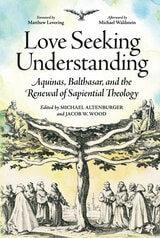
cover of Love Seeking Understanding: Aquinas, Balthasar, and the Renewal of Sapiential Theology

Love Seeking Understanding

Aquinas, Balthasar, and the Renewal of Sapiential Theology

Michael Altenburger

Catholic University of America Press, 2024
As Catholic theology emerged from the crisis of modernity, theologians turned to both patristic and medieval sources to recover lost wisdom from the theological tradition, and adapt it to the challenges of an age that separated reason from faith, the practice of theology from the spiritual life. . In time, Thomas Aquinas and Hans Urs von Balthasar became the patrons of two very different approaches to this challenge. St. Thomas Aquinas offering contemporary theologians an approach rooted in the patristic-medieval Latin synthesis of Augustine and Aristotle that also draws on the East, and von Balthasar offering contemporary theologians a patristic-modern approach rooted in the Eastern theological synthesis of Maximus the Confessor and Erich Przywara, that also draws on the West. Although Aquinas and Balthasar, together with their contemporary followers, sought to unite reason and faith, theology and prayer, contemporary Thomists and Balthasarians have tended to diverge widely from one another, often with a polemical spirit. How should one understand the theological genius of St. Thomas Aquinas and Hans Urs von Balthasar today? How can two of the greatest theologians in the Catholic tradition be brought together in more fruitful and peaceful dialogue? This edited volume comprises contributions from a range of scholars who elucidate the depth and breadth of two of the most prominent figures of the Catholic tradition today. A scholar from each school of thought contributes an essay on a particular theme: Metaphysics, Trinity, Revelation, Christology, Anthropology, Evil, and Eschatology. By presenting the two essays side by side, this volume provides the contemporary reader with an opportunity to better engage both thinkers and understand disagreements and areas for constructive movement forward. The tone of the volume is intentionally irenic, seeking points of constructive dialogue, and opening new pathways to the renewal of sapiential theology through a fruitful synthesis of Thomistic and Balthasarian thought.
[more]
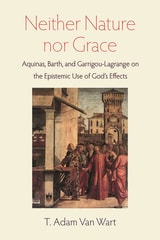
cover of Neither Nature nor Grace: Aquinas, Barth, and Garrigou-Lagrance on the Epistemic Use of God's Effects

Neither Nature nor Grace

Aquinas, Barth, and Garrigou-Lagrance on the Epistemic Use of God's Effects

T. Adam Van Wart

Catholic University of America Press, 2021
Neither Nature nor Grace operates at the intersection of systematic and philosophical theology, exploring in particular how St. Thomas Aquinas variously uses the latter in service to the clarification and faithful advancement of the former. More specifically, Neither Nature nor Grace explores the overlooked logical difficulties that have followed the late modern debates in ecumenical Christian theology as to whether knowledge of God is available solely through God’s gracious self-revelation (e.g., Jesus Christ and Holy Scripture), or through revelation and the deliverances of natural reason. Van Wart takes the prominent French Dominican Reginald Garrigou-Lagrange as paradigmatic for the case that knowledge of God can be had by both revelation and natural reason. Representing the opposing position, that God can only be known through divine revelation, Van Wart highlights the work of influential Protestant theologian Karl Barth. By placing these two imposing 20th century theologians in conversation, and by providing a careful theo-philosophical analysis of the logical mechanics of each thinker’s respective arguments, Van Wart shows how both inadvertently overreach their self-professed epistemological bounds and just so run into significant problems maintaining the coherence of their relative theological positions. That is, against their expressed intentions to the contrary, both thinkers unwittingly evacuate the divine essence of the mystery Christian tradition has always previously claimed it to have, effectively reducing the being of God to mere creaturely being writ large. As a contrasting corrective to this problem, Van Wart proffers a constructive grammatical reading of Aquinas’s measured account of the crucial but often overlooked logical differences between what can be said of the divine, on the one hand, versus what can be known of God, on the other. While many recent works have attempted to solve the ongoing arguments which Garrigou-Lagrange and Barth epitomize regarding the epistemic use of God’s effects, Van Wart’s contribution constructively pushes the conversation to a different level in showing how Aquinas’s grammar of God provides a salutary means of dissolving and moving beyond these contentious debates altogether.
[more]
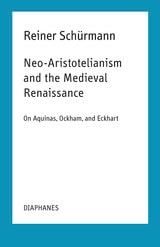
cover of Neo-Aristotelianism and the Medieval Renaissance: On Aquinas, Ockham, and Eckhart

Neo-Aristotelianism and the Medieval Renaissance

On Aquinas, Ockham, and Eckhart

Reiner Schürmann

Diaphanes, 2020

In this lecture course, Reiner Schürmann develops the idea that, in between the spiritual Carolingian Renaissance and the secular humanist Renaissance, there was a distinctive medieval Renaissance connected with the rediscovery of Aristotle. Focusing on Thomas Aquinas’s ontology and epistemology, William of Ockham’s conceptualism, and Meister Eckhart’s speculative mysticism, Schürmann shows how thought began to break free from religion and the hierarchies of the feudal, neo-Platonic order and devote its attention to otherness and singularity. A crucial supplement to Schürmann’s magnum opus Broken Hegemonies, Neo-Aristotelianism and the Medieval Renaissance will be essential reading for anyone interested in the rise and fall of Western principles, and thus in how to think and act today.
[more]
cover of Resilience and the virtue of fortitude: Aquinas in Dialogue with the Psychosocial Sciences

Resilience and the virtue of fortitude

Aquinas in Dialogue with the Psychosocial Sciences

Craig Steven Titus

Catholic University of America Press, 2006
The book offers a renewed, classic vision of the human person and the ordering of the sciences as read through the complementary and, at one level, corrective insights of empirical psychosocial studies on resilience.
[more]
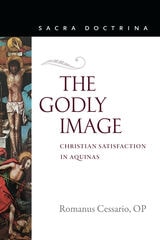
cover of The Godly Image: Christian Satisfaction in Aquinas

The Godly Image

Christian Satisfaction in Aquinas

Romanus Cessario

Catholic University of America Press, 2020
Christian satisfaction stands at the center of the Church’s teaching about salvation. Satisfaction pertains to studies about Christ, redemption, the Sacraments, and pastoral practice. The topic also enters into questions about God and the creature as well as about the divine mercy and providence. Somewhat neglected in the period after Vatican II, satisfaction now appears to scholars as the forgotten key to entering deeply into the mystery of Christ and his work. Seminarians especially will benefit from studying the place satisfaction holds in Catholic life. Further, ecumenical work requires a proper understanding of the place that satisfaction holds in Christian theology. Various factors operative since the sixteenth century have worked to displace satisfaction almost entirely from reformed practice and theology. To address such concerns, The Godly Image, has, over the past several decades and more, done a great deal to put satisfaction within its proper context of image-restoration. That is, to interpret satisfaction within the context of the divine mercy and not the divine justice. This unique contribution to satisfaction studies owes a great deal to the achievement of Saint Thomas Aquinas. In this sense, the book enacts a retrieval of the theology of the high classical period. Like much of Aquinas’s refined teaching, a proper understanding requires appeal to the commentatorial tradition that follows him. Interested students will find in this study the touchstones for further studies of these authors. The Godly Image aims also to distinguish the theology of Aquinas from that of the medieval author with whom the notion of satisfaction remains mostly identified, that is, Anselm of Canterbury. Although not a developed focus of the book’s contents, the attentive reader will recognize that Aquinas treats Saint Anselm with a reverential reading, even as the Common Doctor moves significantly away from interpretations of satisfaction that suggest that an angry God exacts from his innocent Son a painful substitutional penalty for a fallen human race.
[more]
cover of The Logic of Desire: Aquinas on Emotion

The Logic of Desire

Aquinas on Emotion

Nicholas E. Lombardo, O.P.

Catholic University of America Press, 2011
Focusing on the Summa theologiae, Nicholas Lombardo contributes to the recovery, reconstruction, and critique of Aquinas's account of emotion in dialogue with both the Thomist tradition and contemporary analytic philosophy
[more]
cover of The Metaphysical Foundations of Love: Aquinas on Participation, Unity, and Union

The Metaphysical Foundations of Love

Aquinas on Participation, Unity, and Union

Anthony T. Flood

Catholic University of America Press, 2018
The Metaphysical Foundations of Love: Aquinas on Participation, Unity, and Union offers a systematic treatment of St. Thomas Aquinas’s account of the metaphysical relations of unity-to-union and unity-to-participation in God as the key structuring elements to the nature of love and friendship. In general, Aquinas identifies love as the source and summit of the life of each human being. Everything in the created realm issues forth from God’s creative love, and the ultimate end of all human persons is the greatest possible union with God. Aquinas contends that the love of friendship allows for the greatest union between two persons; thus, the greatest union with God takes the form of friendship with him.
[more]
cover of The Suffering Servant in Aquinas: Isaiah 53 and Thomas's Theology of Christ's Passion

The Suffering Servant in Aquinas

Isaiah 53 and Thomas's Theology of Christ's Passion

Daniel R. Waldow

Catholic University of America Press, 2024
The “Suffering Servant” text of Isaiah 53 is a perennial topic of debate within Jewish and Christian biblical theology. Is the Suffering Servant an individual, a group, or both? How and why did he suffer? What role did God play in his suffering? How is his suffering related to human salvation? The answers to these questions often divide Jewish and Christian readers of Scripture as well as Christians across different denominations. In particular, Isaiah 53 tends to inform different Christian accounts of the origin, nature, and saving value of Christ’s Passion. The Suffering Servant in Aquinas contributes to the debate on the meaning of Isaiah 53 and its bearing upon the Passion of Christ by examining how St. Thomas Aquinas engaged this biblical text. This book examines every explicit reference to Isaiah 53 that Aquinas makes in his biblical commentaries, Commentary on the Sentences, Summa Theologiae, and Opuscula. It analyzes how and why Aquinas interprets Isaiah 53 in the ways that he does. It focuses especially upon how Aquinas draws upon Isaiah 53 to shed light on the saving mystery of Christ’s Passion. Readers will see how Aquinas articulates the relationship between God’s will and Christ’s suffering, the diverse forms of Christ’s pain, the degree to which the Passion can be considered a “punishment,” and the saving functions of the Passion as example, merit, satisfaction, and sacrifice. This book makes an original contribution to the growing field of Biblical Thomism. It examines Aquinas’s exegetical methods as well as the role of Scripture within his speculative theology. And it properly contextualizes Aquinas’s exegesis by considering the differences between his Latin version of Isaiah 53 and contemporary renderings of Hebrew and Greek versions. Readers will see that Aquinas’s Christological interpretations of Isaiah 53 are both exegetically intriguing and theologically rich.
[more]
cover of The Wayfarer's End: Bonaventure and Aquinas on Divine Rewards in Scripture and Sacred Doctrine

The Wayfarer's End

Bonaventure and Aquinas on Divine Rewards in Scripture and Sacred Doctrine

Shawn M. Colberg

Catholic University of America Press, 2020
The Wayfarer’s End follows the human person’s journey to union with God in the theologies of Saint Bonaventure and Saint Thomas Aquinas. It argues that these seminal thinkers of the 13th Century emphasize scriptural notions of divine rewards as ordering principles for the graced movement of human viators to eternal life. Divine rewards emerge as a fundamental category through the study’s emphasis on Thomas and Bonaventure as scriptural commentators and preachers whose work in sacra pagina structures the content of their sacra doctrina. Shawn Colberg places Bonaventure’s and Aquinas’s scriptural, dogmatic, and polemical works into conversation and illumines their mutually edifying depictions of the way to eternal life. Looking to the journey itself, The Wayfarer’s End demonstrates a nuanced understanding of the roles played by God and human beings in the movement to full beatitude. To that end, it explores the relationships between grace and human nature, the effects of sin on the human person, the vital themes of predestination, conversion, perseverance, and the place of “reward-worthy” human action within the overall movement toward union with God. While St. Bonaventure and St. Thomas both stress the priority of grace and divine action for the journey, the study also illustrates their distinct frameworks for human action, unpacking Bonaventure’s preference for the language of acceptatio versus Thomas’s emphasis on ordinatio. This difference inflects their language of rewards, their exposition of scripture, and the scope of free human action in the movement to union with God. This study places the two most seminal theologians of the 13th Century into conversation on central and enduring topics of Christian life. Such a comparative study has been sorely lacking in the field of studies on Aquinas and Bonaventure. It offers insight to those interested in high scholastic thought, Franciscan and Dominican understandings of human salvation, and Thomist and Franciscan theology as it pertains to questions of the Reformation, including biblical exegesis on justification and sanctification. Above all, the study appreciates and foregrounds the richness of Bonaventure’s and Aquinas’s vocations: mendicant theologians concerned to share the fruits of contemplation with fellow friars and others seeking the goal of the wayfarer’s end.
[more]
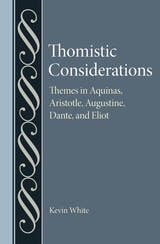
cover of Thomistic Considerations: Themes in Aquinas, Aristotle, Augustine, Dante and Eliot

Thomistic Considerations

Themes in Aquinas, Aristotle, Augustine, Dante and Eliot

Kevin White

Catholic University of America Press, 2026

This collection of essays considers a variety of themes in philosophy, theology, and poetry, three ways of thinking that share a certain openness and comprehensiveness. The essays show how philosophy, theology, and poetry are ways of thinking in the medium of words—in large part in the medium of written words—against the background of all things and from the point of view of all of human life. As the essays make clear, philosophy, theology, and poetry are special ways of thinking and speaking, but they are the contrary of specializations. Many of the themes are perennial preoccupations in philosophy: being, time, number, friendship, pleasure, purpose, choice, reason, and order. Others are particular concerns of theology and poetry, such as the divine presence and absence in the world, and poetic form. The volume is divided into two parts: a first part consisting of eight essays on themes in Aquinas’s work, and a second part consisting of five essays on other authors whose thought, in one way or another, has an affinity with the thought of Aquinas: Aristotle, Augustine, Anselm, Dante, T. S. Eliot, and Robert Sokolowski. The volume’s title pays homage to Aquinas’s use of the Latin word consideratio, a favorite term of the scholastics that could refer to any careful attending to what one knows. The essays illustrate ways in which considerations undertaken in philosophy, theology, and poetry provide points of survey from which to take in, to the extent we can, the great panorama of the whole of things.
[more]