Results by title
8 books match the query 'Eros'
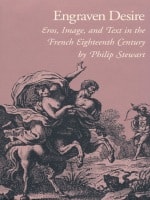
Engraven Desire
Eros, Image, and Text in the French Eighteenth CenturyPhilip Stewart
Duke University Press, 1992
Focusing on the objectification of women by the “male gaze,” Stewart analyzes the varous ways in which this masculine power is simultaneously represented and veiled: the fascination with women playing “male” roles, such as soldiers; the preponderance of voyeuristic images of the naked female body; the transformation of male power into hostile forces of nature that render women helpless. Further, Stewart shows how “indecent” engravings that purported to test the limits of eighteenth-century morality often merely reinforced prevailing images of women.
Addressing critical concerns about the societal enforcement of gender roles in literature along with essential questions about the function of illustration, Engraven Desire provides surprising insight into the culturally conditioned act of reading. Stewart’s work, itself richly illustrated with hundreds of arresting reproductions, makes a significant contribution to our understanding of the interplay of art, literature, and society.
Eros and Inwardness in Vienna
Weininger, Musil, DodererDavid S. Luft
University of Chicago Press, 2003
According to Luft, Otto Weininger viewed human beings as bisexual and applied this theme to issues of creativity and morality. Robert Musil developed a creative ethics that was closely related to his open, flexible view of sexuality and gender. And Heimito von Doderer portrayed his own sexual obsessions as a way of understanding the power of total ideologies, including his own attraction to National Socialism. For Luft, the significance of these three writers lies in their understandings of eros and inwardness and in the roles that both play in ethical experience and the formation of meaningful relations to the world-a process that continues to engage artists, writers, and thinkers today.
Eros and Inwardness in Vienna will profoundly reshape our understanding of Vienna's intellectual history. It will be important for anyone interested in Austrian or German history, literature, or philosophy.
Eros and Magic in the Renaissance
Ioan P. Couliano
University of Chicago Press, 1987
Renaissance magic, according to Ioan Couliano, was a scientifically plausible attempt to manipulate individuals and groups based on a knowledge of motivations, particularly erotic motivations. Its key principle was that everyone (and in a sense everything) could be influenced by appeal to sexual desire. In addition, the magician relied on a profound knowledge of the art of memory to manipulate the imaginations of his subjects. In these respects, Couliano suggests, magic is the precursor of the modern psychological and sociological sciences, and the magician is the distant ancestor of the psychoanalyst and the advertising and publicity agent.
In the course of his study, Couliano examines in detail the ideas of such writers as Giordano Bruno, Marsilio Ficino, and Pico della Mirandola and illuminates many aspects of Renaissance culture, including heresy, medicine, astrology, alchemy, courtly love, the influence of classical mythology, and even the role of fashion in clothing.
Just as science gives the present age its ruling myth, so magic gave a ruling myth to the Renaissance. Because magic relied upon the use of images, and images were repressed and banned in the Reformation and subsequent history, magic was replaced by exact science and modern technology and eventually forgotten. Couliano's remarkable scholarship helps us to recover much of its original significance and will interest a wide audience in the humanities and social sciences.
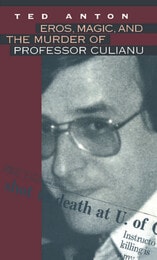
Eros, Magic, and the Murder of Professor Culianu
Ted Anton
Northwestern University Press, 1996
Winner of 1997 Carl Sandburg Award
On May 21, 1991, University of Chicago professor Ioan Culianu was murdered execution-style on campus. The crime stunned the school, terrified students, and mystified the FBI. The case remains unsolved. In Eros, Magic, and the Murder of Professor Culianu, award-winning investigative reporter Ted Anton shows that the murder is what Culianu's friends suspected all along: the first political assassination of a professor on American soil.
Eros, Wisdom, and Silence
Plato's Erotic DialoguesJames M. Rhodes
University of Missouri Press, 2003
Erotikon
Essays on Eros, Ancient and ModernEdited by Shadi Bartsch and Thomas Bartscherer
University of Chicago Press, 2005
An idea charged with paradox, eros has always defied categorization, and yet it cannot—it will not—be ignored. Erotikon aims to raise the difficult question of what, if anything, unifies the erotic manifold. How is eros in a sculpture like eros in a poem? Does the ancient story of Cupid and Psyche still speak meaningfully to modern readers, and if so, why? Is Plato's eros the same as Freud's? Or Proust's? And what is the erotic dimension in Nietzsche's thought? While each essay takes on a specific issue, together they constitute a wide-ranging conversation in which these broader questions are at play. A compilation of the latest, best efforts to reckon with eros, Erotikon will appeal not just to scholars and educators, but also to artists and critics, to the curious and the disillusioned, to the prurient and the prudent.
Posthumous Love
Eros and the Afterlife in Renaissance EnglandRamie Targoff
University of Chicago Press, 2014
Targoff shows that medieval notions of the somewhat flexible boundaries between love in this world and in the next were hardened by Protestant reformers, who envisioned a total break between the two. Tracing the narrative of this rupture, she focuses on central episodes in poetic history in which poets developed rich and compelling compensations for the lack of posthumous love—from Thomas Wyatt’s translations of Petrarch’s love sonnets and the Elizabethan sonnet series of Shakespeare and Spencer to the carpe diem poems of the seventeenth century. Targoff’s centerpiece is Romeo and Juliet, where she considers how Shakespeare’s reworking of the Italian story stripped away any expectation that the doomed teenagers would reunite in heaven. Casting new light on these familiar works of poetry and drama, this book ultimately demonstrates that the negation of posthumous love brought forth a new mode of poetics that derived its emotional and aesthetic power from its insistence upon love’s mortal limits.
The Song of Eros
Ancient Greek Love PoemsTranslated by Bradley P. Nystrom Illustrated by Claudette Sherbert Little
Southern Illinois University Press, 1991
This collection of new translations of eighty poems provides a pleasant, thought-provoking reminder of love’s vagaries as captured through the wit, charm, and insight of the master poets of antiquity.
All the emotions and experiences associated with love—rejection, infatuation, ecstasy, desperation, loneliness—are rendered accessible to contemporary readers through this lively, modern, yet faithful English translation of works that date from the seventh century B.C.to the sixth century A.D.Illustrations accompany the poetry of Plato, Sappho, Stratto, Meleagros, and others, capturing both the flavor of the age and the theme of the texts.