Results by title
9 books match the query 'Essence'
Fiction, Fact and Future
The Essence of EU DemocracyJames Elles
Haus Publishing, 2019
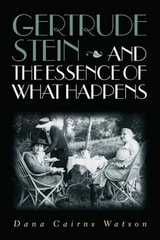
Gertrude Stein and the Essence of What Happens
Dana Cairns Watson
Vanderbilt University Press, 2005
Seeking to sustain Stein's lively, pleasant, populist spirit, Watson shows how the writer's playful entanglement of sight and sound--of silent reading and social speaking--reveals the crucial ambiguity by which reading and conversation build communities of meaning, and thus form not only personal relationships but also our very selves and the larger political structures we inhabit. Stein reminds us that the residual properties of words and the implications behind the give-and-take of ordinary conversation offer alternatives to linear structures of social order, alternatives especially precious in times of political oppression. For example, her novels Mrs. Reynolds and Brewsie and Willie, both written in embattled Vichy France, contemplate the speech patterns of totalitarian leaders and the ways in which everyday discourse might capitulate to--or resist--such verbal tyranny.
Like recent theorists, Stein recognized the repressiveness of conventional order--carried in language and thus in thought and social organization--but as Watson persuasively shows, she also insisted that the free will of individuals can persist in language and enable change. In the play of literary aesthetics, Stein saw a liberating force.
On "A Being" and "An Essence" (<i>De ente et essentia</i>)
Thomas Aquinas
Catholic University of America Press, 2026

Resistance
The Essence of the Islamist RevolutionAlastair Crooke
Pluto Press, 2009
This book traces the essence of the Islamist Revolution from its origins in Egypt, through Najaf, Lebanon, Iran and the Iranian Revolution to today. Alastair Crooke presents a compelling account of the ideas and energy which are mobilising the Islamic world.
Crooke argues that the West faces a mass mobilisation against the US-led Western project. The roots of this conflict are described in terms of religious themes that extend back over 500 years. They represent clashing systems of thinking and values. Islamists have a vision for the future of their own societies which would entail radical change from Western norms. Resistance is presented as the means to force Western behaviour to change and to expose the essential differences between the two modes of thinking.
This is a rigourous account that traces the threads of revolution of various movements, including the influence of 'political Shi'ism' and the Iranian Revolution and its impact on Hezbollah and Hamas.
Schelling’s Treatise on the Essence of Human Freedom
On Essence Human FreedomMartin Heidegger
Ohio University Press, 1985
Heidegger’s lectures delivered at the University of Freiburg in 1936 on Schelling’s Treatise On Human Freedom came at a crucial turning point in Heidegger’s development. He had just begun his study to work out the term “Ereignis.” Heidegger’s interpretation of Schelling’s work reveals a dimension of his thinking which has never been previously published in English.
While Schelling’s philosophy is less known than that of the other major German Idealists, Fichte and Hegel, he is one of the thinker with whom Heidegger has the most affinity, making this study fruitful for an understanding of both philosophers. Heidegger’s interpretation of On Human Freedom is the most straightforward of the studies to have appeared in English on the Treatise, and is the only work that is devoted to Schelling in Heidegger’s corpus. The basic problems at stake in Schelling’s Treatise lie at the very heart of the idealist tradition: the question of the compatibility of the system and individual freedom, the questions of pantheism and the justification of evil. Schelling was the first thinker in the rationalist-idealist tradition to grapple seriously with the problem of evil.
These are the great questions of the philosophical tradition. They lead Schelling and, with him, Heidegger, to possibilities that come very close to the boundaries of the idealist tradition. For example, Schelling’s concept of the “groundless”—what reason can no longer ground and explain—points back to Jacob Boehme and indirectly forward to the direction of Heidegger’s own inquiry into “Being.” Heidegger’s reading of Schelling, especially of the topics of evil and freedom, clearly shows Schelling’s influence on Heidegger’s views.
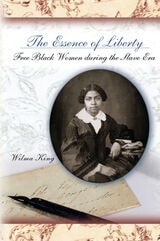
The Essence of Liberty
Free Black Women During the Slave EraWilma King
University of Missouri Press, 2006
The Essence of Liberty blends social, political, and economic history to analyze black women’s experience in both the North and the South, from the colonial period through emancipation. Focusing on class and familial relationships, King examines the myriad sources of freedom for black women to show the many factors that, along with time spent in slavery before emancipation, shaped the meaning of freedom. Her book also raises questions about whether free women were bound to or liberated from gender conventions of their day.
Drawing on a wealth of untapped primary sources—not only legal documents and newspapers but also the diaries, letters, and autobiographical writings of free women—King opens a new window on the world of black women. She examines how they became free, educated themselves, found jobs, maintained self-esteem, and developed social consciousness—even participating in the abolitionist movement. She considers the stance of southern free women toward their enslaved contemporaries and the interactions between previously free and newly freed women after slavery ended. She also looks closely at women’s spirituality, disclosing the dilemma some women faced when they took a stand against men—even black men—in order to follow their spiritual callings.
Throughout this engaging history, King underscores the pernicious constraints that racism placed on the lives of free blacks in spite of the fact that they were not enslaved. The Essence of Liberty shows the importance of studying these women on their own terms, revealing that the essence of freedom is more complex than the mere absence of shackles.
The Essence of Politics
Cees van der Eijk
Amsterdam University Press, 2018
This book is about the 'essence' of politics, which is introduced by way of key questions and concepts that are indispensable for understanding politics in many different settings.
The Essence of Strategic Giving
A Practical Guide for Donors and FundraisersPeter Frumkin
University of Chicago Press, 2010
In the face of global financial problems and stressed government budgets, the ability of private philanthropy to step in and help solve public problems—and support vital private institutions as well—has perhaps never been more important. But how can donors be sure their contributions will be effective? And how can fundraisers make their case for support in a way that is compelling and productive?
With The Essence of Strategic Giving, Peter Frumkin distills the lessons of his comprehensive, award-winning study, Strategic Giving, into a concise, practical guide for everyone involved in private philanthropy, from donors to managers of nonprofits to fund-raisers. He defines five critical challenges that all donors must address if their philanthropy is to amount to more than indiscriminate charity, including being aware of the time frame that guides a gift, specifying the intended impact being pursued, and recognizing how a donation fits with a donor’s own identity and style. Acknowledging and understanding these fundamental, strategic aspects of giving, Frumkin argues, will help ensure philanthropy that more effectively achieves its aims—and at the same time builds a lasting relationship between donors and the institutions they support.
As the next generation of donors wrestle with the challenge of effectively distributing what Andrew Carnegie called “surplus wealth,” Frumkin’s road map will be an indispensible resource for years to come.
Theater of Essence
Jan Kott
Northwestern University Press, 1986