Results by title
3 books match the query 'Essential History'
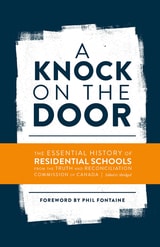
A Knock on the Door
The Essential History of Residential Schools from the Truth and Reconciliation Commission of CanadaUniversity of Manitoba Press, 2015
[more]
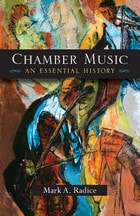
Chamber Music
An Essential HistoryMark A. Radice
University of Michigan Press, 2012
Intended for the music student, the professional musician, and the music lover, Chamber Music: An Essential History covers repertoire from the Renaissance to the present, crossing genres to include string quartets, piano trios, clarinet quintets, and other groupings. Mark A. Radice gives a thorough overview and history of this long-established and beloved genre, typically performed by groups of a size to fit into spaces such as homes or churches and tending originally toward the string and wind instruments rather than percussion. Radice begins with chamber music's earliest expressions in the seventeenth century, discusses its most common elements in terms of instruments and compositional style, and then investigates how those elements play out across several centuries of composers- among them Mozart, Bach, Haydn, and Brahms- and national interpretations of chamber music. While Chamber Music: An Essential History is intended largely as a textbook, it will also find an audience as a companion volume for musicologists and fans of classical music, who may be interested in the background to a familiar and important genre.
[more]
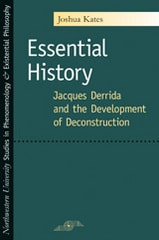
Essential History
Jacques Derrida and the Development of DeconstructionJoshua Kates
Northwestern University Press, 2005
However widely—and differently—Jacques Derrida may be viewed as a "foundational" French thinker, the most basic questions concerning his work still remain unanswered: Is Derrida a friend of reason, or philosophy, or rather the most radical of skeptics? Are language-related themes--writing, semiosis--his central concern, or does he really write about something else? And does his thought form a system of its own, or does it primarily consist of commentaries on individual texts? This book seeks to address these questions by returning to what it claims is essential history: the development of Derrida's core thought through his engagement with Husserlian phenomenology. Joshua Kates recasts what has come to be known as the Derrida/Husserl debate, by approaching Derrida's thought historically, through its development. Based on this developmental work, Essential History culminates by offering discrete interpretations of Derrida's two book-length 1967 texts, interpretations that elucidate the until now largely opaque relation of Derrida's interest in language to his focus on philosophical concerns.
A fundamental reinterpretation of Derrida's project and the works for which he is best known, Kates's study fashions a new manner of working with the French thinker that respects the radical singularity of his thought as well as the often different aims of those he reads. Such a view is in fact "essential" if Derrida studies are to remain a vital field of scholarly inquiry, and if the humanities, more generally, are to have access to a replenishing source of living theoretical concerns.
A fundamental reinterpretation of Derrida's project and the works for which he is best known, Kates's study fashions a new manner of working with the French thinker that respects the radical singularity of his thought as well as the often different aims of those he reads. Such a view is in fact "essential" if Derrida studies are to remain a vital field of scholarly inquiry, and if the humanities, more generally, are to have access to a replenishing source of living theoretical concerns.
[more]