Results by title

45 books match the query 'Ethics & Moral Teaching'
cover of Action and Conduct: Thomas Aquinas and the Theory of Action

Action and Conduct

Thomas Aquinas and the Theory of Action

Stephen Brock

Catholic University of America Press, 2021

"Both Thomistic scholars and analytic philosophers interested in theories of human action and accountability will find this book a welcome addition to their libraries. Truly a substantive addition to both Thomistic scholarship and the ongoing analytic investigation into human action and responsible agency."—American Catholic Philosophical Quarterly

"A first-rate book...Brock's lucid and illuminating analysis offers much of value to both intellectual historians and theologians, as well as philosophers."—Theological Studies"Brock's treatment of Aquinas's account of action exhibits a rare combination of rigor and learning. It is, no doubt, the best we have."—The Thomist
[more]
cover of Animal Theology

Animal Theology

Andrew Linzey

University of Illinois Press, 1995

“What are we to say of a theology which has so proceeded on the basis of a moral neglet of God’s creatures?” asks Andrew Linzey. In Animal Theology, he seeks ways in which doctrine can help morally motivated Christians to perceive meaning in animal suffering.

In Linzey’s view, animal rights is synonymous with animal theology. Linzey argues that historical theology, creatively defined, must reject humanocentricity. Questioning the assumption that if theology is to speak on this issue, “it must only do so on the side of the oppressors,” Linzey investigates not only the abstractions of theory, but also the realities of hunting, animal experimentation, and genetic engineering. His is a pioneering, vital, and unequivocally Christian voice advocating on behalf of the countless creatures who share our world and our lives but cannot speak for themselves.
[more]
cover of Aquinas's <i>Summa</i> and Jesuit Ethics: A Call for Ressourcement

Aquinas's <i>Summa</i> and Jesuit Ethics

A Call for Ressourcement

Justin M. Anderson

Catholic University of America Press, 2026
This book explores how the great sixteenth- and early-seventeenth-century Jesuits read the secunda pars of the Summa theologiae. Their interpretation of Aquinas’s moral theology is shaped in part by their historical context, including the impact of the Protestant Reformation and the European discovery of the "New World," as well as new trade routes with Asia. The essays in this volume explore a wide variety of topics, including the natural desire to see God, infused moral virtues, freedom of conscience, faith and justification, doctrinal development, just war, slavery, the virtue of religion, Eucharistic sacrifice, sexual ethics, the theology of vocation, and natural law. The essays engage the thought of Francisco Suárez, Gabriel Vázquez, Luis de Molina, Francisco de Toledo, and various others. The underlying argument of the book is that this erudite, deeply Catholic and broadly Thomistic approach to ethics should be retrieved, given its Christian seriousness. Guided by divine revelation as taught in Scripture and Tradition, moral theologians in the Jesuit tradition ground themselves in Aquinas and in a rich understanding of natural law, universal moral norms, and the virtues, as well as in appreciation for spiritual interiority, conscience, and discernment.
[more]
cover of Before Amoris Laetitia: The Sources of the Controversy

Before Amoris Laetitia

The Sources of the Controversy

Jaroslaw Kupczak

Catholic University of America Press, 2021
The publication of Pope Francis’ post-synodal apostolic exhortation, Amoris Laetitia started the most important theological debate in the Catholic Church since the end of the Second Vatican Council. The cardinals, bishops, theologians, priests, lay Catholics found themselves on the opposite sides of this crucial and complicated discussion. This book attempts to shed some light on this debate by tracing its genealogy. Since Amoris Laetitia is a post-synodal document, the large part of the book is devoted to the theological analysis of the two Synods of Bishops convoked by Pope Francis in the first years of his pontificate: the extraordinary in October 2014 and the ordinary that took place a year later. The main topics for the two synods were determined, however, in the speech given by Cardinal Walter Kasper during the cardinals consistory in February 2014 whose main aim was to prepare the possibility of admitting divorced persons who live in second unions to Holy Communion. The arguments of Cardinal Kasper are presented in the first chapter of the book and confronted with the most significant statements of the Magisterium of the Church on the issue of admittance to the Holy Communion. This book is a study at the intersection of Church history, the history of theology, and systematic theology: dogmatic and moral. Kupczak is interested in the chronology of the events connected to the two synods on the family but in the context of theological problems discussed therein: the theological significance of contemporary cultural changes; the relation of the Church to the world; the understanding of the indissolubility of the sacramental marriage and the Eucharist; the methods of ethically assessing human acts, particularly the concept of so-called intrinsically evil acts (intrinsece malum); and the relation of conscience to the general moral norm. The non-partisan ambition of this book is to serve as a “road map”— a help in navigation for the reader in the complicated discussions leading to publication of Amoris Laetitia. The uniqueness of this book consists in combining the historical analysis of the events leading to the publication of Amoris Laetitia with research of the theological discussion that ensued. Since Amoris Laetitia is a post-synodal exhortation, this book rests on the assumption that crucial for its understanding is a thorough analysis of its genealogy. Only in the light of this historical and theological perspective the debates surrounding Amoris Laetitia may be understood.
[more]
cover of Bioethics: A Catholic Primer

Bioethics

A Catholic Primer

Thomas Cavanaugh

Catholic University of America Press, 2026
Bioethics: A Catholic Primer is a succinct, precise, and accurate treatment of the Catholic moral tradition in medicine. Professors teaching an undergraduate bioethics course will use it as a primary text or as an ancillary text in a general ethics course that has a medical ethics section. Professors in both situations will find it an attractive alternative or addition to current offerings. This applies especially to those teaching at a Catholic-affiliated college or university. Professors teaching in pre-health­care professional, pre-medical, and in nursing programs (both undergraduate and graduate) will adopt this text both as a primary text and as an ancillary text, depending on their needs. Because of its slender, compact, yet rewarding content, professors will find it appealing to assign. Moreover, students will not find its size daunting. Its accuracy, precision, and small size will make it appealing to a more general audience. Moreover, by its brevity, it will gain an audience interested in Catholic med­ical ethics, yet often overwhelmed by the very size of the volumes available. People interested in an overarching, accurate, yet brief treatment of the Catholic moral tradition in medicine will read this slim volume (for exam­ple, members on ethics committees at Catholic hospitals). Others (faculty, students, patients, pastors, physicians, and nurses) will read it themselves and confidently share it with their friends and loved ones, knowing that they will find in it a rewarding, slender, accessible treatment of a rich moral tradition.
[more]
cover of Biomedicen and Beatitude: An Introduction to Catholic Bioethics, Second Edition

Biomedicen and Beatitude

An Introduction to Catholic Bioethics, Second Edition

Nicanor Pier Giorgio Austriaco

Catholic University of America Press, 2021
This timely and up to date new edition of Biomedicine and Beatitude features an entirely new chapter on the ethics of bodily modification. It is also updated throughout to reflect the pontificate of Pope Francis, recent concerns including ethical issues raised by the COVID-19 pandemic, and feedback from the many instructors who used the first edition in the classroom.
[more]
cover of Blood in the Fields: Óscar Romero, Catholic Social Teaching, and Land Reform

Blood in the Fields

Óscar Romero, Catholic Social Teaching, and Land Reform

Matthew Philipp Whelan

Catholic University of America Press, 2020
On March 24, 1980, a sniper shot and killed Archbishop Óscar Romero as he celebrated mass. Today, nearly four decades after his death, the world continues to wrestle with the meaning of his witness. Blood in the Fields: Óscar Romero, Catholic Social Teaching, and Land Reform treats Romero’s role in one of the central conflicts that seized El Salvador during his time as archbishop and that plunged the country into civil war immediately after his death: the conflict over the concentration of agricultural land and the exclusion of the majority from access to land to farm. Drawing extensively on historical and archival sources, Blood in the Fields examines how and why Romero advocated for justice in the distribution of land, and the cost he faced in doing so. In contrast to his critics, who understood Romero’s calls for land reform as a communist-inspired assault on private property, Blood in the Fields shows how Romero relied upon what Catholic Social Teaching calls the common destination of created goods, drawing out its implications for what property is and what possessing it entails. For Romero, the pursuit of land reform became part of a more comprehensive politics of common use, prioritizing access of all peoples to God’s gift of creation. In this way, Blood in the Fields reveals how close consideration of this conflict over land opened up into a much more expansive moral and theological landscape, in which the struggle for justice in the distribution of land also became a struggle over what it meant to be human, to live in society with others, and even to be a follower of Christ. Understanding this conflict and its theological stakes helps clarify the meaning of Romero’s witness and the way God’s work to restore creation in Christ is cruciform.
[more]
cover of By knowledge & by love: charity and knowledge in the moral theology of St. Thomas Aquinas

By knowledge & by love

charity and knowledge in the moral theology of St. Thomas Aquinas

Michael S. Sherwin

Catholic University of America Press, 2005
By Knowledge and By Love represents a major contribution to Thomistic moral theology and philosophy by providing a thoughtful examination of Aquinas' psychology of action and his theology of charity.
[more]
cover of Can AI Ever Be Human? Consciousness Explained

Can AI Ever Be Human? Consciousness Explained

Steven Umbrello

Catholic University of America Press, 2026
Can a machine ever truly be human? In an age where artificial intelligence writes poems, diagnoses illnesses, and converses with uncanny fluency, the line between human and machine seems to blur. Yet beneath the surface lies a fundamental distinction. Drawing on Bernard Lonergan’s insights as well as the rich Catholic intellectual tradition, Can AI Ever Be Human? argues that while machines can simulate aspects of human behavior, they cannot cross the threshold into genuine consciousness. O’Hara and Umbrello guide readers through the essential structures of human knowing: experience, understanding, judgment, and decision. In doing so, they show how each involves intentionality, self-awareness, and freedom. These uniquely human capacities cannot be reduced to algorithms or replicated by even the most advanced neural networks. The book also addresses pressing ethical and theological questions: What does it mean to be made in the image of God? How do we preserve human dignity in a world increasingly shaped by artificial intelligence? Far from being anti-technology, O’Hara and Umbrello affirm the value of AI as a tool that emulates a Turing machine, although constrained by Gödel’s theorem, while rejecting the illusion that it can replace human beings. Accessible yet rigorous, Can AI Ever Be Human? speaks to scholars, students, clergy, and general readers alike. It is essential reading for anyone interested in the intersection of technology, scientific methodology, philosophy, and theology, and for all who seek to understand what makes us irreducibly human in an era of rapid technological change.
[more]
cover of Can Ethics Be Christian?

Can Ethics Be Christian?

James M. Gustafson

University of Chicago Press, 1977

Is there a special relation between religious beliefs and moral behavior? In particular, is there a distinctive Christian moral character and how is this manifested in moral actions? The influential theologian James M. Gustafson probes these questions and offers an analysis of the distinctively religious reasons of the "heart and mind" which constitute the basis for a Christian ethics.

Professor Gustafson grounds his discussion in a concrete example of moral conduct which deeply impressed him. The incident—narrated in detail at the start and referred to throughout—concerns a nonreligious colleague who came to the aid of an intoxicated soldier. Although seemingly trivial, this incident, in the author's view, approximates the normal sorts of experiences in which individuals have to make moral decisions every day; it becomes a touchstone to investigate the logical, social, and religious elements in moral decision making.
[more]
cover of Christian America and the Kingdom of God: White Christian Nationalism from the Puritans through January 6, 2021

Christian America and the Kingdom of God

White Christian Nationalism from the Puritans through January 6, 2021

Richard T. Hughes and Christina Littlefield

University of Illinois Press, 2025

The myth of a Christian America fuels a powerful political force sure of its moral superiority and intent on implementing a Christian nationalist agenda. Richard T. Hughes and Christina Littlefield draw on discussions of civil religion and forms of nationalism to explore the complex legal and cultural arguments for a Christian America. The authors also provide an in-depth examination of the Bible’s words on the “chosen nation” and “kingdom of God” that Christian nationalists quote to support the idea of the US as a Christian nation.

A timely new edition of the acclaimed work, Christian America and the Kingdom of God spotlights how the centuries-long pursuit of a Christian America has bred an aggressive white Christian nationalism that twists faith, unleashes unchristian behavior, and threatens the nation.
[more]
cover of Church, State, and Society: An Introduction to Catholic Social Doctrine, Second Edition

Church, State, and Society

An Introduction to Catholic Social Doctrine, Second Edition

J. Brian Benestad

Catholic University of America Press, 2025
Church, State, and Society explains the nuanced understanding of human dignity and the common good found in the Catholic intellectual tradition. It makes the case that liberal-arts education is an essential part of the common good because it helps people understand their dignity and all that justice requires. The book is divided into four parts. The first treats key themes of social life: the dignity of the human person, human rights, natural law, and the common good. Part two focuses on the three principal mediating institutions of civil society: the family, the Church, and the Catholic university. Part three considers the economy, work, poverty, immigration, and the environment, while part four focuses on the international community and just war principles. The conclusion discusses tension between Catholic Social Doctrine and liberal democracy. This second edition contains new chapters on religious liberty, cooperation with evil, issues around gender ideology, and contemporary questions of Catholics in political life, including regarding the reception of the sacraments. The book also includes new material on economic and social teaching of the Magisterium promulgated since the first edition, especially related to the teaching of Benedict XVI.
[more]
cover of Counsels of Imperfection: Thinking Through Catholic Social Teaching

Counsels of Imperfection

Thinking Through Catholic Social Teaching

Edward Hadas

Catholic University of America Press, 2021
For more than a century, the teaching authority of the Catholic Church has attempted to walk along with the modern world, criticizing what is bad and praising what is good. Counsels of Imperfection described the current state of that fairly bumpy journey. The book is divided into 11 chapters. First comes an introduction to ever-changing modernity and the unchanging Christian understanding of human nature and society. Then come two chapters on economics, including a careful delineation of the Catholic response, past and present, to socialism and capitalism. The next topic is government, with one chapter on Church and State, another on War, and a third that runs quickly through democracy, human rights, the welfare state, crimes and punishments (including the death penalty), anti-Semitism, and migration. Counsels of Imperfection then dedicates two chapters on ecology, including an enthusiastic analysis of Francis’s “technocratic paradigm”. The last topic is the family teaching, which presents the social aspects of the Church’s sexual teaching. A brief concluding chapter looks at the teaching’s changing response to the modern world, and at the ambiguous Catholic appreciation of the modern idea of progress. For each topic, Counsels of Imperfection provides biblical, historical and a broad philosophical background. Thomas Aquinas appears often, but so does G. W. F Hegel. The goal is not only to explain what the Church really says, but also how it got to its current position and who it is arguing with. In the spirit of a doctrine that is always in development, Counsels of Imperfection points out both strong-points and imperfections in the teaching. The book should be of interest to specialists in Catholic Social Teaching, but its main audience is curious newcomers, especially people who do not want to be told that there are simple Catholic answers to the complicated problems of the modern world.
[more]
cover of Creation through Evolution: New Perspectives from Thomistic Theology and Philosophy

Creation through Evolution

New Perspectives from Thomistic Theology and Philosophy

Nicanor Pier Giorgio Austriaco

Catholic University of America Press, 2025
Written and revised over the past three years, Creation through Evolution contains ten new essays that directly respond to the most common philosophical and theological objections put forward by Catholics who are skeptical about evolutionary theory. Significantly, the authors use the conceptual framework of St. Thomas Aquinas as a starting point to engage in the faith and science dialogue and they take the Catechism of the Catholic Church as their starting point. The contributors believe that the solutions proposed by these essays to the disputed questions raised by skeptics are novel and robust. The contents of the essays were presented at colloquia at the University of Oxford and Providence College and were revised in response to criticisms and comments raised by the other participants at these meetings. The chapters were written to respond to Catholic skeptics of Darwinian evolution. They are meant to be read not only by scholars but also by graduate and undergraduate students. Creation through Evolution will be of interest to the informed Catholic reader who is struggling to reconcile evolutionary theory with the claims of the Catechism of the Catholic Church.
[more]
cover of Dwelling in the Splendor of Truth: Catholic Moral Theology in Light of <i>Veritatis splendor</i>

Dwelling in the Splendor of Truth

Catholic Moral Theology in Light of <i>Veritatis splendor</i>

James W. Stroud

Catholic University of America Press, 2026
On August 6, 1993, Pope John Paul II promulgated the long-awaited encyclical on moral theology entitled Veritatis splendor. In this landmark encyclical, directed principally toward bishops, Pope John Paul II sought a reset of the discipline of Catholic moral theology after the Second Vatican Council in response to the theological dissent that had called into question the foundations of Catholic morality. More than thirty years after the promulgation of Veritatis splendor, the essays in this edited volume consider the major themes and topics of this encyclical as it seeks to contribute to the revitalization of moral theology today. These themes and topics include: the rich young man and the renewal of moral theology, freedom, nature, and law, conscience, intrinsically evil acts, the state of revisionism, the moral object, martyrdom and morality, evangelization, the role of the moral theologian, and the role of scripture in moral theology. Contributors include: William C. Mattison, III, Irene Alexander, Matthew Levering, Matthew Dugandzic, James W. Stroud, Stephen L. Brock, Patrick Clark, Timothy P. O’Malley, Jana Marguerite Bennet, John Grabowski, with a foreword by Archbishop of Sydney Anthony Fisher, OP.
[more]
cover of Ethics from a Theocentric Perspective, Volume 1: Theology and Ethics

Ethics from a Theocentric Perspective, Volume 1

Theology and Ethics

James M. Gustafson

University of Chicago Press, 1983
"Ethics from a Theocentric Perspective will surprise some, shock others, and unleash a flood of speculation about what has happened to James Gustafson. The answer quite simply is nothing has happened to Gustafson except that he has now turned his attention to developing his constructive theological position, and we should all be very glad. . . . In this, the first of two volumes, Gustafson displays his colors as a constructive theologian, and they are indeed brilliant and splendid. . . . Though Gustafson is a theologian who works in the Christian tradition, he reminds us that the God Christians worship is not merely the Christian God. For Gustafson the kind of God who is the object of the theologians's reflection eludes or surpasses the inevitably confessional activity of Christian theological reflection. Thus Gustafson, the constructive theologian, is also Gustafson the revisionist theologian who takes as his task nothing less than challenging the anthropocentrism that he alleges characterizes mainstream Western Christian theology."—Stanley Hauerwas, Journal of Religion
[more]
cover of Ethics from a Theocentric Perspective, Volume 2: Ethics and Theology

Ethics from a Theocentric Perspective, Volume 2

Ethics and Theology

James M. Gustafson

University of Chicago Press, 1984

Gustafson's two-volume work has been hailed as a major contribution to Christian ethics. In this second volume, Gustafson considers marriage, suicide, and the allocation of resources in famine and in biomedical research to develop an ethical outlook in which divine purpose is the basis of moral activity.

"Breadth and subtlety, wisdom and insight . . . Gustafson is a first-rate theologian."—Commonweal

"The two-volume work, now complete, will be a benchmark for discussions of Christian ethics for years to come. With it Gustafson becomes one of the thinkers by whom others can, by agreement or divergence, define their own ethics."—Roger L. Shinn, Christianity and Crisis

"Gustafson's theocentrism is an original and creative contribution to modern ethical discussion."—Douglas Sturm, Ethics
[more]
cover of God, Science, Sex, Gender: An Interdisciplinary Approach to Christian Ethics

God, Science, Sex, Gender

An Interdisciplinary Approach to Christian Ethics

Edited by Patricia Beattie Jung and Aana Marie Vigen with John Anderson

University of Illinois Press, 2010

God, Sex, Science, Gender: An Interdisciplinary Approach to Christian Ethics is a timely, wide-ranging attempt to rescue dialogues on human sexuality, sexual diversity, and gender from insular exchanges based primarily on biblical scholarship and denominational ideology. Too often, dialogues on sexuality and gender devolve into the repetition of party lines and defensive postures, without considering the interdisciplinary body of scholarly research on this complex subject. This volume expands beyond the usual parameters, opening the discussion to scholars in the humanities, social sciences, and natural sciences to foster the development of Christian sexual ethics for contemporary times.

Essays by prominent and emerging scholars in the fields of anthropology, sociology, psychology, philosophy, literary studies, theology, and ethics reveal how faith and reason can illuminate our understanding of human sexual and gender diversity. Focusing on the intersection of theology and science and incorporating feminist theory, God, Science, Sex, Gender is a much-needed call for Christian ethicists to map the origins and full range of human sexual experience and gender identity. Essays delve into why human sexuality and gender can be so controversial in Christian contexts, investigate the complexity of sexuality in humans and other species, and reveal the implications of diversity for Christian moral theology.

Contributors are Joel Brown, James Calcagno, Francis J. Catania, Pamela L. Caughie, Robin Colburn, Robert Di Vito, Terry Grande, Frank Fennell, Anne E. Figert, Patricia Beattie Jung, Fred Kniss, John McCarthy, Jon Nilson, Stephen J. Pope, Susan A. Ross, Joan Roughgarden, and Aana Marie Vigen.
[more]
cover of Introduction to Moral Theology (Catholic Moral Thought, Volume 1)

Introduction to Moral Theology (Catholic Moral Thought, Volume 1)

Romanus Cessario, O.P.

Catholic University of America Press, 2001

The present volume, the first in the new Catholic Moral Thought series, responds to the need for a new introduction to the basic and central elements of Catholic moral theology written in the light of Veritatis splendor.
[more]
cover of Justice After War: <i>Jus Post Bellum</i> in the 21st Century

Justice After War

<i>Jus Post Bellum</i> in the 21st Century

David Chiwon Kwon

Catholic University of America Press, 2023
Justice After War is aimed especially to both undergraduate and graduate students, as well as the general audience who want to understand the significance of a recent development within the just war tradition, namely, the increasing attention given to the category of jus post bellum (postwar justice and peace). While examining the interrelated challenges of moral and social norms in both political and legal domains, as well as church practices, this work proposes an innovative methodology for linking theology, ethics, and social science so that the ideal and the real can inform each other in the ethics of war and peacebuilding. The main task of this project, then, is to identify what the author views as three key themes of jus post bellum, and three practices that are essential to implementing jus post bellum immediately after a war: just policing, just punishment, and just political participation. David Kwon endeavors to challenge the view of those who suggest that reconciliation, mainly political reconciliation, is the foremost ambition of jus post bellum. Instead, he attempts to justify the proposition that achieving just policing, just punishment, and just political participation are essential to building a just peace, a peace in which the fundamental characteristic must be human security. It thus demonstrates that human security is an oft-neglected theme in the recent discourse of moral theologians and that a more balanced understanding of jus post bellum will direct attention to the elements composing human security in a postwar context.
[more]
cover of Lands of Likeness: For a Poetics of Contemplation

Lands of Likeness

For a Poetics of Contemplation

Kevin Hart

University of Chicago Press, 2023

An original and profound exploration of contemplation from philosopher, theologian, and poet Kevin Hart.
 
In Lands of Likeness, Kevin Hart develops a new hermeneutics of contemplation through a meditation on Christian thought and secular philosophy. Drawing on Kant, Schopenhauer, Coleridge, and Husserl, Hart first charts the emergence of contemplation in and beyond the Romantic era. Next, Hart shows this hermeneutic at work in poetry by Gerard Manley Hopkins, Marianne Moore, Wallace Stevens, and others. Delivered in its original form as the prestigious Gifford Lectures, Lands of Likeness is a revelatory meditation on contemplation for the modern world.
[more]
cover of Love and Good Reasons: Postliberal Approaches to Christian Ethics and Literature

Love and Good Reasons

Postliberal Approaches to Christian Ethics and Literature

Fritz Oehlschlaeger

Duke University Press, 2003

Insisting on the vital, productive relationship between ethics and the study of literature, Love and Good Reasons demonstrates ways of reading novels and stories from a Christian perspective. Fritz Oehlschlaeger argues for the study of literature as a training ground for the kinds of thinking on which moral reasoning depends. He challenges methods of doing ethics that attempt to specify universally binding principles or rules and argues for the need to bring literature back into conversation with the most basic questions about how we should live.

Love and Good Reasons combines postliberal narrative theology—especially Stanley Hauerwas’s Christian ethics and Alasdair MacIntyre’s idea of traditional inquiry—with recent scholarship in literature and ethics including the work of Martha Nussbaum, J. Hillis Miller, Wayne Booth, Jeffrey Stout, and Richard Rorty. Oehlschlaeger offers detailed readings of literature by five major authors—Herman Melville, Jane Austen, Anthony Trollope, Henry James, and Stephen Crane. He examines their works in light of biblical scripture and the grand narratives of Israel, Jesus, and the Church. Discussing the role of religion in contemporary higher education, Oehlschlaeger shares his own experiences of teaching literature from a religious perspective at a state university.
[more]
cover of Moral Absolutes: Tradition, Revision, and Truth (Michael J. McGivney Lectures of the John Paul II Institute)

Moral Absolutes

Tradition, Revision, and Truth (Michael J. McGivney Lectures of the John Paul II Institute)

John Finnis

Catholic University of America Press, 1991
Moral Absolutes sets forth a vigorous but careful critique of much recent work in moral theology. It is illustrated with examples from the most controversial aspects of Christian moral doctrine, and a frank account is given of the roots of the upheaval in Roman Catholic moral theology in and after the 1960s.
[more]
cover of Morality: The Catholic View

Morality

The Catholic View

Servais O.P. Pinckaers

St. Augustine's Press, 2003

Fr. Servais Pinckaers’s work is well on its way to being accepted as the work on Catholic moral thinking for the coming generation of laymen and students. Pinckaers sharply distinguishes this view of morality from modern “moralities of obligation,” which regard the moral life primarily as obedience to rules that limit human freedom and curb human desires. Pinckaers sees moralities of obligation as the logical outcome of a new understanding of human freedom. Instead of regarding freedom as the capacity to engage in excellent acts of virtue (freedom for excellence), the modern view understands freedom as the radical ability to do good or evil indifferently (freedom of indifference). Pinckaers argues convincingly that this view of freedom and the morality of obligation that flows from it have impoverished the Catholic understanding of the moral life. This work offers the reader a compelling itinerary of moral development, rooted in the theology of St. Paul and the morality of the Gospels.

Now, for a new generation of students, the book is made available in an ebook version.

In addition, under the direction of Fr. Michael Sherwin, a teacher’s edition of the work is to be published, which will greatly aid the teacher in high school or home school to help his or her students to gain the most from this seminal work.

“As Alasdair MacIntyre notes in the preface, the work of Pinckaers attracted strong and fully justified notice in this country with the publication in English of his The Sources of Christian Ethics. As Pinckaers himself notes in the text, excellently translated by Michael Sherwin, the interest should in no way be limited to Roman Catholics. Morality recasts the earlier book in an argument that is both lower and upper case ‘catholic,’ and is accessible to readers and teachers outside the limited circle of moral theologians and academic ethicists. Pinckaers contends that Christian morality is not first of all about obligations but about happiness, understanding that the happiness of union with God is our natural destiny made possible by grace. The Sermon on the Mount is at the center of an approach to morality that turns on the distinction between ‘freedom for excellence’ and ‘freedom of indifference,’ the former understood as human flourishing and the latter as a ‘neutral’ capacity to choose between controversies. The proposal of Morality is thoroughly Christ-centered, humanistic, and faithful to the magisterial teaching of the Church. Warmly recommended.” - First Things

“If you want to have the experience of reflecting on Catholic morality as though you were reading about it for the first time, treat yourself to Father Servais Pinckaers’ Morality: The Catholic View. He has recovered the classical view of the moral life as the quest for happiness and has presented it with disarming simplicity. Bringing us back to the Sermon on the Mount and Romans 12–15, the writings of Augustine and Aquinas, and the theme of natural law, he has freed those texts from the layers of legalism which has hidden their liberating, spiritual powers for moral living. By distinguishing freedom of indifference from freedom for excellence, he has restored a wise vision of freedom. No one has shown better the role of virtues as building blocks for morality. Catechists need to read this book.” Rev. Alfred McBride, O.Praem., Professor of Homilectics and Catechetics at Blessed Pope John XXIII Seminary, Weston, Massachusetts


“Father Pinckaers has given us a masterful exposition of Christian living. The clarity and brevity of his presentation – captured well by the translator – make this book ideal for classroom and parish use. “Readers will find the historical and systematic observations very informative.” Romanus Cessario, St. John’s Seminary, Brighton, Massachusetts
[more]
cover of Naming Our Sins: How Recognizing the Seven Deadly Vices can Renew the Sacrament of Reconciliation

Naming Our Sins

How Recognizing the Seven Deadly Vices can Renew the Sacrament of Reconciliation

Jana Bennett

Catholic University of America Press, 2019
What would it take to renew our ability to name our sins in a meaningful and pertinent way? Naming sins is a particularly important task for Catholic moral theology, but it is one that often falls back into a paradigm of simple violations of rules. While laws and commandments are essential, Vatican II’s universal call to holiness and the revival of virtue ethics require moving further. Yet in part because moral theologians today tend to be lay people, not priests, there has been a de-emphasis on the confession of sins. Contemporary questions like poverty, racism, and abortion are usually connected to questions about sin in some way, but they are disconnected from the idea of naming specific sins in the sacrament of penance. Lay moral theologians raise these issues in a way that makes clear their implications for a parish social justice committee (or the voting booth), but not their implications for the naming of sins in the sacrament of reconciliation. Naming Our Sins proposes to re-make that connection: the moral theologian’s task of helping people name individual sins needs to be restored, though in ways distinctive from dominant pre-Vatican II notions. In this volume, editors Jana Bennett and David Cloutier gather some of the best of the current generation of moral theologians in order to reflect on the classic tradition of the vices. It is crucial to the Christian understanding of sin that we recognize (a) we bear at least some responsibilities for injuries, and (b) God wants us to participate in the process of healing and conversion. Neither the sin itself nor the healing simply come from somewhere else; the task of naming sins enlists us as mature, growing disciples. Each chapter takes on a different classical vice, describing the vice, exploring its dimensions in contemporary experience, and moving the reader toward naming specific sins that arise from the vice. The concluding chapters from Catholic priests explore two basic dimensions of the sacrament of penance: liturgical and communal.
[more]
cover of Nature as Guide: Wittgenstein and the Renewal of Moral Theology

Nature as Guide

Wittgenstein and the Renewal of Moral Theology

David Goodill, OP

Catholic University of America Press, 2022
Wittgenstein influenced a generation of philosophers and theologians, with works such as Fergus Kerr’s Theology After Wittgenstein showing the relevance of Wittgenstein’s philosophy for contemporary questions in theology. Nature as Guide follows many of the insights of this earlier generation of Wittgenstein influenced scholars, to bring Wittgenstein into conversation with contemporary Catholic moral theology. The first four chapters of the book provides a reading of key themes in Wittgenstein’s philosophy, and draw among others on G.E.M. Anscombe to situate Wittgenstein in relation to the Platonic tradition. Understanding the relationship between grammar, metaphysics and nature is central to this tradition and these themes are examined through an account of Wittgenstein’s philosophical development. These four chapters also provides a critical perspective on Wittgenstein’s thought, engaging with the criticisms of Wittgenstein offered by philosophers such as Rhees Rush and William Charlton. Chapter five lays the groundwork for a dialogue between Wittgenstein and moral theology. Firstly, by examining how open Wittgenstein’s philosophy is to dialogue with theology, and secondly through proposing the use of Servais Pinckaers’ definition of moral theology to structure the conversation developed in subsequent chapters. Pinckaers’ definition is based upon St Thomas Aquinas’ presentation of the principles of human acts in the Prima Secundae of the Summa Theologiae and the final three chapters focus on the question of human acts and their basis in human nature. The reading of Wittgenstein developed in the first part of the book is brought into dialogue with the tradition of Catholic moral theology represented by Pinckaers and other students of St Thomas, such as Anscombe, Josef Pieper, Herbert McCabe, Jean Porter and Alasdair MacIntyre. The book finishes with McCabe’s account of the transformation of human nature through God’s Word, showing how Wittgenstein’s understanding of human practices can shed light on the life of grace.
[more]
cover of On Love and Charity: Readings from the Commentary on the Sentences of Peter Lombard (Thomas Aquinas in Translation)

On Love and Charity

Readings from the Commentary on the Sentences of Peter Lombard (Thomas Aquinas in Translation)

Saint Thomas Aquinas

Catholic University of America Press, 2008
No description available
[more]
cover of On the Cessation of the Laws

On the Cessation of the Laws

Robert Grosseteste

Catholic University of America Press, 2012
In On the Cessation of the Laws, Grosseteste draws out the theological, christological, and soteriological issues implicit in the question of the relationship between the Old and New Covenants.
[more]
cover of On the Virtues

On the Virtues

Jean Capreolus

Catholic University of America Press, 2001
The selection from Capreolus's work represented in this translation shows him defending Aquinas's conclusions on faith, hope, charity, the gifts of the Holy Spirit, and the virtues against such adversaries.
[more]
cover of Once Out of Nature: Augustine on Time and the Body

Once Out of Nature

Augustine on Time and the Body

Andrea Nightingale

University of Chicago Press, 2011
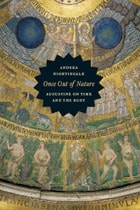
Once Out of Nature offers an original interpretation of Augustine’s theory of time and embodiment. Andrea Nightingale draws on philosophy, sociology, literary theory, and social history to analyze Augustine’s conception of temporality, eternity, and the human and transhuman condition.
 
In Nightingale’s view, the notion of embodiment illuminates a set of problems much larger than the body itself: it captures the human experience of being an embodied soul dwelling on earth. In Augustine’s writings, humans live both in and out of nature—exiled from Eden and punished by mortality, they are “resident aliens” on earth. While the human body is subject to earthly time, the human mind is governed by what Nightingale calls psychic time. For the human psyche always stretches away from the present moment—where the physical body persists—into memories and expectations. As Nightingale explains, while the body is present in the here and now, the psyche cannot experience self-presence. Thus, for Augustine, the human being dwells in two distinct time zones, in earthly time and in psychic time. The human self, then, is a moving target. Adam, Eve, and the resurrected saints, by contrast, live outside of time and nature: these transhumans dwell in an everlasting present.
 
Nightingale connects Augustine’s views to contemporary debates about transhumans and suggests that Augustine’s thought reflects our own ambivalent relationship with our bodies and the earth. Once Out of Nature offers a compelling invitation to ponder the boundaries of the human.
[more]
cover of Peace in the Thought of Thomas Aquinas: Philosophy, Theology, and Ethics

Peace in the Thought of Thomas Aquinas

Philosophy, Theology, and Ethics

John M. Meinert

Catholic University of America Press, 2024
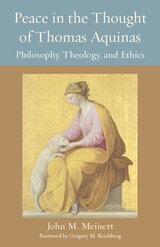
What does Aquinas have to teach us on the topic of peace? Looking over the scholarly literature, one would think very little. Most Thomists ignore Aquinas’s thought on peace. Most peace researchers summarily dismiss Aquinas. Peace in the Thought of Thomas Aquinas challenges both these trends and offers the first book length study of peace in Aquinas’s thought. John Meinert outlines Aquinas's historical predecessors, then provides an exposition and interpretation of the full scope of Aquinas's thought on peace: metaphysics, Trinitarian theology, Christology, Pneumatology, ecclesiology, natural theology, ethics, and sacramental theology. What emerges from this extended study is a new vision of Aquinas’s work. Peace in the Thought of Thomas Aquinas establishes Aquinas as an indispensable dialogue partner for anyone thinking rigorously about the theology, philosophy, and ethics of peace. As Aquinas himself says, “observe peace and you will come to salvation.”
[more]
cover of Protestant and Roman Catholic Ethics: Prospects for Rapprochement

Protestant and Roman Catholic Ethics

Prospects for Rapprochement

James M. Gustafson

University of Chicago Press, 1978

"If Catholic and Protestant ethicians were asked to name a single theologian who was qualified to write a comprehensive overview of the historical divergences of Catholic and Protestant positions on ethical questions, the bases for those divergences in fundamentally different philosophical and theological perspectives, and the possibilities for future convergences of the traditions, my guess is that James Gustafson would be the one. . . . This brilliant and tightly argued book . . . will be the most important book on moral theology to appear this year."—John Coleman, National Catholic Reporter
[more]
cover of Puzzles: A Seminar on the ‘Benefit of Christ’

Puzzles

A Seminar on the ‘Benefit of Christ’

Carlo Ginzburg and Adriano Prosperi

Seagull Books, 2025

A seminar, a sixteenth-century heretical text, and the art of slow reading—this is historical research as you’ve never seen it before.

Patience Games: A Seminar on the 'Benefit of Christ' invites readers into the unpredictable world of scholarly discovery, where interpretation is not a straight path but a labyrinth of dialogue revision. At the heart of this book is a seminar held forty years ago at the University of Bologna, where students wrestled with The Beneficio di Cristo, the incendiary sixteenth-century text that questioned Church authority and championed salvation through grace alone. This is not a neatly packaged historical study, however—it is an unfiltered look at the errors and insights that emerge in the collective process of reading and debating a text.

Through shifting hypotheses and the sheer unpredictability of research, Patience Games dismantles the illusion of scholarship as a sterile pursuit, revealing instead a messy, deeply human endeavor. Blending sharp analysis with wit and self-irony, the book makes a compelling case for the continued importance of slow reading—even in an age where knowledge is just a click away.
[more]
cover of Reading Patristic Texts on Social Ethics: Issues and Challenges for the Twenty-First Century

Reading Patristic Texts on Social Ethics

Issues and Challenges for the Twenty-First Century

Johan Leemans

Catholic University of America Press, 2011
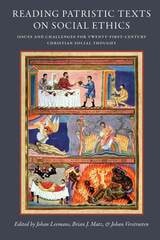
Can writings of the church fathers related to the field of social ethics be of value to contemporary discussions on the topic? In addressing this question, the authors of this book discuss the exciting challenges that scholars of both early Christianity and contemporary Catholic social thought face regarding the interaction of historical sources and present issues.
[more]
cover of Rethinking Cooperation with Evil: A Virtue-Based Approach

Rethinking Cooperation with Evil

A Virtue-Based Approach

Ryan Connors

Catholic University of America Press, 2023
Rethinking Cooperation with Evil: A Virtue-Based Approach applies Thomistic virtue theory to today’s most challenging questions of cooperation with evil. For centuries, moralists have struggled to determine the conditions necessary to justify moral cooperation with evil. The English Jesuit Henry Davis even observed: “[T]here is no more difficult question than this in the whole range of Moral Theology.” This important book addresses this challenge by applying the virtue-based method of moral reasoning of St. Thomas Aquinas to issues of cooperation with evil. Those who pastor souls report frequently receiving questions from attentive believers about whether a particular human action inadvertently contributes to some moral evil. Examples of potentially immoral cooperation with evil include whether one may shop at a particular franchise known for its support of abortion, whether Catholics may attend civil marriages outside the Church, or whether an organization may submit to government mandates that health insurance include payment for immoral practices. Although recent moralists have tackled specific topics related to cooperation with evil, agreement on an overall common paradigm has not yet been reached. Rethinking Cooperation with Evil proposes a method for Christian believers and others to approach these questions from the foundation of the thought of St. Thomas Aquinas and the magisterial teaching of the Catholic Church. This text provides both an overall method for how to understand the issue of cooperation, as well as practical counsel for specific cases. Rethinking Cooperation with Evil advances the theological conversation on this topic from both speculative and practical vantage points. To facilitate his argument, Connors utilizes historical analyses that contrast Aquinas’s method of moral reasoning with that of the casuist treatment of cooperation. Consequently, the book includes numerous case studies that will be of interest both to moral theologians and readers new to the topic.
[more]
cover of The Best Effect: Theology and the Origins of Consequentialism

The Best Effect

Theology and the Origins of Consequentialism

Ryan Darr

University of Chicago Press, 2023

A theological history of consequentialism and a fresh agenda for teleological ethics.
 

Consequentialism—the notion that we can judge an action by its effects alone—has been among the most influential approaches to ethics and public policy in the Anglophone world for more than two centuries. In The Best Effect, Ryan Darr argues that consequentialist ethics is not as secular or as rational as it is often assumed to be. Instead, Darr describes the emergence of consequentialism in the seventeenth century as a theological and cosmological vision and traces its intellectual development and eventual secularization across several centuries. The Best Effect reveals how contemporary consequentialism continues to bear traces of its history and proposes in its place a more expansive vision for teleological ethics.
[more]
cover of The Hauerwas Reader

The Hauerwas Reader

Stanley Hauerwas

Duke University Press, 2001

Stanley Hauerwas is one of the most widely read and oft-cited theologians writing today. A prolific lecturer and author, he has been at the forefront of key developments in contemporary theology, ranging from narrative theology to the “recovery of virtue.” Yet despite his prominence and the esteem reserved for his thought, his work has never before been collected in a single volume that provides a sense of the totality of his vision.
The editors of The Hauerwas Reader, therefore, have compiled and edited a volume that represents all the different periods and phases of Hauerwas’s work. Highlighting both his constructive goals and penchant for polemic, the collection reflects the enormous variety of subjects he has engaged, the different genres in which he has written, and the diverse audiences he has addressed. It offers Hauerwas on ethics, virtue, medicine, and suffering; on euthanasia, abortion, and sexuality; and on war in relation to Catholic and Protestant thought. His essays on the role of religion in liberal democracies, the place of the family in capitalist societies, the inseparability of Christianity and Judaism, and on many other topics are included as well.
Perhaps more than any other author writing on religious topics today, Hauerwas speaks across lines of religious traditions, appealing to Methodists, Jews, Anabaptists or Mennonites, Catholics, Episcopalians, and others.
[more]
cover of The Miracle of Immortality: What Follows This Earthly Life?

The Miracle of Immortality

What Follows This Earthly Life?

Gerhard Cardinal Muller

Catholic University of America Press, 2026
In The Miracle of Immortality, Gerhard Cardinal Müller tackles some of the great mysteries of human life and hope. The former prefect of the Dicastery for the Doctrine of the Faith is not content merely to present Catholic doc­trine on the afterlife and the last things, although his reflections are always rooted in the teachings and traditions of the Church. Rather, he invites readers to walk with him by the restless sea of human learning, a sea formed by man’s unquenchable thirst for something or someone greater than man himself, by his desire to know the beginning and the end. One who accepts the invitation finds himself in conversation with a mentor whose mind is suffused with scripture and very much sharpened by it. Cherished assumptions are queried or quietly corrected. Slowly but surely he is confronted with the miracle of immortality, without which true happiness is impossible. Cardinal Müller demonstrates in this book that it is entirely possible, and eminently rational, to believe in the miracle of immortality; indeed, that it is ultimately not rational not to believe. The Miracle of Immortality is a work of penetrating theological insight set, chiaroscuro-like, against the darkness of modern and postmodern skepticism. It is at once poetical in spirit and profoundly catechetical in substance, for Müller understands that Christian eschatology cannot be elucidated properly without proclaiming the whole counsel of God. The miracle in question is a miracle for the whole person, accomplished by way of what Paul calls adoption; that is, filiation to the eternal Father through the incarnate Son, effected by the limitless power of the Holy Spirit. It is a miracle that perfects the divine work of creation.
[more]
cover of The Roles of Christ's Humanity in Salvation: Insights from Theodore of Mopsuestia

The Roles of Christ's Humanity in Salvation

Insights from Theodore of Mopsuestia

Frederick G. McLeod S.J.

Catholic University of America Press, 2005
This book enables one to judge Theodore's christological statements in the wider context of how he conceives of Christ's roles in salvation.
[more]
cover of The Spirit of Soul Food: Race, Faith, and Food Justice

The Spirit of Soul Food

Race, Faith, and Food Justice

Christopher Carter

University of Illinois Press, 2021

Soul food has played a critical role in preserving Black history, community, and culinary genius. It is also a response to--and marker of--centuries of food injustice. Given the harm that our food production system inflicts upon Black people, what should soul food look like today?

Christopher Carter's answer to that question merges a history of Black American foodways with a Christian ethical response to food injustice. Carter reveals how racism and colonialism have long steered the development of US food policy. The very food we grow, distribute, and eat disproportionately harms Black people specifically and people of color among the global poor in general. Carter reflects on how people of color can eat in a way that reflects their cultural identities while remaining true to the principles of compassion, love, justice, and solidarity with the marginalized.

Both a timely mediation and a call to action, The Spirit of Soul Food places today's Black foodways at the crossroads of food justice and Christian practice.
[more]
cover of Thomas Aquinas on Faith, Hope, and Love: A Summa of the Summa on the Theological Virtues

Thomas Aquinas on Faith, Hope, and Love

A Summa of the Summa on the Theological Virtues

Christopher Kaczor

Catholic University of America Press, 2020
Thomas Aquinas on Faith, Hope, and Love is designed to make as easy as possible a first reading of key passages from the Summa theologiae. This book contains selections from the Summa that are most influential, most important, or likely to be most interesting to the contemporary reader. The text of the Summa itself is edited and arranged for beginners. Each article begins with Thomas’s answers to the question at hand and then goes to the first objection, followed by the reply to the first objection, the second objection and its reply, and so on. This arrangement provides a greater accessibility and ease in following the argument. Below the text, copious footnotes illuminate the text as a professor in the classroom might. Some notes provide historical background to figures that Thomas presupposes his reader will know such as Gratian, Dionysius, and Lombard. Other notes offer doctrinal summaries of other parts of the Summa that illuminate what Thomas says about faith, hope, or love. Thomas had an enormous influence on theologians, Church councils, and popes after his time, so some footnotes examine this influence. Thomas drew heavily on sources of wisdom before him, so other footnotes summarize the teachings of earlier authors, such as Aristotle and Augustine. This book also contains introductory essays on the Summa, on faith, on hope, and on love, which provide an overview to situate the reader and place treatment of the theological virtues in its larger context of the Summa. For those who have never read Thomas Aquinas on faith, hope, and love (and for those who teach them), this book provides ready access to the wisdom of the Angelic doctor.
[more]
cover of Thomas Aquinas on the Cardinal Virtues: A Summa of the Summa on Prudence, Justice, Temperance, and Courage

Thomas Aquinas on the Cardinal Virtues

A Summa of the Summa on Prudence, Justice, Temperance, and Courage

Christopher Kaczor

Catholic University of America Press, 2020

Thomas Aquinas on the Cardinal Virtues provides essential passages from Thomas's treatment of the cardinal virtues in the Summa theologiae, edited and explained for classroom use or the independent reader. Arranged for beginners, this book contains passages from the Summa theologiae of great historical import, contemporary relevance, or intrinsic interest combined with abundant footnotes aiding the modern reader. Each individual article is arranged so that the question, e.g. “Is capital punishment moral?” is followed directed by Thomas’s answer. Then the first objection is raised, followed immediately by Thomas’s response, the second objection is raised and then Thomas answers it, and so forth. The abundant footnotes help first time readers navigate key theological and philosophical terms which may be unfamiliar. In addition, the notes provide biographical information about key authors cited by Thomas, such as Tully, Vegetius, and Gregory the Great. The footnotes sometimes look back at the sources and philosophical roots of what Thomas teaches. Other notes note how authors after Aquinas including theologians, church councils, and popes developed, synthesized, and sometimes rejected what Thomas teaches. In sum, this book seeks to illuminate Thomas’s teaching on the cardinal virtues such as a teacher might do in the classroom.
[more]
cover of Walk in the Good Way: Classical Natural Law and Civic Friendship

Walk in the Good Way

Classical Natural Law and Civic Friendship

Michael Pakaluk

Catholic University of America Press, 2027
What holds a free society together? Not law alone, and not self-interest — but something older and deeper that the classical tradition called civic friendship: the bonds of genuine goodwill and common purpose that bind citizens to one another and make a republic possible. This book recovers that idea, and argues that without it, neither natural law theory nor political life can be adequately understood. Michael Pakaluk brings together more than two decades of scholarship on Aristotle, Aquinas, and the American Founding to show that the classical conception of natural law is fundamentally different in kind from the modern theories that have displaced it. Where contemporary natural law and liberal political theory — in their best-known versions — begin from abstract principles of practical reason, the classical tradition begins from human nature itself: from our constitution as social beings, equipped by nature and Providence to live together, and oriented toward civic friendship as the proper realization of that nature. The argument moves across three great traditions. In Aristotle, civic friendship is the telos of political life — not an ornament added to justice, but its consummation, the common good understood as a shared form of life. In Aquinas, natural law is the rational creature's participation in divine providence, its precepts providing not a checklist of obligations but starting-points for the cultivation of virtue and the perfection of character. In the American Founders — above all in John Adams, whose Aristotelian convictions Pakaluk examines with care — the ideals of natural sociability were neither decorative nor derivative, but the animating principles of the republican experiment itself. The result is a vision at once ancient and urgently contemporary. At a moment of deepening civic fracture, Walk in the Good Way makes the case that the path to a stable and vigorous free society runs through the recovery of something we have nearly forgotten: that we are, by nature, made for life together — and that nature itself shows us how
[more]
cover of Walking with Jesus Christ: Catholic and Evangelical Visions of the Moral Life

Walking with Jesus Christ

Catholic and Evangelical Visions of the Moral Life

Steven Hoskins

Saint Paul Seminary Press, 2023
Walking with Jesus Christ: Catholic and Evangelical Visions of the Moral Life is the collected essays and consensus statements of the second round of the National Evangelical-Catholic Dialogue. In 2021 the National Evangelical-Catholic Dialogue completed its four-year round of discussion on the moral life, at the University of St. Thomas in St. Paul, MN. Sessions were held each year on the following topics. In 2017, the dialogue discussed the norms governing the moral life. In 2018, the dialogue discussed sexual ethics. In 2019, the dialogue discussed social ethics. Finally, in 2021 the dialogue discussed the relationship of the moral life to eschatology. At each of the annual meetings, members presented background papers that formed the basis of that meeting’s discussion and became starting points for constructing a common statement. These common statements and background papers make up this book. The members of the dialogue hope this book will provide a fruitful starting point for future conversations between evangelicals and Catholics. The Catholic essays begin with the contributions of Catholic theologians Daniel Keating, William Stevenson and Christian Washburn, who examine the various norms for Catholic moral theology including the role of Scripture, tradition, magisterium, and natural law (2017). David Fleischacker, Daniel Keating, and Christian Washburn examine the morality of marriage, contraception, abortion, and homosexual acts (2018). Daniel Keating and William Stevenson discuss social ethics, including Catholic social teaching and socialism (2019). David Fleischacker and Christian Washburn discuss the relationship of the moral life to our final beatific end (2020). The Evangelical essays begin with the contribution of Evangelical theologians Bruce Cromwell and Dennis Jowers who explore the norms of Protestant Ethics (2017). David Van Drunen and Luke Geraty discuss sexual ethics from different ends of the Evangelical perspective (2018). Glen Menzies and Steve Hoskins evaluate approaches to evangelical social ethics from Pentecostal and Wesleyan points of view (2019). Bruce Cromwell and Steve Hoskins discuss the notions of eschatology and ethics from a Wesleyan viewpoint (2020).
[more]
cover of When the Good Life Goes Bad: The US and Its Seven Deadly Sins

When the Good Life Goes Bad

The US and Its Seven Deadly Sins

Stacey M. Floyd-Thomas Foreword by Michael Eric Dyson

University of Illinois Press, 2026

The Seven Deadly Sins have become the seven markers of success in America. Lust, pride, greed, sloth, envy, gluttony, wrath—these once-condemned principles now guide people’s pursuit of the good life.

Stacey M. Floyd-Thomas examines how the Seven Deadly Sins have shaped the moral strivings and sociopolitical condition of American society and culture in the twenty-first century. Drawing on a multidimensional approach, Floyd-Thomas uses race, gender, class, and other lenses to break down the moral crises that define the American Dream. Her critique exposes the harm done by individual and collective practices of sexual objectification, capitalist materialism, wealth inequality, and technological hubris before pivoting to the rise of right-wing populism, white Christian nationalism, and the politics of cruelty. But Floyd-Thomas also proposes an ethic that emphasizes truth-telling, community engagement, and values rooted in humility, justice, and mercy—a new path for the US to overcome systemic oppression and create a more just society.

Evocative and ambitious, When the Good Life Goes Bad takes readers on a wide-ranging journey through US life and culture to explain what corrupted the American dream.
[more]