Results by title
2 books match the query 'Ethnographic Study'
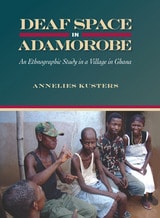
Deaf Space in Adamorobe
An Ethnographic Study in a Village in GhanaAnnelies Kusters
Gallaudet University Press, 2015
Shared signing communities consist of a relatively high number of hereditarily deaf people living together with hearing people in relative isolation. In the United States, Martha’s Vineyard gained mythical fame as a paradise for deaf people where everyone signed up until the 19th century. That community disappeared when deaf people left the island, newcomers moved in, married locals, and changed the gene pool. These unique communities still exist, however, one being the Akan village in Ghana called Adamorobe. Annelies Kusters, a deaf anthropologist, traveled to Adamorobe to conduct an ethnographic study of how deaf and hearing people live together in the village. In her new book, Kusters reveals how deaf people in Adamorobe did not live in a social paradise and how they created “deaf spaces” by seeking each other out.
Deaf Space in Adamorobe reveals one example of the considerable variation in shared signing communities regarding rates of sign language proficiency and use, deaf people’s marriage rates, deaf people’s participation in village economies and politics, and the role of deaf education. Kusters describes spaces produced by both deaf and hearing people as a cohesive community where living together is an integral fact of their sociocultural environments. At the same time, Kusters identifies tension points between deaf and hearing perspectives and also between outside perspectives and discourses that originated within the community. Because of these differences and the relatively high number of deaf people in the community, Kusters concludes it is natural that they form deaf spaces within the shared space of the village community.
Deaf Space in Adamorobe reveals one example of the considerable variation in shared signing communities regarding rates of sign language proficiency and use, deaf people’s marriage rates, deaf people’s participation in village economies and politics, and the role of deaf education. Kusters describes spaces produced by both deaf and hearing people as a cohesive community where living together is an integral fact of their sociocultural environments. At the same time, Kusters identifies tension points between deaf and hearing perspectives and also between outside perspectives and discourses that originated within the community. Because of these differences and the relatively high number of deaf people in the community, Kusters concludes it is natural that they form deaf spaces within the shared space of the village community.
[more]
Gender, Work and Property
An Ethnographic Study of Value in a Spanish VillageNancy Konvalinka
Campus Verlag, 2013
Why do young men born in many small villages in Spain tend, at the end of the twentieth century, to stay there to live, often remaining unmarried, while young women from the same villages tend to leave? In Gender, Work, and Property, Nancy Konvalinka explores this phenomenon using the case of one small village in northwestern Spain, and she extrapolates her findings there to understand similar processes elsewhere in Europe.
The changes in this village are analyzed and documented through long-term ethnographic research, participant observation, interviews, kinship diagrams, life-course models, and archive study in order to help bring the village alive for the reader.
[more]