Results by title
26 books match the query 'Euripides'
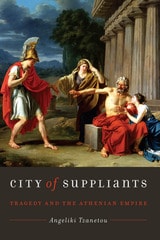
City of Suppliants
Tragedy and the Athenian EmpireBy Angeliki Tzanetou
University of Texas Press, 2012
After fending off Persia in the fifth century BCE, Athens assumed a leadership position in the Aegean world. Initially it led the Delian League, a military alliance against the Persians, but eventually the league evolved into an empire with Athens in control and exacting tribute from its former allies. Athenians justified this subjection of their allies by emphasizing their fairness and benevolence towards them, which gave Athens the moral right to lead. But Athenians also believed that the strong rule over the weak and that dominating others allowed them to maintain their own freedom. These conflicting views about Athens’ imperial rule found expression in the theater, and this book probes how the three major playwrights dramatized Athenian imperial ideology.
Through close readings of Aeschylus’ Eumenides, Euripides’ Children of Heracles, and Sophocles’ Oedipus at Colonus, as well as other suppliant dramas, Angeliki Tzanetou argues that Athenian tragedy performed an important ideological function by representing Athens as a benevolent and moral ruler that treated foreign suppliants compassionately. She shows how memorable and disenfranchised figures of tragedy, such as Orestes and Oedipus, or the homeless and tyrant-pursued children of Heracles were generously incorporated into the public body of Athens, thus reinforcing Athenians’ sense of their civic magnanimity. This fresh reading of the Athenian suppliant plays deepens our understanding of how Athenians understood their political hegemony and reveals how core Athenian values such as justice, freedom, piety, and respect for the laws intersected with imperial ideology.
Electras
Aeschylus, Sophocles, and EuripidesMichael Davis
St. Augustine's Press, 2023
Davis accomplishes much more than an exegetical bridge as he connects us with ancient memory and wisdom. "When we cannot resist the temptation to recoil morally from their terminology, we risk the tragedy of losing their profound thoughts about our humanity––their philosophical anthropology." Davis has remarkably made of a niche study a stunning source material for more universal questions. This is a book that is as timely as it is ageless.
Euripides I
Alcestis, Medea, The Children of Heracles, HippolytusEdited and Translated by Mark Griffith, Glenn W. Most, David Grene, and Richmond Lattimore
University of Chicago Press, 2013
Euripides I contains the plays “Alcestis,” translated by Richmond Lattimore; “Medea,” translated by Oliver Taplin; “The Children of Heracles,” translated by Mark Griffith; and “Hippolytus,” translated by David Grene.
Many years ago, the University of Chicago Press undertook a momentous project: a new translation of the Greek tragedies that would be the ultimate resource for teachers, students, and readers. They succeeded. Under the expert management of eminent classicists David Grene and Richmond Lattimore, those translations combined accuracy, poetic immediacy, and clarity of presentation to render the surviving masterpieces of Aeschylus, Sophocles, and Euripides in an English so lively and compelling that they remain the standard translations. The updated third editions of these classic works were designed to ensure that our Greek tragedies remain the leading English-language versions throughout the twenty-first century.
In this highly anticipated third edition, Mark Griffith and Glenn W. Most have carefully updated the translations to bring them even closer to the ancient Greek while retaining the vibrancy for which our English versions are famous. This edition also includes brand-new translations of Euripides’ Medea, The Children of Heracles, Andromache, and Iphigenia among the Taurians, fragments of lost plays by Aeschylus, and the surviving portion of Sophocles’s satyr-drama The Trackers. New introductions for each play offer essential information about its first production, plot, and reception in antiquity and beyond. In addition, each volume includes an introduction to the life and work of its tragedian, as well as notes addressing textual uncertainties and a glossary of names and places mentioned in the plays.
In addition to the new content, the volumes have been reorganized both within and between volumes to reflect the most up-to-date scholarship on the order in which the plays were originally written. The result is a set of handsome paperbacks destined to introduce new generations of readers to these foundational works of Western drama, art, and life.
Euripides II
Andromache, Hecuba, The Suppliant Women, ElectraEdited and Translated by Mark Griffith, Glenn W. Most, David Grene, and Richmond Lattimore
University of Chicago Press, 2013
Euripides II contains the plays “Andromache,” translated by Deborah Roberts; “Hecuba,” translated by William Arrowsmith; “The Suppliant Women,” translated by Frank William Jones; and “Electra,” translated by Emily Townsend Vermeule.
Many years ago, the University of Chicago Press undertook a momentous project: a new translation of the Greek tragedies that would be the ultimate resource for teachers, students, and readers. They succeeded. Under the expert management of eminent classicists David Grene and Richmond Lattimore, those translations combined accuracy, poetic immediacy, and clarity of presentation to render the surviving masterpieces of Aeschylus, Sophocles, and Euripides in an English so lively and compelling that they remain the standard translations. The updated third editions of these classic works were designed to ensure that our Greek tragedies remain the leading English-language versions throughout the twenty-first century.
In this highly anticipated third edition, Mark Griffith and Glenn W. Most have carefully updated the translations to bring them even closer to the ancient Greek while retaining the vibrancy for which our English versions are famous. This edition also includes brand-new translations of Euripides’ Medea, The Children of Heracles, Andromache, and Iphigenia among the Taurians, fragments of lost plays by Aeschylus, and the surviving portion of Sophocles’s satyr-drama The Trackers. New introductions for each play offer essential information about its first production, plot, and reception in antiquity and beyond. In addition, each volume includes an introduction to the life and work of its tragedian, as well as notes addressing textual uncertainties and a glossary of names and places mentioned in the plays.
In addition to the new content, the volumes have been reorganized both within and between volumes to reflect the most up-to-date scholarship on the order in which the plays were originally written. The result is a set of handsome paperbacks destined to introduce new generations of readers to these foundational works of Western drama, art, and life.
Euripides III
Heracles, The Trojan Women, Iphigenia among the Taurians, IonEdited and Translated by Mark Griffith, Glenn W. Most, David Grene, and Richmond Lattimore
University of Chicago Press, 2013
Euripides III contains the plays “Heracles,” translated by William Arrowsmith; “The Trojan Women,” translated by Richmond Lattimore; “Iphigenia among the Taurians,” translated by Anne Carson; and “Ion,” translated by Ronald Frederick Willetts.
Many years ago, the University of Chicago Press undertook a momentous project: a new translation of the Greek tragedies that would be the ultimate resource for teachers, students, and readers. They succeeded. Under the expert management of eminent classicists David Grene and Richmond Lattimore, those translations combined accuracy, poetic immediacy, and clarity of presentation to render the surviving masterpieces of Aeschylus, Sophocles, and Euripides in an English so lively and compelling that they remain the standard translations. The updated third editions of these classic works were designed to ensure that our Greek tragedies remain the leading English-language versions throughout the twenty-first century.
In this highly anticipated third edition, Mark Griffith and Glenn W. Most have carefully updated the translations to bring them even closer to the ancient Greek while retaining the vibrancy for which our English versions are famous. This edition also includes brand-new translations of Euripides’ Medea, The Children of Heracles, Andromache, and Iphigenia among the Taurians, fragments of lost plays by Aeschylus, and the surviving portion of Sophocles’s satyr-drama The Trackers. New introductions for each play offer essential information about its first production, plot, and reception in antiquity and beyond. In addition, each volume includes an introduction to the life and work of its tragedian, as well as notes addressing textual uncertainties and a glossary of names and places mentioned in the plays.
In addition to the new content, the volumes have been reorganized both within and between volumes to reflect the most up-to-date scholarship on the order in which the plays were originally written. The result is a set of handsome paperbacks destined to introduce new generations of readers to these foundational works of Western drama, art, and life.
Euripides IV
Helen, The Phoenician Women, OrestesEdited and Translated by Mark Griffith, Glenn W. Most, David Grene, and Richmond Lattimore
University of Chicago Press, 2013
Euripides IV contains the plays “Helen,” translated by Richmond Lattimore; “The Phoenician Women,” translated by Elizabeth Wyckoff; and “Orestes,” translated by William Arrowsmith.
Many years ago, the University of Chicago Press undertook a momentous project: a new translation of the Greek tragedies that would be the ultimate resource for teachers, students, and readers. They succeeded. Under the expert management of eminent classicists David Grene and Richmond Lattimore, those translations combined accuracy, poetic immediacy, and clarity of presentation to render the surviving masterpieces of Aeschylus, Sophocles, and Euripides in an English so lively and compelling that they remain the standard translations. The updated third editions of these classic works were designed to ensure that our Greek tragedies remain the leading English-language versions throughout the twenty-first century.
In this highly anticipated third edition, Mark Griffith and Glenn W. Most have carefully updated the translations to bring them even closer to the ancient Greek while retaining the vibrancy for which our English versions are famous. This edition also includes brand-new translations of Euripides’ Medea, The Children of Heracles, Andromache, and Iphigenia among the Taurians, fragments of lost plays by Aeschylus, and the surviving portion of Sophocles’s satyr-drama The Trackers. New introductions for each play offer essential information about its first production, plot, and reception in antiquity and beyond. In addition, each volume includes an introduction to the life and work of its tragedian, as well as notes addressing textual uncertainties and a glossary of names and places mentioned in the plays.
In addition to the new content, the volumes have been reorganized both within and between volumes to reflect the most up-to-date scholarship on the order in which the plays were originally written. The result is a set of handsome paperbacks destined to introduce new generations of readers to these foundational works of Western drama, art, and life.
Euripides V
Bacchae, Iphigenia in Aulis, The Cyclops, RhesusEdited and Translated by Mark Griffith, Glenn W. Most, David Grene, and Richmond Lattimore
University of Chicago Press, 2013
Euripides V includes the plays “The Bacchae,” translated by William Arrowsmith; “Iphigenia in Aulis,” translated by Charles R. Walker; “The Cyclops,” translated by William Arrowsmith; and “Rhesus,” translated by Richmond Lattimore.
Many years ago, the University of Chicago Press undertook a momentous project: a new translation of the Greek tragedies that would be the ultimate resource for teachers, students, and readers. They succeeded. Under the expert management of eminent classicists David Grene and Richmond Lattimore, those translations combined accuracy, poetic immediacy, and clarity of presentation to render the surviving masterpieces of Aeschylus, Sophocles, and Euripides in an English so lively and compelling that they remain the standard translations. The updated third editions of these classic works were designed to ensure that our Greek tragedies remain the leading English-language versions throughout the twenty-first century.
In this highly anticipated third edition, Mark Griffith and Glenn W. Most have carefully updated the translations to bring them even closer to the ancient Greek while retaining the vibrancy for which our English versions are famous. This edition also includes brand-new translations of Euripides’ Medea, The Children of Heracles, Andromache, and Iphigenia among the Taurians, fragments of lost plays by Aeschylus, and the surviving portion of Sophocles’s satyr-drama The Trackers. New introductions for each play offer essential information about its first production, plot, and reception in antiquity and beyond. In addition, each volume includes an introduction to the life and work of its tragedian, as well as notes addressing textual uncertainties and a glossary of names and places mentioned in the plays.
In addition to the new content, the volumes have been reorganized both within and between volumes to reflect the most up-to-date scholarship on the order in which the plays were originally written. The result is a set of handsome paperbacks destined to introduce new generations of readers to these foundational works of Western drama, art, and life.
Euripides and the Instruction of the Athenians
Justina Gregory
University of Michigan Press, 1997

Euripides and the Poetics of Sorrow
Art, Gender, and Commemoration in Alcestis, Hippolytus, and HecubaCharles Segal
Duke University Press, 1993
Alcestis, Hippolytus, and Hecuba, the three early plays interpreted here, are linked by common themes of violence, death, lamentation and mourning, and by their implicit definitions of male and female roles. Segal shows how these plays draw on ancient traditions of poetic and ritual commemoration, particularly epic song, and at the same time refashion these traditions into new forms. In place of the epic muse of martial glory, Euripides, Segal argues, evokes a muse of sorrows who transforms the suffering of individuals into a "common grief for all the citizens," a community of shared feeling in the theater.
Like his predecessors in tragedy, Euripides believes death, more than any other event, exposes the deepest truth of human nature. Segal examines the revealing final moments in Alcestis, Hippolytus, and Hecuba, and discusses the playwright's use of these deaths--especially those of women--to question traditional values and the familiar definitions of male heroism. Focusing on gender, the affective dimension of tragedy, and ritual mourning and commemoration, Segal develops and extends his earlier work on Greek drama. The result deepens our understanding of Euripides' art and of tragedy itself.
Euripides and the Tragic Tradition
Ann Norris Michelini
University of Wisconsin Press, 2006

Intimate Commerce
Exchange, Gender, and Subjectivity in Greek TragedyBy Victoria Wohl
University of Texas Press, 1997
Exchanges of women between men occur regularly in Greek tragedy—and almost always with catastrophic results. Instead of cementing bonds between men, such exchanges rend them. They allow women, who should be silent objects, to become monstrous subjects, while men often end up as lifeless corpses. But why do the tragedies always represent the transferal of women as disastrous?
Victoria Wohl offers an illuminating analysis of the exchange of women in Sophocles' Trachiniae, Aeschylus' Agamemnon, and Euripides' Alcestis. She shows how the attempts of women in these plays to become active subjects rather than passive objects of exchange inevitably fail. While these failures seem to validate male hegemony, the women's actions, however futile, blur the distinction between male subject and female object, calling into question the very nature of the tragic self. What the tragedies thus present, Wohl asserts, is not only an affirmation of Athens' reigning ideologies (including its gender hierarchy) but also the possibility of resistance to them and the imagination of alternatives.
Iphigenia among the Taurians
Euripides
University of Chicago Press, 2014
My father killed me
Few contemporary poets elicit such powerful responses from readers and critics as Anne Carson. The New York Times Book Review calls her work “personal, necessary, and important,” while Publishers Weekly says she is “nothing less than brilliant.” Her poetry—enigmatic yet approachable, deeply personal yet universal in scope, wildly mutable yet always recognizable as her distinct voice—invests contemporary concerns with the epic resonance and power of the Greek classics that she has studied, taught, and translated for decades.
Iphigenia among the Taurians is the latest in Carson’s series of translations of the plays of Euripides. Originally published as part of the third edition of Chicago’s Complete Greek Tragedies, it is published here as a stand-alone volume for the first time. In Carson’s stunning translation, Euripides’s play—full of mistaken identities, dangerous misunderstandings, and unexpected interventions by gods and men—is as fierce and fresh as any contemporary drama. Carson has accomplished one of the rarest feats of translation: maintaining fidelity to a writer’s words even as she inflects them with her own unique poetic voice.
Destined to become the standard translation of the play, Iphigenia among the Taurians is a remarkable accomplishment, and an unforgettable work of poetic drama.
Medea
Euripides
University of Chicago Press, 2014
This new translation of Medea by classicist Oliver Taplin, originally published as part of the acclaimed third edition of Chicago’s Complete Greek Tragedies, brilliantly replicates the musicality and strength of Euripides’s verse while retaining the play’s dramatic and emotional impact. Taplin has created an edition of Medea that is particularly suited to performance, while not losing any of the power it has long held as an object of reading or study. This edition is poised to become the new standard, and to introduce a new generation of readers to the heights and depths of Greek tragedy.

The Bacchae
Euripides
University of Chicago Press, 2013
A stand-alone edition of Euripides’s The Bacchae taken from Chicago’s renowned translations of the Greek tragedies.
Dionysus, son of Zeus, has journeyed to the land of his birth expecting to be received as a god. After being rejected by his kin, he turns to the women of Thebes, driving them into a delirious frenzy. Dressed in animal skins and crowned with leaves, they roam wild in the hills as the king tries to restore order—with horrifying results.
Written in the final years of Euripides’s life and first staged posthumously, The Bacchae is presented here in William Arrowsmith’s energetic translation, drawn from the authoritative third edition of the University of Chicago Press’s Complete Greek Tragedies series. An introduction by Mark Griffith and Glenn W. Most provides essential information about The Bacchae’s first production, plot, and reception in antiquity, and an appendix presents Arrowsmith’s hypothetical reconstruction of fifty lines missing from the denouement of the play.

The Bakkhai
Robert Euripides
University of Massachusetts Press, 1978

The Complete Greek Tragedies, Volume 3
EuripidesEdited by David Grene and Richmond Lattimore
University of Chicago Press, 1992
For the Centennial Edition two of the original translations have been replaced. In the original publication David Grene translated only one of the three Theban plays, Oedipus the King. Now he has added his own translations of the remaining two, Oedipus at Colonus and Antigone, thus bringing a new unity of tone and style to this group. Grene has also revised his earlier translation of Prometheus Bound and rendered some of the former prose sections in verse. These new translations replace the originals included in the paperback volumes Sophocles I (which contains all three Theban plays), Aeschylus II, Greek Tragedies, Volume I, and Greek Tragedies, Volume III, all of which are now being published in second editions.
All other volumes contain the translations of the tragedies of Aeschylus, Sophocles, and Euripides for the most part from the original versions first published in the 1940s and 1950s. These translations have been the choice of generations of teachers and students, selling in the past forty years over three million copies.
The Complete Greek Tragedies, Volume 4
EuripidesEdited by David Grene and Richmond Lattimore
University of Chicago Press, 1992
For the Centennial Edition two of the original translations have been replaced. In the original publication David Grene translated only one of the three Theban plays, Oedipus the King. Now he has added his own translations of the remaining two, Oedipus at Colonus and Antigone, thus bringing a new unity of tone and style to this group. Grene has also revised his earlier translation of Prometheus Bound and rendered some of the former prose sections in verse. These new translations replace the originals included in the paperback volumes Sophocles I (which contains all three Theban plays), Aeschylus II, Greek Tragedies, Volume I, and Greek Tragedies, Volume III, all of which are now being published in second editions.
All other volumes contain the translations of the tragedies of Aeschylus, Sophocles, and Euripides for the most part from the original versions first published in the 1940s and 1950s. These translations have been the choice of generations of teachers and students, selling in the past forty years over three million copies.
The Complete Greek Tragedies
Euripides IEdited by David Grene and Richmond Lattimore
University of Chicago Press, 1955

The Complete Greek Tragedies
Euripides IIEdited by David Grene and Richmond Lattimore
University of Chicago Press, 1956
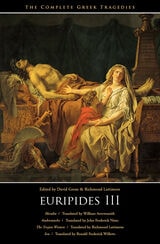
The Complete Greek Tragedies
Euripides IIIEdited by David Grene and Richmond Lattimore
University of Chicago Press, 1992
"These authoritative translations consign all other complete collections to the wastebasket."—Robert Brustein, The New Republic
"This is it. No qualifications. Go out and buy it everybody."—Kenneth Rexroth, The Nation
"The translations deliberately avoid the highly wrought and affectedly poetic; their idiom is contemporary....They have life and speed and suppleness of phrase."—Times Education Supplement
"These translations belong to our time. A keen poetic sensibility repeatedly quickens them; and without this inner fire the most academically flawless rendering is dead."—Warren D. Anderson, American Oxonian
"The critical commentaries and the versions themselves...are fresh, unpretentious, above all, functional."—Commonweal
"Grene is one of the great translators."—Conor Cruise O'Brien, London Sunday Times
"Richmond Lattimore is that rara avis in our age, the classical scholar who is at the same time an accomplished poet."—Dudley Fitts, New York Times Book Review
The Complete Greek Tragedies
Euripides IVEdited by David Grene and Richmond Lattimore
University of Chicago Press, 1968
The Complete Greek Tragedies
Euripides VEdited by David Grene and Richmond Lattimore
University of Chicago Press, 1969
The Greek Tragedies
Seventeen Plays by Aeschylus, Sophocles, and EuripidesAeschylus, Sophocles, and Euripides
University of Chicago Press, 2025
The most authoritative, accessible, and poetic translations of the Greek Tragedies ever produced, now in one volume!
Drawn from the authoritative third editions of David Grene and Richmond Lattimore’s collections of the complete Greek tragedies, expertly updated by Mark Griffith and Glenn W. Most, this collection brings together seventeen of the greatest surviving plays of ancient Greece. Combining accuracy, poetic immediacy, and clarity of presentation, the masterpieces of Aeschylus, Sophocles, and Euripides have been rendered so compellingly in English that they remain the definitive translations. Each text has been carefully updated to bring it even closer to the ancient Greek original while retaining the vibrancy for which Chicago’s versions are famous.
Alongside the plays, this edition includes an introduction to the life and work of each tragedian; an introduction to each play offering essential information about its first production, plot, and reception through the centuries; and notes addressing textual uncertainties. Featuring lively translations by eminent classicists and authors including Anne Carson, Robert Fitzgerald, David Grene, Richmond Lattimore, Oliver Taplin, Emily Townsend Vermeule, and Elizabeth Wyckoff, this is an indispensable anthology for any reader of the foundational works of Western drama, art, and life.
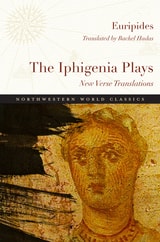
The Iphigenia Plays
New Verse TranslationsEuripides, Translated by Rachel Hadas
Northwestern University Press, 2018
At the heart of Iphigenia’s enduring story are an ambitious, opportunistic, and indecisive leader and the daughter whose life he is willing to sacrifice. In The Iphigenia Plays, poet Rachel Hadas offers a new generation of readers a graceful, clear, and powerful translation of Euripides’s two spellbinding (and very different) plays drawn from this legend: Iphigenia in Aulis and Iphigenia among the Taurians.
Even for readers unfamiliar with Greek mythology or drama, these plays are suspenseful, poignant, and haunting. Euripides’s ability to evoke emotion and raise difficult questions has long engaged viewers and readers alike. Taken together, the two plays illuminate timeless human conflicts, showcasing individuals and families ensnared by the fury of war, of politics, of religion, and of ambition. Euripidean characters are always second-guessing themselves; now new readers can also ponder their dilemmas.
Poet and translator Rachel Hadas highlights the lyricism, emotion, and sheer humanity of Euripides’s plays. Mordant humor is here; so are heartbreak and tenderness. Hadas offers an Iphigenia story that resonates with our own troubled times and demonstrates anew the genius of one of the world’s supreme dramatists.
The Trojan Women
Euripides
University of Chicago Press, 2013
A stand-alone edition of Euripides’s The Trojan Women, taken from Chicago’s renowned translations of the Greek tragedies.
Drawn from the authoritative third edition of the University of Chicago Press’s Complete Greek Tragedies series, this stand-alone edition presents Richmond Lattimore’s celebrated translation of a play with an antiwar message that continues to inspire and resonate with readers today. The Trojan Women takes place following the conquest of Troy and tells the story of its sole survivors—all women—who have been enslaved by the Greeks. Mourning their families and their fate, they grapple with the trauma they have experienced and contemplate a future far from home.
The aftermath of the Trojan War, while extensively depicted in ancient Greek epic, lyric poetry, and art, is rendered especially powerful through the hands of Euripides. An introduction by Mark Griffith and Glenn W. Most provides essential contextual information about the play’s first production, plot, and reception in antiquity.
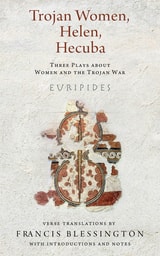
Trojan Women, Helen, Hecuba
Three Plays about Women and the Trojan WarEuripides, Verse translations by Francis Blessington, with introductions and notes
University of Wisconsin Press, 2015
Francis Blessington combines his work as a poet, translator, and teacher of literature and Greek with his theatrical experience to create fresh and faithful verse translations suitable for the stage, the classroom, or the general reader. The three plays are augmented by introductions, notes, and an appendix on elements of Greek tragedy. Blessington glosses historical and mythological terms, identifies Greek themes in the texts, offers literary interpretations, and suggests topics for discussion.