Results by title

6 books match the query 'European federation'
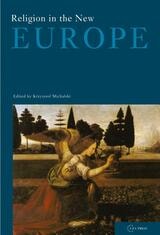
cover of Religion in the New Europe

Religion in the New Europe

Krzysztof Michalski

Central European University Press, 2006

The articles in this volume deal with the role of Christianity in the definition of European identity. Europeans often identify advanced civilizations with secularity. But religion is very much alive in other fast developing countries of the world. In Europe, nevertheless, the organized churches very much wanted to stress the Christian character of European identity, and this engendered a lively protest focusing on the perceived threat to the secular European tradition. Also, Europe is facing its greatest cultural challenge in the demand of Turkey to be admitted as a member, and in the demand of many Muslims in Europe, often citizens of the countries in which they live, to be recognized in their difference and at the same time integrated in the European national and supranational institutions.
[more]
cover of The Dynamics of European Integration: Causes and Consequences of Institutional Choices

The Dynamics of European Integration

Causes and Consequences of Institutional Choices

Thomas König

University of Michigan Press, 2024
In Europe’s recent history, there have been several challenges to the strength of the European Union—Brexit, COVID, financial crises, and global tensions—bringing an increased need to understand the ways that the European Union (EU) could successfully stay together or fall apart. In examining how the European Union has changed since 1993, important puzzles have emerged, including how national government functions are transferred to the EU without reforming the EU, how increased transparency is announced while decisions are approved in informal meetings, and how the effects of the polarizing rise of Euroscepticism can be managed to still promote the formation of solidarity and trust among Europeans. To understand these puzzles, Thomas König introduces a new theory of (supra)national partyism to help explain the causes and consequences of choices made by political leaders for Europe. He uses a game-theoretical perspective to look at how conditions for leaders change through accessions of new members, shocks, and crises, and separates institutional choices into two different games played by office- and policy-seeking political leaders—the interstate summit game and the national game of party competition. The Dynamics of European Integration reveals how the reorganization of electoral systems can harness dissensus and polarization among diverse national constituencies to enable the promotion of solidarity and trust in the EU.
[more]
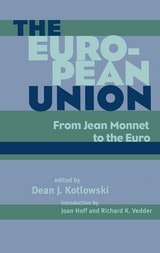
cover of The European Union: From Jean Monnet to the Euro

The European Union

From Jean Monnet to the Euro

Dean Kotlowski

Ohio University Press, 2000

The transformation of Europe since the end of World War II has been astounding. In 1945, a battle–scarred continent lay in ruins. Today, it has achieved a level of integration, prosperity, and stability that few people could have anticipated. The life and career of the French statesman Jean Monnet and the recent adoption of the “euro” as Europe's common currency represent the bookends of this half–century–long metamorphosis.

This collection of essays, drawn from the lectures of the 1999 Baker Conference at Ohio University, explores Monnet's vision of an integrated Europe, its gradual implementation, and the social, economic, and international consequences. The scholarship focuses upon Monnet's life, personality, and legacy, the development of social policy within the European Union (EU), the economic and national security implications of the EU, and the continuation of an American presence in Europe through the North Atlantic Treaty Organization.

This significant collection fuses biography with comparative political economy and policy studies to help political scientists, sociologists, economists, international lawyers, and historians on both sides of the Atlantic understand important aspects of Europe's post–1945 development.
[more]
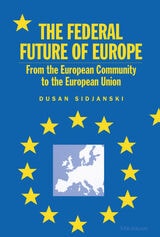
cover of The Federal Future of Europe: From the European Community to the European Union

The Federal Future of Europe

From the European Community to the European Union

Dusan Sidjanski

University of Michigan Press, 2000

The European Union is building step-by-step a new federal system based on states, nations, and regions. In his authoritative and comprehensive book, Dusan Sidjanski describes the formation of the original European Community and the dynamics of the process of integration that has brought the Union to its current state. He then provides a sophisticated analytic framework for considering the future of the Union.
The author argues that federalism is the best antidote to the reemergence of nationalism in Europe. It is also the best guarantee for a peaceful community that balances the claims of national, regional, and local identity against the need for large-scale economies that springs from the forces of globalization, competition, and technical change. The Union preserves diversity within a flexible and innovating European system.
This major study of the development of the European project, informed by a thorough knowledge of the Community and Union over the years and by deep understanding of the relevant literatures in political science and political economy is important for all who study the European Union or work with it as officials and business people.
Dusan Sidjanski is founder and Professor Emeritus of the Department of Political Science, University of Geneva and Professor Emeritus, European Institute. He has authored numerous publications, most recently, The ECE in the Age of Change (United Nations Economic Commission for Europe, United Nations).

[more]
cover of What Holds Europe Together?

What Holds Europe Together?

Krzysztof Michalski

Central European University Press, 2006
The book addresses contemporary developments in European identity politics as part of a larger historical trajectory of a common European identity based on the idea of 'solidarity.' The authors explain the special sense in which Europeans perceive their obligations to their less fortunate compatriots, to the new East European members, and to the world at large. An understanding of this notion of 'solidarity' is critical to understanding the specific European commitment to social justice and equality. The specificity of this term helps to distinguish between what the Germans call "social state" from the Anglo-Saxon, and particularly American, political and social system focused on capitalism and economic liberalism. This collection is the result of the work of an extremely distinguished group of scholars and politicians, invited by the previous President of the European Union, Romano Prodi, to reflect on some of the most important subjects affecting the future of Europe.
[more]
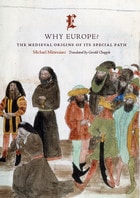
cover of Why Europe?: The Medieval Origins of Its Special Path

Why Europe?

The Medieval Origins of Its Special Path

Michael Mitterauer

University of Chicago Press, 2010

Why did capitalism and colonialism arise in Europe and not elsewhere? Why were parliamentarian and democratic forms of government founded there? What factors led to Europe’s unique position in shaping the world? Thoroughly researched and persuasively argued, Why Europe? tackles these classic questions with illuminating results.

Michael Mitterauer traces the roots of Europe’s singularity to the medieval era, specifically to developments in agriculture. While most historians have located the beginning of Europe’s special path in the rise of state power in the modern era, Mitterauer establishes its origins in rye and oats. These new crops played a decisive role in remaking the European family, he contends, spurring the rise of individualism and softening the constraints of patriarchy. Mitterauer reaches these conclusions by comparing Europe with other cultures, especially China and the Islamic world, while surveying the most important characteristics of European society as they took shape from the decline of the Roman empire to the invention of the printing press. Along the way, Why Europe? offers up a dazzling series of novel hypotheses to explain the unique evolution of European culture.

[more]