Results by title
5 books match the query 'Euthanasia'
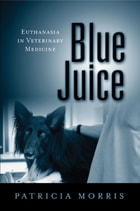
Blue Juice
Euthanasia in Veterinary MedicinePatricia Morris
Temple University Press, 2012
Offering a candid behind-the-scenes look at small-animal veterinary practices, Blue Juice explores the emotional and ethical conflicts involved in providing a "good death" for companion animals. Patricia Morris presents a nuanced ethnographic account of how veterinarians manage patient care and client relations when their responsibility shifts from saving an animal's life to negotiating a decision to end it.
Using her own experiences and observations in veterinary settings as well as the voices of seasoned and novice vets, Morris reveals how veterinarians think about euthanasia and why this "dirty work" often precipitates "burnout," moral quandaries, and even tense or emotional interactions with clients. Closely observing these interactions, Morris illuminates the ways in which euthanasia reflects deep and unresolved tension in human-animal relationships.
Blue Juice seeks to understand how practitioners, charged with the difficult task of balancing the interests of animals and their humans, deal with the responsibility of ending their patients' lives.

Confronting the "Good Death"
Nazi Euthanasia on Trial, 1945-1953Michael S. Bryant
University Press of Colorado, 2022
The first author to address the impact of geopolitics on the courts’ representation of Nazi euthanasia, Bryant argues that international power relationships wreaked havoc on the prosecutions.
Drawing on primary sources, this provocative investigation of the Nazi campaign against the mentally ill and the postwar quest for justice will interest general readers and provide critical information for scholars of Holocaust studies, legal history, and human rights. Support for this publication was generously provided by the Eugene M. Kayden Fund at the University of Colorado.

The Last Walk
Reflections on Our Pets at the End of Their LivesJessica Pierce
University of Chicago Press, 2012
The product of a lifetime of loving pets, studying philosophy, and collaborating with scientists at the forefront of the study of animal behavior and cognition, The Last Walk asks—and answers—the toughest questions pet owners face. The result is informative, moving, and consoling in equal parts; no pet lover should miss it.

The Right to Die with Dignity
An Argument in Ethics, Medicine, and LawCohen-Almagor, Raphael
Rutgers University Press, 2001
There are few issues more divisive than what has become known as “the right to die.” One camp upholds “death with dignity,” regarding the terminally ill as autonomous beings capable of forming their own judgment on the timing and process of dying. The other camp advocates “sanctity of life,” regarding life as intrinsically valuable, and that should be sustained as long as possible. Is there a right answer?
Raphael Cohen-Almagor takes a balanced approach in analyzing this emotionally charged debate, viewing the dispute from public policy and international perspectives. He offers an interdisciplinary, compelling study in medicine, law, religion, and ethics. It is a comprehensive look at the troubling question of whether physician-assisted suicide should be allowed. Cohen-Almagor delineates a distinction between active and passive euthanasia and discusses legal measures that have been invoked in the United States and abroad. He outlines reasons non-blood relatives should be given a role in deciding a patient’s last wishes. As he examines euthanasia policies in the Netherlands and the 1994 Oregon Death with Dignity Act, the author suggests amendments and finally makes a circumscribed plea for voluntary physician-assisted suicide.
Understanding Assisted Suicide
Nine Issues to ConsiderJohn B. Mitchell
University of Michigan Press, 2007
Assisted suicide remains one of the most emotionally charged and controversial topics—and the issue isn’t going away any time soon. As the baby boomer generation ages, many of us will watch as our parents—and ourselves—grow older, and wonder at the decisions that lie ahead.
Understanding Assisted Suicide provides both a fresh take on this important topic and the framework for intelligent participation in the discussion. Uniquely, the author frames the issue using his own experience watching both his parents die, which led him to ask fundamental questions about death, dying, religion, and the role of medicine and technology in alleviating human suffering.
In concerns about assisted suicide, each person’s “big picture” has largely been created out of picking and choosing from nine separate snapshot albums.
Understanding this offers a perspective for quickly determining the sources of another’s opinion on assisted suicide, as well as the issues they are not considering. Most importantly, Understanding Assisted Suicide offers a clear, easy-to-traverse landscape over which those who are sincerely looking for their own answers can navigate. The “nine-issue structure” allows both careful exploration of separate issues and a view of the full spectrum of ideas involved.