Results by title
14 books match the query 'Ex-convicts'
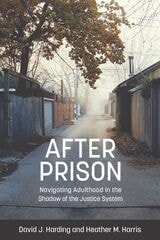
After Prison
Navigating Adulthood in the Shadow of the Justice SystemDavid J. Harding
Russell Sage Foundation, 2020
The transition to young adulthood typically includes school completion, full-time employment, leaving the childhood home, marriage, and childbearing, events that are disrupted by incarceration. While one quarter of the young men who participated in the study successfully transitioned into adulthood—achieving employment and residential independence and avoiding arrest and incarceration—the same number of young men remained deeply involved with the criminal justice system, spending on average four out of the seven years after their initial release re-incarcerated. Not surprisingly, whites are more likely to experience success after prison. The authors attribute this racial disparity to the increased stigma of criminal records for blacks, racial discrimination, and differing levels of social network support that connect whites to higher quality jobs. Black men earn less than white men, are more concentrated in industries characterized by low wages and job insecurity, and are less likely to remain employed once they have a job.
The authors demonstrate that families, social networks, neighborhoods, and labor market, educational, and criminal justice institutions can have a profound impact on young people’s lives. Their research indicates that residential stability is key to the transition to adulthood. Harding and Harris make the case for helping families, municipalities, and non-profit organizations provide formerly incarcerated young people access to long-term supportive housing and public housing. A remarkably large number of men in this study eventually enrolled in college, reflecting the growing recognition of college as a gateway to living wage work. But the young men in the study spent only brief spells in college, and the majority failed to earn degrees. They were most likely to enroll in community colleges, trade schools, and for-profit institutions, suggesting that interventions focused on these kinds of schools are more likely to be effective. The authors suggest that, in addition to helping students find employment, educational institutions can aid reentry efforts for the formerly incarcerated by providing supports like childcare and paid apprenticeships.
After Prison offers a set of targeted policy interventions to improve these young people’s chances: lifting restrictions on federal financial aid for education, encouraging criminal record sealing and expungement, and reducing the use of incarceration in response to technical parole violations. This book will be an important contribution to the fields of scholarly work on the criminal justice system and disconnected youth.
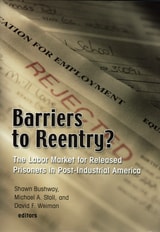
Barriers to Reentry?
The Labor Market for Released Prisoners in Post-Industrial AmericaShawn D. Bushway
Russell Sage Foundation, 2007

Beyond the Wire
Former Prisoners and Conflict Transformation in Northern IrelandPeter Shirlow and Kieran McEvoy
Pluto Press, 2008
This book provides the first detailed examination of the role played by former loyalist and republican prisoners in grass roots conflict transformation work in the Northern Ireland peace process. It challenges the assumed passivity of former prisoners and ex-combatants. Instead, it suggests that such individuals and the groups which they formed have been key agents of conflict transformation. They have provided leadership in challenging cultures of violence, developed practical methods of resolving inter-communal conflict and found ways for communities to explore their troubled past. In analysing this, the authors challenge the sterile demonisation of former prisoners and the processes that maintain their exclusion from normal civic and social life.
The book is a constructive reminder of the need for full participation of both former combatants and victims in post-conflict transformation. It also lays out a new agenda for reconciliation which suggests that conflict transformation can and should begin ‘from the extremes’.
The book will be of interest to students of criminology, peace and conflict studies, law and politics, geography and sociology as well as those with a particular interest in the Northern Ireland conflict.
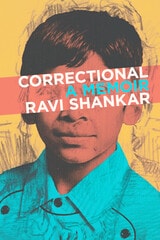
Correctional
Ravi Shankar
University of Wisconsin Press, 2021
Shankar’s bold and complex self-portrait—and portrait of America—challenges us to rethink our complicity in the criminal justice system and mental health policies that perpetuate inequity and harm. Correctional dives into the inner workings of his mind and heart, framing his unexpected encounters with law and order through the lenses of race, class, privilege, and his bicultural upbringing as the first and only son of South Indian immigrants. Vignettes from his early life set the scene for his spectacular fall and subsequent struggle to come to terms with his own demons. Many of them, it turns out, are also our own.
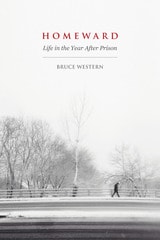
Homeward
Life in the Year After PrisonBruce Western
Russell Sage Foundation, 2018
Western and his research team conducted comprehensive interviews with men and women released from the Massachusetts state prison system who returned to neighborhoods around Boston. Western finds that for most, leaving prison is associated with acute material hardship. In the first year after prison, most respondents could not afford their own housing and relied on family support and government programs, with half living in deep poverty. Many struggled with chronic pain, mental illnesses, or addiction—the most important predictor of recidivism. Most respondents were also unemployed. Some older white men found union jobs in the construction industry through their social networks, but many others, particularly those who were black or Latino, were unable to obtain full-time work due to few social connections to good jobs, discrimination, and lack of credentials. Violence was common in their lives, and often preceded their incarceration. In contrast to the stereotype of tough criminals preying upon helpless citizens, Western shows that many former prisoners were themselves subject to lifetimes of violence and abuse and encountered more violence after leaving prison, blurring the line between victims and perpetrators.
Western concludes that boosting the social integration of former prisoners is key to both ameliorating deep disadvantage and strengthening public safety. He advocates policies that increase assistance to those in their first year after prison, including guaranteed housing and health care, drug treatment, and transitional employment. By foregrounding the stories of people struggling against the odds to exit the criminal justice system, Homeward shows how overhauling the process of prisoner reentry and rethinking the foundations of justice policy could address the harms of mass incarceration.
Life after Death Row
Exonerees' Search for Community and IdentitySaundra D. Westervelt and Kimberly J. Cook
Rutgers University Press, 2012
Life after Death Row examines the post-incarceration struggles of individuals who have been wrongly convicted of capital crimes, sentenced to death, and subsequently exonerated.
Saundra D. Westervelt and Kimberly J. Cook present eighteen exonerees’ stories, focusing on three central areas: the invisibility of the innocent after release, the complicity of the justice system in that invisibility, and personal trauma management. Contrary to popular belief, exonerees are not automatically compensated by the state or provided adequate assistance in the transition to post-prison life. With no time and little support, many struggle to find homes, financial security, and community. They have limited or obsolete employment skills and difficulty managing such daily tasks as grocery shopping or banking. They struggle to regain independence, self-sufficiency, and identity.
Drawing upon research on trauma, recovery, coping, and stigma, the authors weave a nuanced fabric of grief, loss, resilience, hope, and meaning to provide the richest account to date of the struggles faced by people striving to reclaim their lives after years of wrongful incarceration.
Living Black
Social Life in an African American NeighborhoodMark S. Fleisher
University of Wisconsin Press, 2015
Mark S. Fleisher offers a window into daily life in this neighborhood, particularly through the stories of Mo and Memphis Washington, who fight to sustain a stable home for their children, and of Burpee, a local man who has returned to the North End to rebuild his life after years of crime and punishment in Chicago.
“Outstanding” books for public & secondary school libraries from university presses, American Library Association
Marked
Race, Crime, and Finding Work in an Era of Mass IncarcerationDevah Pager
University of Chicago Press, 2007
Nearly every job application asks it: have you ever been convicted of a crime? For the hundreds of thousands of young men leaving American prisons each year, their answer to that question may determine whether they can find work and begin rebuilding their lives.
The product of an innovative field experiment, Marked gives us our first real glimpse into the tremendous difficulties facing ex-offenders in the job market. Devah Pager matched up pairs of young men, randomly assigned them criminal records, then sent them on hundreds of real job searches throughout the city of Milwaukee. Her applicants were attractive, articulate, and capable—yet ex-offenders received less than half the callbacks of the equally qualified applicants without criminal backgrounds. Young black men, meanwhile, paid a particularly high price: those with clean records fared no better in their job searches than white men just out of prison. Such shocking barriers to legitimate work, Pager contends, are an important reason that many ex-prisoners soon find themselves back in the realm of poverty, underground employment, and crime that led them to prison in the first place.
“Using scholarly research, field research in Milwaukee, and graphics, [Pager] shows that ex-offenders, white or black, stand a very poor chance of getting a legitimate job. . . . Both informative and convincing.”—Library Journal
“Marked is that rare book: a penetrating text that rings with moral concern couched in vivid prose—and one of the most useful sociological studies in years.”—Michael Eric Dyson

Night Sky, Morning Star
Evelina Zuni Lucero
University of Arizona Press, 2000
At the Indian artisans show in Santa Clara Pueblo, Cecelia Bluespruce sits with her wares in the middle of a row of booths—a good place to catch buyers. She is a successful Native American artist, a sculptor and potter of renown. But Cecelia is in the middle of something deeper than an art show, for she has become trapped by dreams and shadows of her past.
Night Sky, Morning Star is a story of remembrance and reconciliation in one Native American family separated by time and chance. Cecelia’s grown son, Jude, now wants to learn about the father he has never known. Political activist Julian Morning Star, imprisoned twenty years for a crime he did not commit, is unaware that his son even exists. Troubled by dreams, lies, and denial of the past, Cecelia is guided toward wholeness by family and friends who have their own pasts to confront.
This compelling novel plunges readers into the hubbub of the Indian arts market and into the grim reality of prison life. Evelina Zuni Lucero introduces us to experiences we may find unfamiliar: diverse Native American traditions, life on a BIA Indian agency compound, the making of an Indian activist. But she also reintroduces us to two things we all live for: the power of story and the power of love.
Night Sky, Morning Star is the fiction winner of the 1999 First Book Awards competition of the Native Writers’ Circle of the Americas.
Out of the Red
My Life of Gangs, Prison, and RedemptionChristian L. Bolden
Rutgers University Press, 2020
Faculty Senate Award for Research from Loyola University New Orleans
Out of the Red is one man’s pathbreaking story of how social forces and personal choices combined to deliver an unfortunate fate. After a childhood of poverty, institutional discrimination, violence, and being thrown away by the public education system, Bolden's life took him through the treacherous landscape of street gangs at the age of fourteen. The Bloods offered a sense of family, protection, excitement, and power. Incarcerated during the Texas prison boom, the teenage former gangster was thrust into a fight for survival as he navigated the perils of adult prison. As mass incarceration and prison gangs swallowed up youth like him, survival meant finding hope in a hopeless situation and carving a path to his own rehabilitation. Despite all odds, he forged a new path through education, ultimately achieving the seemingly impossible for a formerly incarcerated ex-gangbanger.

Pony
A PlaySylvan Oswald
Northwestern University Press, 2025
When Pony, a formerly incarcerated trans guy, moves to a small rural town to start a new life, he quickly becomes entangled with its isolated community. He starts to fall for a waitress who is obsessed with a local murder; he must comply with a butch social worker who doesn’t understand him; and he is pursued by a young trans man who thinks Pony could be the father he always wanted. Amid this whirlwind of fear and desire, Pony must find the strength to confront the stories he's been told about masculinity, violence, and self-worth. With a new preface by the author on searching for queer and trans community in the theater, and an afterword by critic Miriam Felton-Dansky contextualizing its place in contemporary theater, Pony is a seminal work of trans theater exploring questions of generational difference, class, and gender on an epic scale.
The Disenfranchisement of Ex-Felons
Elizabeth A. Hull, foreword by Representative John Conyers, Jr.
Temple University Press, 2006
The Disenfranchisement of Ex-Felons provides a comprehensive overview of the history, nature, and far-reaching sociological and political consequences of denying ex-felons the right to vote. Readers learn state practices in Florida and Ohio during the 2000 and 2004 presidential elections; arguments that have been used in court houses, legislatures, and the press to justify such practices; and attempts to reverse legislation through state and federal governments. In a timely appendix to the 2004 election, Elizabeth Hull makes her case that the battle for civil rights will not be won unless ex-felons, who have fulfilled their obligations to society, are restored the same rights afforded all other American citizens.
The Ex-Prisoner's Dilemma
How Women Negotiate Competing Narratives of Reentry and DesistanceLeverentz, Andrea M
Rutgers University Press, 2014
When a woman leaves prison, she enters a world of competing messages and conflicting advice. Staff from prison, friends, family members, workers at halfway houses and treatment programs all have something to say about who she is, who she should be, and what she should do. The Ex-Prisoner’s Dilemma offers an in-depth, firsthand look at how the former prisoner manages messages about returning to the community.
Over the course of a year, Andrea Leverentz conducted repeated interviews with forty-nine women as they adjusted to life outside of prison and worked to construct new ideas of themselves as former prisoners and as mothers, daughters, sisters, romantic partners, friends, students, and workers. Listening to these women, along with their family members, friends, and co-workers, Leverentz pieces together the narratives they have created to explain their past records and guide their future behavior. She traces where these narratives came from and how they were shaped by factors such as gender, race, maternal status, age, and experiences in prison, halfway houses, and twelve-step programs—factors that in turn shaped the women’s expectations for themselves, and others’ expectations of them. The women’s stories form a powerful picture of the complex, complicated human experience behind dry statistics and policy statements regarding prisoner reentry into society for women, how the experience is different for men and the influence society plays.
With its unique view of how society’s mixed messages play out in ex-prisoners’ lived realities, The Ex-Prisoner’s Dilemma shows the complexity of these women’s experiences within the broad context of the war on drugs and mass incarceration in America. It offers invaluable lessons for helping such women successfully rejoin society.
Unsettled Futures
Carceral Circuits and Old Age in JapanJason Danely
Vanderbilt University Press, 2024
Elderly ex-offenders are some of the most vulnerable and marginalized groups in Japan today, with high levels of poverty and homelessness, disability, mental health problems, and social isolation. Those with a history of incarceration and, by extension, their family, face stigma and discrimination that further erodes their ability to reintegrate and puts them at greater risk of reoffending. Unlike in any other country in the world, older people in Japan have a higher rate of reoffending than other age groups. In Unsettled Futures, author Jason Danely argues that we cannot dismiss these individuals merely as deviants; rather, their circumstances reveal deep contradictions in the overlapping terrain of welfare and punishment, and the precarity that forecloses on possibilities for older people to build a good life.