Results by title
5 books match the query 'Examinations'
Objectifying Measures
The Dominance of High-Stakes Testing and the Politics of SchoolingAmanda Walker Johnson
Temple University Press, 2009
In the past twenty years, the number of educational tests with high-stakes consequences—such as promotion to the next grade level or graduating from high school—has increased. At the same time, the difficulty of the tests has also increased. In Texas, a Latina state legislator introduced and lobbied for a bill that would take such factors as teacher recommendations, portfolios of student work, and grades into account for the students—usually students of color—who failed such tests. The bill was defeated.
Using several types of ethnographic study (personal interviews, observations of the Legislature in action, news broadcasts, public documents from the Legislature and Texas Education Agency), Amanda Walker Johnson observed the struggle for the bill’s passage. Through recounting this experience, Objectifying Measures explores the relationship between the cultural production of scientific knowledge (of statistics in particular) and the often intuitive resistance to objectification of those adversely affected by the power of policies underwritten as "scientific."
PMP Certification
A Beginner's Guide, Fourth EditionGeorge G. Angel
University Press of Colorado, 2023
This beginner’s guide will teach you real-world project management skills for any project and will help prepare you to become a certified Project Management Professional (PMP) or Certified Associate Project Manager (CAPM).
This fourth edition provides up-to-date information on how to effectively manage projects, programs, and portfolios to achieve organizational success. It includes tips and sample questions at the end of each chapter as well as a mock exam to help prepare you for the Project Management Institute (PMI) certification exams.
This text follows the three PMI domains: People, Business Environment, and Processes. A case study with detailed real-world examples, sample templates, and actual project documents guides you through your own projects, from charter to close, using all five project groups (initiating, planning, executing, monitoring and controlling, and closing projects).
This edition takes the standard processes and framework for traditional projects introduced in PMI’s sixth edition Project Management Body of Knowledge (PMBOK) and adds the new focus on Agile (adaptive) project management methods, tools, and techniques in PMBOK’s seventh edition to enhance your knowledge and ability to handle a wide range of projects.
Problem with Education Technology (Hint
It's Not the Technology)Ben Fink
Utah State University Press, 2016
Education is in crisis—at least, so we hear. And at the center of this crisis is technology. New technologies like computer-based classroom instruction, online K–12 schools, MOOCs (massive open online courses), and automated essay scoring may be our last great hope—or the greatest threat we have ever faced.
In The Problem with Education Technology, Ben Fink and Robin Brown look behind the hype to explain the problems—and potential—of these technologies. Focusing on the case of automated essay scoring, they explain the technology, how it works, and what it does and doesn’t do. They explain its origins, its evolution (both in the classroom and in our culture), and the controversy that surrounds it. Most significantly, they expose the real problem—the complicity of teachers and curriculum-builders in creating an education system so mechanical that machines can in fact often replace humans—and how teachers, students, and other citizens can work together to solve it.
Offering a new perspective on the change that educators can hope, organize, and lobby for, The Problem with Education Technology challenges teachers and activists on “our side,” even as it provides new evidence to counter the profit-making, labor-saving logics that drive the current push for technology in the classroom.
Test-Taking Strategies
Judi Kesselman-Turkel
University of Wisconsin Press, 2004
Test taking is a skill apart from learning course material, a skill every student must acquire in order to survive. Test-Taking Strategies is the book for anyone who has ever dreaded an exam.
Strategies for taking every kind of test are dealt with—objective tests (multiple choice, true/false, matching), essay tests, and oral exams. The authors also offer help for handling anxiety, explaining relaxation and desensitization techniques that help students control nervousness and keep it from detracting from performance. There are tips for managing time during the test, knowing when to guess, and for pulling answers out of your memory even when the question drew a blank at first glance.
Essay tests and oral exams are particularly gruesome for most students, and until now there has been very little advice for handling such tests. Test-Taking Strategies includes plenty of advice for developing ideas while under pressure.
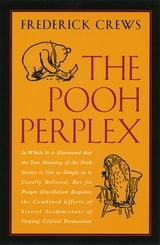
The Pooh Perplex
Frederick Crews
University of Chicago Press, 2003