Results by title
98 books match the query 'Existentialism' and 6 start with a
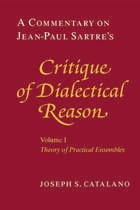
A Commentary on Jean-Paul Sartre's Critique of Dialectical Reason, Volume 1, Theory of Practical Ensembles
Joseph S. Catalano
University of Chicago Press, 1986
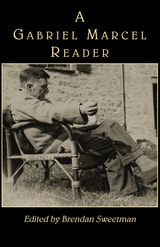
A Gabriel Marcel Reader
Gabriel Marcel
St. Augustine's Press, 2011
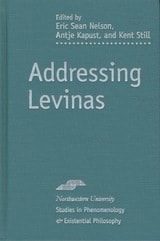
Addressing Levinas
Eric Sean Nelson
Northwestern University Press, 2005
In their radical singularity, these essays reveal the inalienable alterity at the heart of Levinas's ethics. At the same time, each essay remains open to the others, and to the perspectives and positions they advocate. Thus the volume, in its quality and diversity, enacts an authentic encounter with Levinas's thought, embodying an intellectual ethics by virtue of its style. Bringing together contributions from philosophy, theology, literary theory, gender studies, and political theory, this book offers a deeper and more thorough encounter with Levinas's ethics than any yet written.

After Poststructuralism
Transitions and TransformationsEdited by Rosi Braidotti
University of Chicago Press, 2010
From Kant to Kierkegaard, from Hegel to Heidegger, continental philosophers have indelibly shaped the trajectory of Western thought since the eighteenth century. Although much has been written about these monumental thinkers, students and scholars lack a definitive guide to the entire scope of the continental tradition. The most comprehensive reference work to date, this eight-volume History of Continental Philosophy will both encapsulate the subject and reorient our understanding of it. Beginning with an overview of Kant’s philosophy and its initial reception, the History traces the evolution of continental philosophy through major figures as well as movements such as existentialism, phenomenology, hermeneutics, and poststructuralism. The final volume outlines the current state of the field, bringing the work of both historical and modern thinkers to bear on such contemporary topics as feminism, globalization, and the environment. Throughout, the volumes examine important philosophical figures and developments in their historical, political, and cultural contexts.
The first reference of its kind, A History of Continental Philosophy has been written and edited by internationally recognized experts with a commitment to explaining complex thinkers, texts, and movements in rigorous yet jargon-free essays suitable for both undergraduates and seasoned specialists. These volumes also elucidate ongoing debates about the nature of continental and analytic philosophy, surveying the distinctive, sometimes overlapping characteristics and approaches of each tradition. Featuring helpful overviews of major topics and plotting road maps to their underlying contexts, A History of Continental Philosophy is destined to be the resource of first and last resort for students and scholars alike.
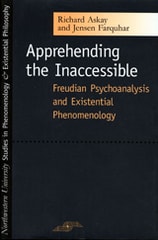
Apprehending the Inaccessible
Freudian Psychoanalysis and Existential PhenomenologyRichard Askay and Jensen Farquhar
Northwestern University Press, 2006
With its unique perspective on Freud's work, Apprehending the Inaccessible puts readers in a better position to appreciate his contributions and evaluate the relationship between his and other philosophical world views. The authors, both of whom have extensive backgrounds in philosophy and psychology, present balanced critical analyses of crucial developments in, for example, the evolution of the Freudian notion of the unconscious, and the engagement of existential phenomenology with Freudian psychoanalysis. Askay and Farquhar then consider—often for the first time—individual thinkers' reflections on and interpretations of Freud, ranging from the primary figures in existential phenomenology to the most prominent figures in the existential psychoanalytic movement. Even as their work offers a new approach to Freudian thought, it reasserts the importance of alternative views found in existential phenomenology as those views pertain to psychoanalysis and the question of apprehending the inaccessible.
At the Heart of Reason
Translated from the French by Michael B. Smith and Claude Romano
Northwestern University Press, 2015
Against the common view, which restricts the range of reason to logic and truth-theory alone, Romano advocates "big-hearted rationality," including in it what is only ostensibly its opposite, that is, sensibility, and locating in sensibility itself the roots of the categorical forms of thought. Contrary to what was claimed by the "linguistic turn," language is not a self-enclosed domain; it cannot be conceived in its specificity unless it is led back to its origin in the pre-predicative or pre-linguistic structure of experience itself.