Results by title
7 books match the query 'Experiments & Projects'
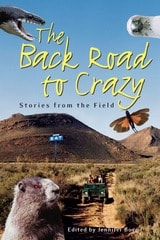
Back Road To Crazy
Stories From The FieldJennifer Bove
University of Utah Press, 2005
During five years of working in snake-ridden sloughs and rough northern seas, Jennifer Bové often asked herself 'Why am I doing this?' Realizing her own experiences were only the tip of the iceberg, she invited friends and colleagues to answer the same question. The result is stories that include deadly snakebites, a plague of marmots, special delivery skunk oil, bald eagle wrangling, and a mountain goat loose in the galley of a research vessel. These adventures are the details behind the data collected by these men and women driven to unlock nature’s truths. In The Back Road to Crazy, seasoned researchers and novices alike reveal the impulse to trade the comfort of a more sheltered career for demanding physical labor, whims of weather, and the company of unruly creatures.
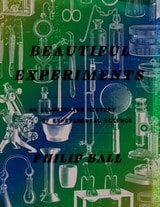
Beautiful Experiments
An Illustrated History of Experimental SciencePhilip Ball
University of Chicago Press, 2023
Featuring two hundred color plates, this history of the craft of scientific inquiry is as exquisite as the experiments whose stories it shares.
This illustrated history of experimental science is more than just a celebration of the ingenuity that scientists and natural philosophers have used throughout the ages to study—and to change—the world. Here we see in intricate detail experiments that have, in some way or another, exhibited elegance and beauty: in their design, their conception, and their execution. Celebrated science writer Philip Ball invites readers to marvel at and admire the craftsmanship of scientific instruments and apparatus on display, from the earliest microscopes to the giant particle colliders of today. With Ball as our expert guide, we are encouraged to think carefully about what experiments are, what they mean, and how they are used. Ranging across millennia and geographies, Beautiful Experiments demonstrates why “experiment” remains a contested notion in science, while also exploring how we came to understand the way the world functions, what it contains, and where the pursuit of that understanding has brought us today.
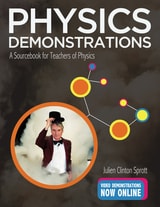
Physics Demonstrations
A Sourcebook for Teachers of PhysicsJulien Clinton Sprott
University of Wisconsin Press, 2015
Dr. Sprott shares demonstrations tested over many years in his popular public lectures on “The Wonders of Physics,” which appeal to general audiences and to students from grade school to graduate school. Science teachers at all levels will find a wealth of detail showing how to present these demonstrations to students with flair. Science professionals will find indispensable information for creating educational and entertaining public programs. Organized to teach the six major areas of classical physics—motion, heat, sound, electricity, magnetism, and light—Physics Demonstrations includes:
• a brief description of each demonstration
• materials lists, with sources for common materials
• preparation procedures
• discussions of the physics principles demonstrated
• potential safety hazards
• references for further information.
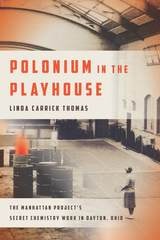
Polonium in the Playhouse
The Manhattan Project's Secret Chemistry Work in Dayton, OhioLinda Carrick Thomas
The Ohio State University Press, 2017
Seized by the War Department in 1944 for the bomb project, the Runnymede Playhouse was transformed into a polonium processing facility, providing a critical radioactive ingredient for the bomb initiator—the mechanism that triggered a chain reaction. With the help of a Soviet spy working undercover at the site, it was also key to the Soviet Union’s atomic bomb program.
The work was directed by industrial chemist Charles Allen Thomas who had been chosen by J. Robert Oppenheimer and General Leslie Groves to coordinate Manhattan Project chemistry and metallurgy. As one of the nation’s first science administrators, Thomas was responsible for choreographing the plutonium work at Los Alamos and the Project’s key laboratories. The elegant glass-roofed building belonged to his wife’s family.
Weaving Manhattan Project history with the life and work of the scientist, industrial leader and singing-showman Thomas, Polonium in the Playhouse offers a fascinating look at the vast and complicated program that changed world history and introduces the men and women who raced against time to build the initiator for the bomb.
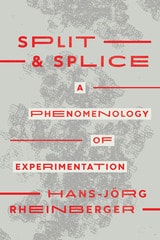
Split and Splice
A Phenomenology of ExperimentationHans-Jörg Rheinberger
University of Chicago Press, 2023
The experiment has long been seen as a test bed for theory, but in Split and Splice, Hans-Jörg Rheinberger makes the case, instead, for treating experimentation as a creative practice. His latest book provides an innovative look at the experimental protocols and connections that have made the life sciences so productive.
Delving into the materiality of the experiment, the first part of the book assesses traces, models, grafting, and note-taking—the conditions that give experiments structure and make discovery possible. The second section widens its focus from micro-level laboratory processes to the temporal, spatial, and narrative links between experimental systems. Rheinberger narrates with accessible examples, most of which are drawn from molecular biology, including from the author’s laboratory notebooks from his years researching ribosomes.
A critical hit when it was released in Germany, Split and Splice describes a method that involves irregular results and hit-or-miss connections—not analysis, not synthesis, but the splitting and splicing that form a scientific experiment. Building on Rheinberger’s earlier writing about science and epistemology, this book is a major achievement by one of today’s most influential theorists of scientific practice.

The Biology of Human Starvation
Volume IAncel Keys
University of Minnesota Press, 1950
The Biology of Human Starvation
Volume IIAncel Keys
University of Minnesota Press, 1950
The Biology of Human Starvation was first published in 1950. Minnesota Archive Editions uses digital technology to make long-unavailable books once again accessible, and are published unaltered from the original University of Minnesota Press editions.
With great areas of the world battling the persistent and basic problem of hunger, this work constitutes a major contribution to needed scientific knowledge. The publication is a definitive treatise on the morphology, biochemistry, physcology, psychology, and medical aspects of calorie undernutrition, cachexia, starvation, and rehabilitation in man.
Presented critically and systematically are the fact and theory from the world literature, including the evidence from World War II and the finding of the Minnesota Starvation Experiment (1944*1946). Pertinent experiments and field and clinical observations to 1949 are covered.
The extensive original research involved was conducted at the University of Minnesota Laboratory of Physiological Hygiene, which Dr. Keys heads. The authors, all of the laboratory staff, were assisted in preparation of the work by Ernst Simonson, Samuel Wells and Angie Sturgeon Skinner.