Results by title
38 books match the query 'Explorations'
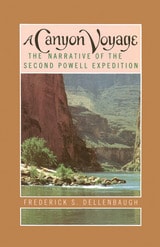
A Canyon Voyage
The Narrative of the Second Powell Expedition down the Green-Colorado River from Wyoming, and the Explorations on Land, in the Years 1871 and 1872Frederick S. Dellenbaugh
University of Arizona Press, 1980
"One of the seminal books on western history . . . The author was only 17 when he began the expedition, and he honestly hero-worshipped Powell all his life. Yet this bright, sharp account is so detailed and truthful that the reader can see through his enthusiasm to discover Powell's mean spirit and sometimes reckless nature. It's also a great river-running book." —Deseret News
"It was decidedly worth writing, this detailed record: a more absorbing, and at times stirring, story of adventure has not seen the light in a long time, and the author's unadorned, yet vivid, style enables the reader to share all the emotions of the explorers:" —The Nation
"In these later years (1909) when amateur travel in the west is frequent, a detailed record of this kind will be of value to seekers after adventure." —Science

A Transforming Faith
Explorations of Twentieth-Century American EvangelicalismDavid Harrington Watt
Rutgers University Press, 1991
Over the course of the twentieth century, evangelicals have in a variety of ways adjusted their world view to accommodate the changes in modern life. At the same time, there are important continuities between the ideas and attitudes of evangelicals in the 1920s and those of the late 1970s. Little attention has actually been paid to changes in this important social and political group since the Scopes trial and the election of 1976, when evangelical concerns played a major role in national politics. David Watt, in this readable and persuasive book, examines what happened in that fifty-year period. This book is an intellectual history of the evangelical movement in the period of its rise to prominence and power.
What Watt finds is that changes were more striking than continuities. Many of these changes manifested themselves in shifts of focus--from an emphasis on the second coming of Christ to the family, from privatization to politicization of religious concerns, from an antipathy to therapeutic practices to an acceptance of many of the assumptions of modern psychology. Watt believes that evangelicalism, as every other "ism," is subject to the influence of conflicting ideologies.
The book explores ideas and attitudes, not practice. It is based on the popular literature produced by evangelicals. In many ways it does not develop and prove a thesis; rather, it puts what we think we know about the experience of evangelicalism in this country into the context of the lives of evangelicals themselves.
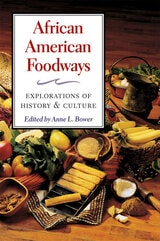
African American Foodways
Explorations of History and CultureEdited by Anne L. Bower
University of Illinois Press, 2006
Ranging from seventeenth-century West African fare to contemporary fusion dishes using soul food ingredients, the essays in this book provide an introduction to many aspects of African American foodways and an antidote to popular misconceptions about soul food. Examining the combination of African, Caribbean, and South American traditions, the volume's contributors offer lively insights from history, literature, sociology, anthropology, and African American studies to demonstrate how food's material and symbolic values have contributed to African Americans' identity for centuries. Individual chapters examine how African foodways survived the passage into slavery, cultural meanings associated with African American foodways, and the contents of African American cookbooks, both early and recent.
Contributors are Anne L. Bower, Robert L. Hall, William C. Whit, Psyche Williams-Forson, Doris Witt, Anne Yentsch, Rafia Zafar.
Apples and Oranges
Explorations In, On, and With ComparisonBruce Lincoln
University of Chicago Press, 2018
Lincoln presents critiques of recent attempts at grand comparison, and enlists numerous theoretical examples of how a more modest, cautious, and discriminating form of comparison might work and what it can accomplish. He does this through studies of shamans, werewolves, human sacrifices, apocalyptic prophecies, sacred kings, and surveys of materials as diverse and wide-ranging as Beowulf, Herodotus’s account of the Scythians, the Native American Ghost Dance, and the Spanish Civil War.
Ultimately, Lincoln argues that concentrating one's focus on a relatively small number of items that the researcher can compare closely, offering equal attention to relations of similarity and difference, not only grants dignity to all parties considered, it yields more reliable and more interesting—if less grandiose—results. Giving equal attention to the social, historical, and political contexts and subtexts of religious and literary texts also allows scholars not just to assess their content, but also to understand the forces, problems, and circumstances that motivated and shaped them.
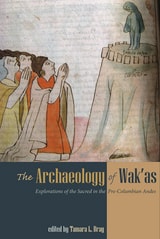
Archaeology of Wak'as
Explorations of the Sacred in the Pre-Columbian AndesTamara L. Bray
University Press of Colorado, 2014
Wak'as were understood as agentive, nonhuman persons within many Andean communities and were fundamental to conceptions of place, alimentation, fertility, identity, and memory and the political construction of ecology and life cycles. The ethnohistoric record indicates that wak'as were thought to speak, hear, and communicate, both among themselves and with humans. In their capacity as nonhuman persons, they shared familial relations with members of the community, for instance, young women were wed to local wak'as made of stone and wak'as had sons and daughters who were identified as the mummified remains of the community's revered ancestors.
Integrating linguistic, ethnohistoric, ethnographic, and archaeological data, The Archaeology of Wak'as advances our understanding of the nature and culture of wak'as and contributes to the larger theoretical discussions on the meaning and role of–"the sacred” in ancient contexts.
Beyond Image and Convention
Explorations in Southern Women's HistoryEdited by Janet L. Coryell, Martha H. Swain, Sandra Goioa Treadway, & ElizabethHayes Turner
University of Missouri Press, 1998
Despite their prevailing image and stereotype, southern women have often gone "beyond convention," living on their own terms within a society that revered tradition and compliance. Spanning the colonial era to the mid-twentieth century, Beyond Image and Convention documents women from widely varied social, economic, religious, and ethnic backgrounds who acted outside the accepted gender boundaries of their day.
Reflecting the quality and breadth of current scholarship in the field of southern women's history, this collection of essays relies upon previously untapped documentary evidence and, in the process, crafts provocative new interpretations of our collective past. The essays explore the historical experience of black and white southern women across nearly three centuries, including a white woman's sexual misconduct in colonial North Carolina, one slave woman's successful attempt to carve out an autonomous existence in southwestern Virginia, an ex-slave's fight for freedom in postbellum Missouri, and the civil rights activism of two white southern women—Sarah Patton Boyle of Virginia and Alice Norwood Spearman of South Carolina.
Breaking new ground in the study of women's history, Beyond Image and Convention provides valuable insights for both specialists and general readers.
Culture, Power, Place
Explorations in Critical AnthropologyAkhil Gupta and James Ferguson, eds.
Duke University Press, 1997
This collection of both new and well-known essays begins by critically exploring the concepts of locality and community; first, as they have had an impact on contemporary global understandings of displacement and mobility, and, second, as they have had a part in defining identity and subjectivity itself. With sites of discussion ranging from a democratic Spain to a Puerto Rican barrio in North Philadelphia, from Burundian Hutu refugees in Tanzania to Asian landscapes in rural California, from the silk factories of Hangzhou to the long-sought-after home of the Palestinians, these essays examine the interplay between changing schemes of categorization and the discourses of difference on which these concepts are based. The effect of the placeless mass media on our understanding of place—and the forces that make certain identities viable in the world and others not—are also discussed, as are the intertwining of place-making, identity, and resistance as they interact with the meaning and consumption of signs. Finally, this volume offers a self-reflective look at the social and political location of anthropologists in relation to the questions of culture, power, and place—the effect of their participation in what was once seen as their descriptions of these constructions. Contesting the classical idea of culture as the shared, the agreed upon, and the orderly, Culture, Power, Place is an important intervention in the disciplines of anthropology and cultural studies.
Contributors. George E. Bisharat, John Borneman, Rosemary J. Coombe, Mary M. Crain, James Ferguson, Akhil Gupta, Kristin Koptiuch, Karen Leonard, Richard Maddox, Lisa H. Malkki, John Durham Peters, Lisa Rofel
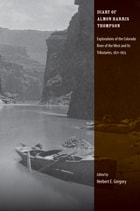
Diary of Almon Harris Thompson
Explorations of the Colorado River of the West and Its Tributaries, 1871-1875Herbert E Gregory
University of Utah Press, 2009
Originally published in 1939 as volume seven of the Utah Historical Quarterly, Thompson’s journal is reprinted here for the first time in seventy years. Co-published with the Utah State Historical Society.
Discovering Design
Explorations in Design StudiesEdited by Richard Buchanan and Victor Margolin
University of Chicago Press, 1995
The contributors (Gianfranco Zaccai, Albert Borgmann, Richard Buchanan, Augusto Morello, Tufan Orel, Nigel Cross, Victor Margolin, Langdon Winner, Carl Mitcham, Tony Fry, and Ezio Manzini) focus on three broad themes that form a sequence of fundamental issues: how to shape design as a subject matter, how to distinguish the activity of designing in the complex world of action, and how to address the basic questions of value and responsibility that persistently arise in the discussion and practice of design. The editors' introduction provides a useful overview of these questions and offers a multidisciplinary framework for design studies. The essays discuss such topics as the relation of aesthetics to technology, the place of design in social action, the role of the consumer in design decisions, and the need for ethical practice in contemporary design. Manzini's concluding essay shows how the issue of ethics should connect responsible behavior to decisions made every day in the manufacture of objects.
Eric Voegelin and the Continental Tradition
Explorations in Modern Political ThoughtEdited by Lee Trepanier & Steven F. McGuire
University of Missouri Press, 2011
Explorations in Behavioral Archaeology
William H. Walker and James M. Skibo
University of Utah Press, 2015
Behavioral archaeology, defined as the study of people-object interactions in all times and places, emerged in the 1970s, in large part because of the innovative work of Michael Schiffer and colleagues. This volume provides an overview of how behavioral archaeology has evolved and how it has affected the field of archaeology at large.
The contributors to this volume are Schiffer’s former students, from his first doctoral student to his most recent. This generational span has allowed for chapters that reflect Schiffer’s research from the 1970s to 2012. They are iconoclastic and creative and approach behavioral archaeology from varied perspectives, including archaeological inference and chronology, site formation processes, prehistoric cultures and migration, modern material culture variability, the study of technology, object agency, and art and cultural resources. Broader questions addressed include models of inference and definitions of behavior, study of technology and the causal performances of artifacts, and the implications of artifact causality in human communication and the flow of behavioral history.
Explorations in Early Southeast Asian History
The Origins of Southeast Asian StatecraftKenneth R. Hall and John K. Whitmore, Editors
University of Michigan Press, 1976
Explorations in Economic Sociology
Richard Swedberg
Russell Sage Foundation, 1993
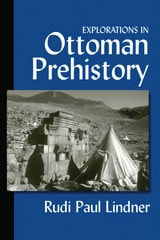
Explorations in Ottoman Prehistory
Rudi Paul Lindner
University of Michigan Press, 2007
The origins of the Ottomans, whose enterprise ruled much of the Near East for more than half a millennium, have long tantalized and eluded scholars, many of whom have thrown up their hands in exasperation. While the later fourteenth- and fifteenth-century history of the Ottomans has become better known, the earlier years have proved an alluring and recalcitrant puzzle. A reconsideration of the sources and a canvass of new ones has long been overdue. Rudi Paul Lindner’s Explorations in Ottoman Prehistory is the first book in over sixty years to reassess the overture to Ottoman history.
In addition to conducting a critical examination of the Ottoman chronicles and the Byzantine annals, Lindner develops hitherto unutilized geographic data and previously unknown numismatic evidence and also draws on travelers’ descriptions of the Anatolian landscape in an earlier epoch. By investigating who the Ottomans were, where they came from, and where they settled and why, as well as what sort of relationships they had with their neighbors in the late thirteenth and early fourteenth centuries, Lindner makes an engaging and lucid contribution to an otherwise very small store of knowledge of Ottoman history in the early stages of the empire.
Rudi Paul Lindner is Professor of History at the University of Michigan and author of Nomads and Ottomans in Medieval Anatolia,part of Indiana University’s Uralic and Altaic Series.
Explorations in Political Psychology
Shanto Iyengar and William J. McGuire, eds.
Duke University Press, 1993
historical evolution as an area of inquiry to the rich and eclectic array of theories, concepts, and methods that mark it as an emerging discipline.
In introductory essays, editors Shanto Iyengar and William J. McGuire identify the points of exchange between the disciplines represented and discuss the issues that make up the subfields of political psychology. Bringing together leading scholars from social psychology and political science, the following sections discuss attitude research (the study of political attitudes and opinions); cognition and information-processing (the relationship between the structures of human information-processing and political and policy preferences); and decision making (how people make decisions about political preferences).
As a comprehensive introduction to a growing field of interdisciplinary concern, Explorations in Political Psychology will prove a useful guide for historians, social psychologists, and political scientists with an interest in individual political behavior.
Contributors. Stephen Ansolabehere, Donald Granberg, Shanto Iyengar, Robert Jervis, Milton Lodge, Roger D. Masters, William J. McGuire, Victor C. Ottati, Samuel L. Popkin, William M. Runyan, David O. Sears, Patrick Stroh, Denis G. Sullivan, Philip E. Tetlock, Robert S. Wyer, Jr.

Explorations in the Economics of Aging
Edited by David A. Wise
University of Chicago Press, 2011
The next two decades will mark a new phase in the demographic transition of the United States as baby boomers become eligible for Social Security and Medicare. Drawing on evidence from the United States and other nations, Explorations in the Economics of Aging yields important new findings on how economic decisions by households and policy choices by governments will influence the effects of this demographic shift. It explores topics such as the implications of differential mortality rates by income on Social Security, the link between cognition and economic outcomes, and scale variations in self-reported work disability. This volume will be an important reference for economists and policymakers alike.
Forms of Knowledge in Early Modern Asia
Explorations in the Intellectual History of India and Tibet, 1500-1800Sheldon Pollock, ed.
Duke University Press, 2011
Contributors. Muzaffar Alam, Imre Bangha, Aditya Behl, Allison Busch, Sumit Guha, Janet Gyatso, Matthew T. Kapstein, Françoise Mallison, Sheldon Pollock, Velcheru Narayana Rao, Kurtis R. Schaeffer, Sunil Sharma, David Shulman, Sanjay Subrahmanyam, Mohamad Tavakoli-Targhi
How Many Exceptionalisms?
Explorations in Comparative MacroanalysisAristide R. Zolberg
Temple University Press, 2008
The essays in How Many Exceptionalisms? span the long history of the intellectual output of Aristide Zolberg, one of the most distinguished social scientists of our time. In this collection, Zolberg shows his originality, insights, and breadth of thought as he addresses subjects ranging from theories of immigration policy, the making of Belgium, and the origins of the modern world system.
Written over three decades, and featuring many essays that have not been in wide circulation, Zolberg here draws from political science, cultural anthropology, sociology, and history to provide a configurative analysis of and long-term approach to the cultural diversity in Africa, Europe, and the United States.
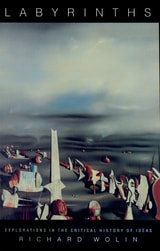
Labyrinths
Explorations in the Critical History of IdeasRichard Wolin
University of Massachusetts Press, 1995
This book offers a series of probing reflections on issues at the heart of recent debates in philosophy, literary theory, and intellectual history. In ten powerfully articulated essays, Richard Wolin calls into question the implied radicalism of the so-called postmodern turn, exposes the unstated agenda of neoconservative cultural theory, and provides a major reinterpretation of Walter Benjamin’s place in contemporary cultural studies.
At the center of the book lie the peculiar and troubling affinities between two groups of cultural critics usually seen as antithetical: the radical conservative thinkers of Germany’s Weimar Republic and the French poststructuralists who came to the prominence in the aftermath of the May 1968 uprising.
Wolin concludes the volume with a cogent reappraisal of “antihumanism” as a leitmotif of postwar French intellectual culture, along with a reassessment of the “de Man affair” and its implications for the poststructuralist interpretation of fascism.

Lesbian Psychologies
EXPLORATIONS AND CHALLENGESEdited by the Boston Lesbian Psychologies Collective
University of Illinois Press, 1987
Literature, Analytically Speaking
Explorations in the Theory of Interpretation, Analytic Aesthetics, and EvolutionBy Peter Swirski
University of Texas Press, 2010
In a new approach to interdisciplinary literary theory, Literature, Analytically Speaking integrates literary studies with analytic aesthetics, girded by neo-Darwinian evolution. Scrutinizing narrative fiction through a lens provided by analytic philosophy, revered literary theorist Peter Swirski puts new life into literary theory while fashioning a set of practical guidelines for critics in the interpretive trenches.
Dismissing critical inquirers who deny intention its key role in the study of literary reception, Swirski extends the defense of intentionality to art and to human behavior in general. In the process, Swirski takes stock of the recent work in evolutionary theory, arguing that the analysis of narrative truth may be grounded in the neo-Darwinian paradigm which forms the empirical backbone behind his analytic approach. Literature, Analytically Speaking provides a series of precepts designed to capture the ways in which we do interpret (and ought to interpret) works of literature. Reflecting a resounding shift from the poststructuralist paradigm, Swirski's lively and colorful presentation, backed up by a dazzling variety of examples and case studies, reconceptualizes the aesthetics of literature and literary studies.

My Private Lennon
Explorations from a Fan Who Never ScreamedSibbie O'Sullivan
The Ohio State University Press, 2020
My Private Lennon charts the author’s realization that the Beatles, especially John Lennon, were a crucial force in her development. A radical departure from other books written by Beatles fans, My Private Lennon invites its readers to consider subjects not usually found in works about Lennon and the band, such as the constraints of memory, the male body, grief, the female breast, race, cultural issues, and the importance of privacy in our over-mediated world. In pieces that engage cultural issues and historical contexts, My Private Lennon creates a witty and provocative intimacy with readers who value the power of art to change one’s life and who love John Lennon and the Beatles.
Nietzsche's New Seas
Explorations in Philosophy, Aesthetics, and PoliticsEdited by Michael Allen Gillespie and Tracy B. Strong
University of Chicago Press, 1988

No Place Else
Explorations in Utopian and Dystopian FictionEric S Rabkin
Southern Illinois University Press, 1983
Writers have created fictions of social perfection at least since Plato’s Republic. Sir Thomas More gave this thread of intellectual history a name when he called his contribution to it Utopia, Greek for noplace.
With each subsequent author cognizant of his predecessors and subject to altered real-world conditions which suggest ever-new causes for hope and alarm, “no place” changed. The fourteen essays presented in this book critically assess man’s fascination with and seeking for “no place.”
“In discussing these central fictions, the contributors see ‘no place’ from diverse perspectives: the sociological, the psychological, the political, the aesthetic. In revealing the roots of these works, the contributors cast back along the whole length of utopian thought. Each essay stands alone; together, the essays make clear what ‘no place’ means today. While it may be true that ‘no place’ has always seemed elsewhere or elsewhen, in fact all utopian fiction whirls contemporary actors through a costume dance no place else but here.”—from the Preface
The contributors are Eric S. Rabkin, B. G. Knepper, Thomas J.Remington, Gorman Beauchamp, William Matter, Ken Davis, Kenneth M. Roemer, William Steinhoff, Howard Segal, Jack Zipes, Kathleen Woodward, Merritt Abrash, and James W. Bittner.
Picturing Culture
Explorations of Film and AnthropologyJay Ruby
University of Chicago Press, 2000
The book begins with analyses of key filmmakers (Robert Flaherty, Robert Garner, and Tim Asch) who have striven to generate profound statements about human behavior on film. Ruby then discusses the idea of research film, Eric Michaels and indigenous media, the ethics of representation, the nature of ethnography, anthropological knowledge, and film and lays the groundwork for a critical approach to the field that borrows selectively from film, communication, media, and cultural studies. Witty and original, yet intensely theoretical, this collection is a major contribution to the field of visual anthropology.

Place in American Fiction
Excursions and ExplorationsEdited by H.L. Weatherby & George Core
University of Missouri Press, 2004
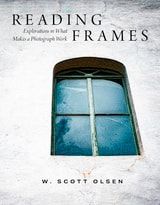
Reading Frames
Explorations in What Makes a Photograph WorkW. Scott Olsen
University of Utah Press, 2026
A collaboration between English professor and photographer W. Scott Olsen and Tomasz Trzebiatowski, founder of Frames magazine, Reading Frames gathers sixty-nine photographs first featured in Frames’ digital companion. Olsen’s essays interrogate the compositional and aesthetic elements of the photographs, but rather than offering technical instruction, Olsen writes with a literary sensibility, tracing how light, tone, color, and line evoke mood, meaning, and story. The essays ask us to linger with each photograph, guiding readers toward attentiveness, presence, and conversation with the image itself. Suited both to introductory photography classes and to general readers, this book is an example of how truly seeing an image is not the same as looking at it.
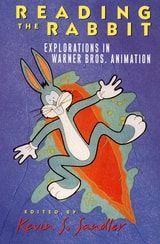
Reading the Rabbit
Explorations in Warner Bros. AnimationSandler, Kevin S
Rutgers University Press, 1998
"A wide-ranging inquiry into an important area of contemporary scholarly interest, and also an engaging, well written and intelligently conceived collection." -Eric Smoodin, author of Animating Culture: Hollywood Cartoons From the Sound Era
Despite the success of Bugs Bunny, Daffy Duck, and their Looney cohorts, Warner Bros. animation worked in the shadow of Disney for many years. The past ten years have seen a resurgence in Warner Bros. animation as they produce new Bugs Bunny cartoons and theatrical features like Space Jam as well as television shows like Tiny Toon Adventures and Animaniacs. While Disney's animation plays it safe and mirrors traditional cinema stories, Warner Bros. is known for a more original and even anarchistic style of narration, a willingness to take risks in story construction, a fearlessness in crossing gender lines with its characters, and a freedom in breaking boundaries. This collection of essays looks at the history of Warner Bros. animation, compares and contrasts the two studios, charts the rise and fall of creativity and daring at Warner's, and analyzes the ways in which the studio was for a time transgressive in its treatment of class, race, and gender. It reveals how safety and commercialization have, in the end, triumphed at Warner Bros. just as they much earlier conquered Disney.
The book also discusses fan parodies of Warner Bros. animation on the Internet today, the Bugs Bunny cross-dressing cartoons, cartoons that were censored by the studio, and the merchandising and licensing strategies of the Warner Bros. studio stores. Contributors are Donald Crafton, Ben Fraser, Michael Frierson, Norman M. Klein, Terry Lindvall, Bill Mikulak, Barry Putterman, Kevin S. Sandler, Hank Sartin, Linda Simensky, Kirsten Moana Thompson, Gene Walz, and Timothy R. White.
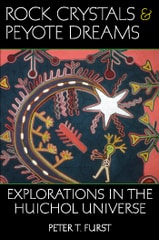
Rock Crystals and Peyote Dreams
Explorations in the Huichol UniverseFurst, Peter T
University of Utah Press, 2006
In the mid-1960s, Peter T. Furst began a lifelong encounter with their intellectual culture, facilitated by a growing relationship of mutual trust with Ramón Medina, an aspiring Huichol shaman, storyteller, and artist, and his wife Guadalupe de la Cruz Ríos. Ramón, who became a full-fledged shaman with his fifth peyote pilgrimage, also had a Huichol name: 'Uru Temay, Young Arrow Person.' Over the years Furst published a number of articles on various facets of Huichol life, many of them centered on what he learned and observed during his growing relationship with Ramón and his people.
Bound together by personal reminiscences and background explanations, Furst here brings many of those articles together and updates them. It includes transcriptions of myths that function as charters for 'being Huichols,' descriptions of deities, rituals, beliefs, as well as discussion of the place of hallucinogens in Huichol culture. Furst skillfully weaves current reflections with memories and older material in a manner that makes for a highly readable, contemporary presentation.
Social Structure and Testosterone
Explorations in the Socio-Bio-Social ChainKemper, Theodore D
Rutgers University Press, 1990

The Foreign Missionary Enterprise at Home
Explorations in North American Cultural HistoryEdited by Daniel H. Bays and Grant Wacker
University of Alabama Press, 2010
This volume is the first to examine at length and in detail the impact of the missionary experience on American cultural, political, and religious history.
This collection of 15 essays provides a fully developed account of the domestic significance of foreign missions from the 19th century through the Vietnam War. U.S. and Canadian missions to China, South America, Africa, and the Middle East have, it shows, transformed the identity and purposes of their mother countries in important ways. Missions provided many Americans with their first significant exposure to non-Western cultures and religions. They helped to establish a variety of new academic disciplines in home universities—linguistics, anthropology, and comparative religion among them. Missionary women helped redefine gender roles in North America, and missions have vitalized tiny local churches as well as entire denominations, causing them to rethink their roles and priorities, both here and abroad. In fact, missionaries have helped define our own national identity by influencing our foreign, trade, military, and immigration policies over the last two centuries.
Topics in the collection range from John Saillant's essay on the missions of free African Americans to Liberia in the 19th century to Grant Wacker's essay on the eventual disillusionment of noted writer Pearl S. Buck. Kathryn T. Long’s essay on the “Auca martyrs” offers a sobering case study of the missionary establishment's power to, in tandem with the evangelical and secular press, create and record the stories of our time. William L. Svelmoe documents the improbable friendship between fundamentalist Bible translator William Cameron Townsend and Mexico’s secular socialist president Lázaro Cárdenas. And Anne Blue Wills details the ways many American groups—black, Protestant, Catholic, and Mormon—sought to convert one another, stead-
fastly envisioning “others” as every bit as “heathen” as those in far-off lands.
The Foreign Missionary Enterprise at Home is an insightful, provocative collection that will stimulate much discussion and debate. It is valuable for academic libraries and seminaries, scholars of religious history and American studies, missionary groups, cultural historians and ethnographers, and political scientists.
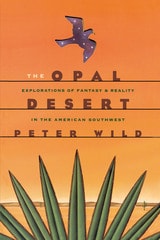
The Opal Desert
Explorations of Fantasy and Reality in the American SouthwestBy Peter Wild
University of Texas Press, 1999
The opalescent deserts of the American Southwest have become romantic icons in the public imagination through the words of writers, the images of artists and photographers, and the visual storytelling of filmmakers. In this spirited, personal, beautifully written book, Peter Wild explores the lives and works of sixteen writers whose words have shaped our visions of the opal desert.
Wild begins with Cabeza de Vaca, whose Relación of his desert wanderings sent treasure-hungry Spaniards searching for cities of gold. He goes on to discuss the works of both widely read and lesser-known nineteenth- and twentieth-century authors, including such luminaries as Mary Austin, Joseph Wood Krutch, Edward Abbey, Ann Zwinger, and Charles Bowden. He links all the writers as explorers of one kind or another, searching for tangible or intangible treasures, some finding and some losing their dreams in the opal desert.
The Pragmatic Mind
Explorations in the Psychology of BeliefMark Bauerlein
Duke University Press, 1997
Bauerlein extracts from Emerson, James, and Peirce an intellectual focus that can be used to advance the broad social and academic reforms that the new pragmatists hail. He claims that, in an effort to repudiate the phony universalism of much contemporary theory, the new generation of theorists has ignored the fact that its visions of pragmatic action are grounded in this "old" school, not just in a way of doing things but also in a way of thinking about things. In other words, despite its inclination to regard psychological questions as irrelevant, Bauerlein shows that the pragmatic method demands a pragmatic mind—that is, a concept of cognition, judgment, habit, and belief. He shows that, in fact, such a concept of mind does exist, in the work of the "old" pragmatists.
Troubling Nationhood in U.S. Latina Literature
Explorations of Place and BelongingSocolovsky, Maya
Rutgers University Press, 2013
Looking at such concerns as nation, place, trauma, and storytelling, writers Denise Chavez, Sandra Cisneros, Esmeralda Santiago, Ana Castillo, Himilce Novas, and Judith Ortiz Cofer challenge popular views of Latino cultural “unbelonging” and make strong cases for the legitimate presence of Latinas/os within the United States. In this way, they also counter much of today’s anti-immigration rhetoric.
Imagining the U.S. as part of a broader "Americas," these writings trouble imperialist notions of nationhood, in which political borders and a long history of intervention and colonization beyond those borders have come to shape and determine the dominant culture's writing and the defining of all Latinos as "other" to the nation.
Universalism without Uniformity
Explorations in Mind and CultureEdited by Julia L. Cassaniti and Usha Menon
University of Chicago Press, 2017
The contributors to Universalism without Uniformity offer tools for bridging silos that have historically separated anthropology’s attention to culture and psychology’s interest in universal mental processes. Throughout, they seek to answer intricate yet fundamental questions about why we are motivated to find meaning in everything around us and, in turn, how we constitute the cultural worlds we inhabit through our intentional involvement in them. Laying bare entrenched disciplinary blind spots, this book offers a trove of insights on issues such as morality, emotional functioning, and conceptions of the self across cultures. Filled with impeccable empirical research coupled with broadly applicable theoretical reflections on taking psychological diversity seriously, Universalism without Uniformity breaks new ground in the study of mind and culture.

Warrior Ways
Explorations in Modern Military FolkloreEric Eliason and Tad Tuleja
Utah State University Press, 2012
Warrior Ways is one of the first book-length explorations of military folklife, and focuses on the lore produced by modern American warriors, illuminating the ways in which members of the armed services creatively express the complex experience of military life. In short, lively essays, contributors to the volume, all of whom have close personal or professional relationships to the military, examine battlefield talismans, personal narrative (storytelling), “Jody calls” (marching and running cadences), slang, homophobia and transgressive humor, music, and photography, among other cultural expressions.
Military folklore does not remain in an isolated subculture; it reveals our common humanity by delighting, disturbing, infuriating, and inspiring both those deeply invested in and those peripherally touched by military life. Highlighting the contemporary and historical importance of the military in American life, Warrior Ways will be of interest to scholars and students of folklore, anthropology, and popular culture; those involved in veteran services and education; and general readers interested in military culture.

Williamstown and Williams College
Explorations in Local HistoryDustin Griffin
University of Massachusetts Press, 2018
Well researched and written in an accessible style, Williamstown and Williams College is a must-have resource for anyone connected with Williams College—from students and parents to alumni—as well as visitors who want to understand what makes this town unique.
Wizards and Scientists
Explorations in Afro-Cuban Modernity and TraditionStephan Palmié
Duke University Press, 2002
Highlighting the ways that Afro-Cuban discourses serve as a means of moral analysis of social action, Palmié suggests that the supposedly irrational premises of Afro-Cuban religious traditions not only rival Western rationality in analytical acumen but are integrally linked to rationality itself. Afro-Cuban religion is as “modern” as nuclear thermodynamics, he claims, just as the Caribbean might be regarded as one of the world’s first truly “modern” locales: based on the appropriation and destruction of human bodies for profit, its plantation export economy anticipated the industrial revolution in the metropolis by more than a century. Working to prove that modernity is not just an aspect of the West, Palmié focuses on those whose physical abuse and intellectual denigration were the price paid for modernity’s achievement. All cultures influenced by the transcontinental Atlantic economy share a legacy of slave commerce. Nevertheless, local forms of moral imagination have developed distinctive yet interrelated responses to this violent past and the contradiction-ridden postcolonial present that can be analyzed as forms of historical and social analysis in their own right.