Results by title
5 books match the query 'Fables'
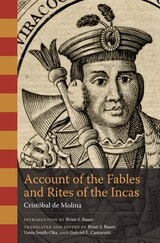
Account of the Fables and Rites of the Incas
By Cristóbal de Molina
University of Texas Press, 2011
Only a few decades after the Spanish conquest of Peru, the third Bishop of Cuzco, Sebastián de Lartaún, called for a report on the religious practices of the Incas. The report was prepared by Cristóbal de Molina, a priest of the Hospital for the Natives of Our Lady of Succor in Cuzco and Preacher General of the city. Molina was an outstanding Quechua speaker, and his advanced language skills allowed him to interview the older indigenous men of Cuzco who were among the last surviving eyewitnesses of the rituals conducted at the height of Inca rule. Thus, Molina's account preserves a crucial first-hand record of Inca religious beliefs and practices.
This volume is the first English translation of Molina's Relación de las fábulas y ritos de los incas since 1873 and includes the first authoritative scholarly commentary and notes. The work opens with several Inca creation myths and descriptions of the major gods and shrines (huacas). Molina then discusses the most important rituals that occurred in Cuzco during each month of the year, as well as rituals that were not tied to the ceremonial calendar, such as birth rituals, female initiation rites, and marriages. Molina also describes the Capacocha ritual, in which all the shrines of the empire were offered sacrifices, as well as the Taqui Ongoy, a millennial movement that spread across the Andes during the late 1560s in response to growing Spanish domination and accelerated violence against the so-called idolatrous religions of the Andean peoples.
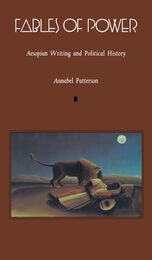
Fables of Power
Aesopian Writing and Political HistoryAnnabel Patterson
Duke University Press, 1991
Patterson begins with an analysis of the legendary Life of Aesop, its cultural history and philosophical implications, a topic that involves such widely separated figures as La Fontaine, Hegel, and Vygotsky. The myth’s origin is recovered here in the saving myth of Aesop the Ethiopian, black, ugly, who began as a slave but become both free and influential, a source of political wisdom. She then traces the early modern history of the fable from Caxton, Lydgate, and Henryson through the eighteenth century, focusing on such figures as Spenser, Sidney, Lyly, Shakespeare, and Milton, as well as the lesser-known John Ogilby, Sir Roger L’Estrange, and Samuel Croxall.
Patterson discusses the famous fable of The Belly and the Members, which, because it articulated in symbolic terms some of the most intransigent problems in political philosophy and practice, was still going strong as a symbolic text in the mid-nineteenth century, where it was focused on industrial relations by Karl Marx and by George Eliot against electoral reform.
Fables of Representation
EssaysPaul Hoover
University of Michigan Press, 2004
With its title essay, "Fables of Representation," one of the most cogent studies ever written of the New York School of poets (a group that includes the influential poet John Ashbery), this book is required reading for anyone who seeks to understand the poetry and culture of the postmodern period.
Author Paul Hoover's wide-ranging subjects include African-American interdisciplinary studies; the position of poetry in the electronic age; the notion of doubleness in the work of Harryette Mullen and others; the lyricism of the New York School poets; and the role of reality in American poetry. Hoover also introduces two provocative essays sure to generate attention and discussion: "The Postmodern Era: A Final Exam" and "The New Millennium: Fifty Statements on Literature and Culture."
Paul Hoover is the editor of the anthology Postmodern American Poetry and author of nine poetry collections, including Totem and Shadow: New and Selected Poems and Viridian. His poetry has appeared in American Poetry Review, The New Republic, and The Paris Review, among others. He is Poet-in-Residence at Columbia College, Chicago.

Fables, Foibles, and Foobles
Carl Sandburg
University of Illinois Press, 1988
Sandburg often incorporated proverbs, riddles, aphorisms, and vernacular wisdom in lectures, poetry, children’s stories, and in his novel Remembrance Rock. Believing that silliness and fun helped preserve sanity and balance, he put together a collection of fanciful anecdotes - alive with alliteration - for his own amusement. Now, more than twenty years after his death, the publication of Fables, Foibles, and Foobles truly reveals, for perhaps the first time, the playful spirit of this great American poet.
George Hendrick has compiled the best of these never-before-published nonsensical pieces, which include Flies, Fleas, Flinyons, Flicks, Flooches, Flacks, Flatches, and assorted F-friends deep in dialogue about books and reading; the fascinating worlds of the curious hoomadooms, hongdorshes, and onkadonks; fables to rival Thurber; jokes about every conceivable type of nut; and cameo appearances by Hank the Honk and Flitty the Wid, among others. Robert Harvey’s whimsical drawings, scattered throughout the book, illuminate this charming cast of characters.
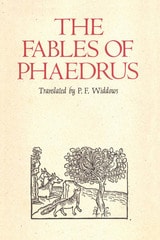
The Fables of Phaedrus
Translated by P. F. Widdows
University of Texas Press, 1992
Animal fables are said to have originated with Aesop, a semilegendary Samian slave, but the earliest surviving record of the fables comes from the Latin poet Phaedrus, who introduced the new genre to Latin literature. This verse translation of The Fables is the first in English in more than two hundred years.
In addition to the familiar animal fables, about a quarter of the book includes such diverse material as prologues and epilogues, historical anecdotes, short stories, enlarged proverbs and sayings, comic episodes and folk wisdom, and many incidental glimpses of Greek and Roman life in the classical period.
The Fables also sheds light on the personal history of Phaedrus, who seems to have been an educated slave, eventually granted his freedom by the emperor Augustus. Phaedrus' style is lively, clean, and sparse, though not at the cost of all detail and elaboration. It serves well as a vehicle for his two avowed purposes—to entertain and to give wise counsel for the conduct of life. Like all fabulists, Phaedrus was a moralist, albeit on a modest and popular level.
An excellent introduction by P. F. Widdows provides information about Phaedrus, the history of The Fables, the metric style of the original and of this translation, and something of the place of these fables in Western folklore. The translation is done in a free version of Anglo-Saxon alliterative verse, a form used by W. H. Auden and chosen here to match the popular tone of Phaedrus' Latin verse.