Results by title
3 books match the query 'Fagan, Patricia'
A Companion to Ancient Philosophy
Edited and with an introduction by Sean D. Kirkland and Eric Sanday
Northwestern University Press, 2018
Rather than offering synoptic and summary treatments of preestablished positions and themes, these essays engage with the ancient texts directly, focusing attention on concepts that emerge as urgent in the readings themselves and then clarifying those concepts interpretively. Indeed, this is a companion volume that takes a very serious and considered approach to its designated task—accompanying readers as they move through the most crucial passages of the infinitely rich and compelling texts of the ancients. Each essay provides a tutorial in close reading and careful interpretation.
Because it offers foundational treatments of the most important works of ancient philosophy and because it, precisely by doing so, arrives at numerous original interpretive insights and suggests new directions for research in ancient philosophy, this volume should be of great value both to students just starting off reading the ancients and to established scholars still fascinated by philosophy's deepest abiding questions.
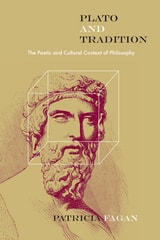
Plato and Tradition
The Poetic and Cultural Context of PhilosophyPatricia Fagan
Northwestern University Press, 2013
Plato’s dialogues are some of the most widely read texts in Western philosophy, and one would imagine them fully mined for elemental material. Yet, in Plato and Tradition, Patricia Fagan reveals the dialogues to be continuing sources of fresh insight. She recovers from them an underappreciated depth of cultural reference that is crucial to understanding their central philosophical concerns. Through careful readings of six dialogues, Fagan demonstrates that Plato’s presentation of Socrates highlights the centrality of tradition in political, erotic, and philosophic life. Plato embeds Socrates’s arguments and ideas in traditional references that would have been familiar to contemporaries of Socrates or Plato but that today’s reader typically passes over. Fagan’s book unpacks this cultural and literary context for the proper and full understanding of the philosophical argument of the Platonic dialogues. She concludes that, as Socrates demonstrates in word and deed, tradition is essential to successful living. But we must take up tradition with a critical openness to questioning its significance and future. Her original and compelling analyses may change the views of many readers who think themselves already well versed in the dialogues.
Reexamining Socrates in the Apology
Edited by Patricia Fagan and John Russon
Northwestern University Press, 2009
An oracle was reported to have said, "No one is wiser than Socrates." And in fact it was Socrates’ life’s work to interpret these words, which demanded and defined the practice of philosophy. Each of these original essays attends carefully to the specifics of the Apology, looking to its dramatic details, its philosophic teaching, and its complexity as a work of writing to bring into focus the "Socrates" of the Apology.
Overall, the contributors, distinguished scholars of ancient philosophy, share a belief in the unity of the letter and the spirit of Platonic philosophy: the conviction that the Platonic text cannot be reached except through reading and cannot be read except through thinking. In this way, the readings in this volume mirror Socrates’ own hermeneutical practice of uniting the demands of the mind and the demands of the text—the Socratic "examination." The result, true to the Socratic injunction that the unexamined life is not worth living, continues that practice of examination, here offering a reexamination of Socrates in the Apology.