Results by title
8 books match the query 'Failure (Psychology)'

Identity and the Failure of America
From Thomas Jefferson to the War on TerrorJohn Michael
University of Minnesota Press, 2008
From Thomas Jefferson to John Rawls, justice has been at the center of America’s self-image and national creed. At the same time, for many of its peoples-from African slaves and European immigrants to women and the poor-the American experience has been defined by injustice: oppression, disenfranchisement, violence, and prejudice.
In Identity and the Failure of America, John Michael explores the contradictions between a mythic national identity promising justice to all and the realities of a divided, hierarchical, and frequently iniquitous history and social order. Through a series of insightful readings, Michael analyzes such cultural moments as the epic dramatization of the tension between individual ambition and communal complicity in Moby-Dick, attempts to effect social change through sympathy in the novels of Lydia Marie Child and Harriet Beecher Stowe, Ralph Waldo Emerson’s antislavery activism and Frederick Douglass’s long fight for racial equity, and the divisive figures of John Brown and Nat Turner in American letters and memory.
Focusing on exemplary instances when the nature of the United States as an essentially conflicted nation turned to force, Michael ultimately posits the development of a more cosmopolitan American identity, one that is more fully and justly imagined in response to the nation’s ethical failings at home and abroad.
John Michael is professor of English and of visual and cultural studies at the University of Rochester. He is the author of Anxious Intellects: Academic Professionals, Public Intellectuals, and Enlightenment Values and Emerson and Skepticism: The Cipher of the World.

If at First You Don't Succeed?
Writing, Rhetoric, and the Question of FailureSteven J. Corbett
University Press of Colorado, 2025

Living On After Failure
Affective Structures of Modern LifeIrving Goh
Duke University Press, 2025

The Colonel's Dream
Charles W. Chesnutt
West Virginia University Press, 2014
Charles Waddell Chesnutt (1858-1932) was an African American writer, essayist, Civil Rights activist, legal-stenography businessman, and lawyer whose novels and short stories explore race, racism, and the problematic contours of African Americans’ social and cultural identities in post-Civil War South. He was the first African American to be published by a major American publishing house and served as a beacon-point for future African American writers.
The Colonel’s Dream, written in 1905, is a compelling tale of the post-Civil War South’s degeneration into a region awash with virulent racist practices against African Americans: segregation, lynchings, disenfranchisement, convict-labor exploitation, and endemic violent repression. The events in this novel are powerfully depicted from the point of view of a philanthropic but unreliable southern white colonel. Upon his return to the South, the colonel learns to abhor this southern world, as a tale of vicious racism unfolds. Throughout this narrative, Chesnutt confronts the deteriorating position of African Americans in an increasingly hostile South. Upon its publication The Colonel’s Dream was considered too controversial and unpalatable because of its bitter criticisms of southern white prejudice and northern indifference, and so this groundbreaking story failed to gain public attention and acclaim.
This is the first scholarly edition of The Colonel’s Dream. It includes an introduction and notes by R. J. Ellis and works to reestablish this great novel’s reputation.

The Failed Individual
Amid Exclusion, Resistance, and the Pleasure of Non-ConformityEdited by Katharina Motyl and Regina Schober
Campus Verlag, 2017
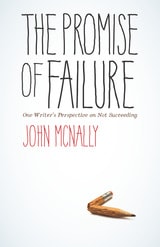
The Promise of Failure
One Writer's Perspective on Not SucceedingJohn McNally
University of Iowa Press, 2018
The Promise of Failure is part memoir of the writing life, part advice book, and part craft book; sometimes funny, sometimes wrenching, but always honest. McNally uses his own life as a blueprint for the writer’s daily struggles as well as the existential ones, tackling subjects such as when to quit and when to keep going, how to deal with depression, what risking something of yourself means, and ways to reenergize your writing through reinvention.
What McNally illuminates is how rejection, in its best light, is another element of craft, a necessary stage to move the writer from one project to the next, and that it’s best to see rejection and failure on a life-long continuum so that you can see the interconnectedness between failure and success, rather than focusing on failure as a measure of self-worth. As brutally candid as McNally can sometimes be, The Promise of Failure is ultimately an inspiring book—never in a Pollyannaish self-help way. McNally approaches the reader as a sympathetic companion with cautionary tales to tell. Written by an author who has as many unpublished books under his belt as published ones, The Promise of Failure is as much for the newcomer as it is for the established writer.

The Queer Art of Failure
Jack Halberstam
Duke University Press, 2011

The Whole of the Moon
A NovelBrian Rogers
University of Nevada Press, 2017
An actor sits poolside waiting to hear whether he has been cast in a television pilot. Two kids ditch school in 1964 and go for a hike in the woods that turns dangerous. A woman named Dot remembers her husband who spent years working on a musical adaptation of The Great Gatsby. A young woman Felicity deals with the consequences of an unexpected pregnancy. Mike, a former high school star, attends an open tryout for the California Angels baseball team. And a boarding school teacher tells the story of his cousin, a social climber who has disappeared in the wake of a murder. These are the characters that populate The Whole of the Moon. Brian Rogers’ novel is about determination and failure and life in Southern California away from the red carpet.