Results by title
3 books match the query 'Farina, Alfonso'

Polarimetric Radar Signal Processing
Augusto Aubry
The Institution of Engineering and Technology, 2022
Polarimetric Radar Signal Processing provides an overview of advanced techniques and technologies developed for polarimetric radars to meet challenging performance requirements. It aims to cover some of the most challenging application fields, including: target detection for active and passive surveillance systems, interference suppression, detection of temporal changes in a given scene, environment classification, automatic target recognition, non-cooperative target imaging, polarimetric coding in radar and SAR systems, pol-SAR ambiguities suppression, space-debris detection, tracking, and classification, estimation of biological and behavioural parameters of insects, precipitations localization as well as type and motion parameters estimation via real-life practical polarimetric weather radar.
[more]
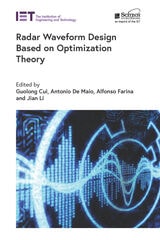
Radar Waveform Design based on Optimization Theory
Guolong Cui
The Institution of Engineering and Technology, 2020
This book provides an overview of radar waveform synthesis obtained as the result of computational optimization processes and covers the most challenging application fields. The book balances a practical point of view with a rigorous mathematical approach corroborated with a wealth of numerical study cases and some real experiments. Additionally, the book has a cross-disciplinary approach because it exploits cross-fertilization with the recent research and discoveries in optimization theory. The material of the book is organized into ten chapters, each one completed with a comprehensive list of references.
[more]
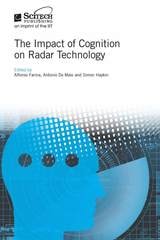
The Impact of Cognition on Radar Technology
Alfonso Farina
The Institution of Engineering and Technology, 2018
Cognitive dynamic systems are inspired by the computational capability of the brain and the viewpoint that cognition is a supreme form of computation. The key idea behind this new paradigm is to mimic the human brain as well as that of other mammals with echolocation capabilities which continuously learn and react to stimulations according to four basic processes: perception-action cycle, memory, attention, and intelligence.
[more]