Results by title
12 books match the query 'Yukon'

Han
People of the RiverCraig Mishler
University of Alaska Press, 2004
The history of the upper Yukon valley from the earliest Western contact with the Han in the 1840s has been one of continuous change. As a result of the gold rush, the Han suddenly became homeless in their own homeland. This book tells the story of that displacement and of current efforts by the Han to reclaim their lands and restore a vibrant way of life. In-depth profiles of Chief Isaac, Chief Charley, and others illustrate the critical importance of traditional leadership in stressful times.
Mishler and Simeone have carefully researched and compiled new information from historic records, adding their own, firsthand field observations and oral interviews with Elders during the 1970s, 1980s, and 1990s. They present detailed historical data on the fur trade, missionization, and the gold rush, as well as an analysis of Han social structure, settlement patterns, religion, subsistence, and expressive culture. The final chapter illustrates contemporary life in Eagle Village with two vivid ethnographic snapshots- a Christmas eve dance in 1972 and a long summer day in 1997. Appendices include a methodological essay, a historic chronology, rules for Han card games, and genealogies for many Han families. As a model of innovative ethnographic and ethnohistorical work, Han, People of the River makes an important contribution to anthropological and indigenous studies literature. As a vivid and deeply thoughtful depiction of the past, present, and future of the Han, it is meant for all Alaskans and everyone who cares about Alaska history and Alaska Native peoples.
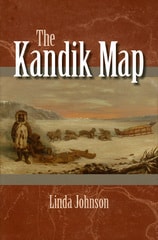
Kandik Map
Linda Johnson
University of Alaska Press, 2009

Klondike Women
True Tales of the 1897–1898 Gold RushMelanie J. Mayer
Ohio University Press, 1989
Challenging the myth that the only women who participated in gold rushes were prostitutes and gold-diggers of the euphemistic sort, Melanie Mayer shows us that Klondike women came from all walks of life—socialites to poor immigrants, single women, wives, widows, and children. They planned to make their money through many different undertakings including mining, business, entertainment, professional, and service enterprises. Their approaches to life were as varied as their roles—optimistic or skeptical; cautious or adventuresome; gregarious or self-contained; contemplative or active. There was no typical Klondike woman. Individually, their stories can be funny, hopeful, tragic, or poignant. Taken together, they give rich, complex images of the people, times, and places of the gold rush.
A visually exciting book, Klondike Women features over 150 photographs and illustrations. This volume should appeal not only to the general reader, but to those interested in history, women’s studies, and the Pacific Northwest as well.
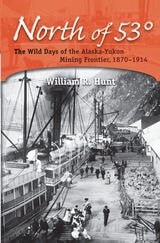
North of 53°
The Wild Days of the Alaska-Yukon Mining Frontier, 1870-1914William R. Hunt
University of Alaska Press, 2009
“Saints and sinners, whores and housewives, swindlers and laborers alike attempted a hasty adjustment to novel conditions in a land that seemed strange and forbidding,” writes William R. Hunt in his narrative history of Alaska mining. Hunt offers an exciting anecdotal account that follows hungry prospectors, canny shopkeepers, hopeful hangers-on, and crafty lawyers through the gold mining camps and temporary towns of nineteenth-century Alaska. Hunt has hiked and mined many of the same claims he writes about in the book, and North of 53 offers a rare glimpse into far-flung communities from Skagway to the Yukon to the deep interior of Alaska to the Ididarod and Nome on the Bering Sea.
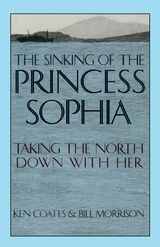
Sinking of the Princess Sophia
Taking the North Down with HerKen Coates and Bill Morrison
University of Alaska Press, 1991
On October 23, 1918, a storm rose and the Canadian Pacific steamer Princess Sophia ran aground on Vanderbilt Reef, northwest of Juneau, Alaska. Tragically, there were no survivors. The 353 aboard represented a significant cross-section of the population of the Yukon and Alaska, and their loss was a heavy blow to a society that, with the end of the gold rush, was already in decline. This book tells the dramatic stories of many of the passengers, how they had gone to the north, what they did there, and why they were leaving that fall, and sheds light on a little-known aspect of Alaska's history.
Staking Her Claim
Life Of Belinda MulrooneyMelanie J. Mayer
Ohio University Press, 1999
In Staking Her Claim, Melanie Mayer and Robert N. DeArmond provide a faithful and comprehensive portrait of this unique character in North American frontier history. Their exhaustive research has resulted in a sweeping saga of determination and will, tempered by disaster and opportunity.
Like any good Horatio Alger hero, Belinda overcame the challenges that confronted her, including poverty, prejudice, a lack of schooling, and the early loss of parents. Her travels took her from her native Ireland as a young girl to a coal town in Pennsylvania to Chicago, San Francisco, and finally, in 1897, to the Yukon.
Staking Her Claim is a testament to the human spirit and to the idea of the frontier. It is a biography of a woman who made her own way in the world and in doing so left an indelible mark.
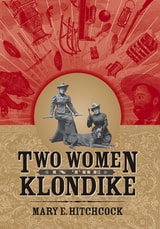
Two Women in the Klondike
Mary Hitchcock
University of Alaska Press, 2025
Two Women in the Klondike created a sensation when it was first published in 1899. The idea that two well-bred socialites could survive the dangers of the north thrilled nineteenth-century readers from San Francisco to New York.
When Mary Hitchcock heard about the discovery of gold in the Klondike in 1898, she left her privileged city life for the wilds of Alaska, planning to stake her own claims. She persuaded her friend Edith Van Buren to accompany her, and the two began preparations for "roughing it." The "necessities" that they brought up the Yukon River to Dawson City, Canada, included a portable bowling alley, an ice cream maker, a Great Dane named Ivan, and a full-size circus tent.
Hitchcock relates the struggles, surprises, and pleasures of traveling in the late nineteenth century in her trademark style. She describes in diary form the people she met and her impressions of rural Alaska and Dawson City. Invaluable for its detailed descriptions of manners, food, and personalities, Hitchcock's account of the Klondike Gold Rush is an outrageous adventure for general readers, armchair travelers, and anyone interested in the lives of American women in the late 1800s.
This new, abridged version includes a map of Hitchcock's northern travels and an introduction by Terrence Cole, professor of history at the University of Alaska Fairbanks.
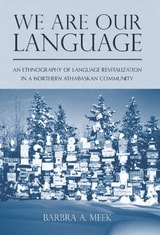
We Are Our Language
An Ethnography of Language Revitalization in a Northern Athabaskan CommunityBarbra A. Meek
University of Arizona Press, 2012
In presenting the case of Kaska, an endangered language in an Athabascan community in the Yukon, Barbra A. Meek asserts that language revitalization requires more than just linguistic rehabilitation; it demands a social transformation. The process must mend rips and tears in the social fabric of the language community that result from an enduring colonial history focused on termination. These “disjunctures” include government policies conflicting with community goals, widely varying teaching methods and generational viewpoints, and even clashing ideologies within the language community.
This book provides a detailed investigation of language revitalization based on more than two years of active participation in local language renewal efforts. Each chapter focuses on a different dimension, such as spelling and expertise, conversation and social status, family practices, and bureaucratic involvement in local language choices. Each situation illustrates the balance between the desire for linguistic continuity and the reality of disruption.
We Are Our Language reveals the subtle ways in which different conceptions and practices—historical, material, and interactional—can variably affect the state of an indigenous language, and it offers a critical step toward redefining success and achieving revitalization.
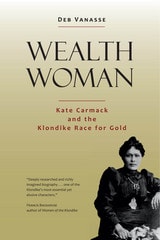
Wealth Woman
Kate Carmack and the Klondike Race for GoldDeb Vanasse
University of Alaska Press, 2016
In Wealth Woman, Deb Vanasse recounts Kate’s life from her early years on the frontier with George, through the history-making discovery of gold, and on to her subsequent fame, when she traveled alone down the West Coast through Washington and California, telling her story and fighting for her wealth, her family, and her reputation. Recovering the lost story of a true pioneer and a fiercely independent woman, Wealth Woman brings gold rush Alaska to life in all its drama and glory.
When Our Words Return
Writing, Hearing, and Remembering Oral Traditions from Alasak and the Yukonedited by Phyllis Morrow & William Schneider
Utah State University Press, 1995
The title to this interdisciplinary collection draws on the Yupik Eskimo belief that seals, fish, and other game are precious gifts that, when treated with respect and care, will return to be hunted again. Just so, if oral traditions are told faithfully and respectfully, they will return to benefit future generations. The contributors to this volume are concerned with the interpretation and representation of oral narrative and how it is shaped by its audience and the time, place, and cultural context of the narration. Thus, oral traditions are understood as a series of dialogues between tradition bearers and their listeners, including those who record, write, and interpret.
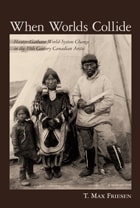
When Worlds Collide
Hunter-Gatherer World-System Change in the 19th Century Canadian ArcticT. Max Friesen
University of Arizona Press, 2013
Max Friesen has adapted and expanded world-system theory in order to develop a model that explains how hunter-gatherer interaction networks, or world-systems, are structured—and why they change. He has utilized this model to better understand the development of Inuvialuit society in the western Canadian Arctic over a 500-year span, from the pre-contact period to the early twentieth century.
As Friesen combines local archaeological data with more extensive ethnographic and archaeological evidence from the surrounding region, a picture emerges of a dynamic Inuvialuit world-system characterized by bounded territories, trade, warfare, and other forms of interaction. This world-system gradually intensified as the impacts of Euroamerican colonial activities increased. This intensification, Friesen suggests, was based on pre-existing Inuvialuit social and economic structures rather than on patterns imposed from outside. Ultimately, this intense interacting network collapsed near the end of the nineteenth century. When Worlds Collide offers a new way to comprehend small-scale world-systems from the point of view of indigenous people. Its approach will prove valuable for understanding hunter-gatherer societies around the globe.