Results by title
2 books match the query 'Fascism in literature'
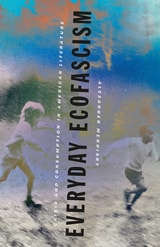
Everyday Ecofascism
Crisis and Consumption in American LiteratureAlexander Menrisky
University of Minnesota Press, 2025
A timely look into how fascist ideas permeate contemporary culture well beyond the far right
As challenges posed by climate change have intensified in the twenty-first century, right-wing figures in the United States and abroad have increasingly framed anti-immigrant, anti-Indigenous, and white-supremacist sentiments in terms of environmental survival. Everyday Ecofascism explores the insidious nature of this tendency, revealing how permutations of these perspectives in fact resonate across the political spectrum. Drawing on comparative studies of fascism writ large, Alexander Menrisky demonstrates that ecofascism is best understood not as a uniquely right-wing ideology but as a political genre that reinforces white supremacy and other forms of domination.
Presenting a view of fascism as a complex power network that plays out on scales both large and small, Menrisky shows how extremist sentiments have crept into everyday language, stories, and ideas. Through a literary and cultural studies lens, he illuminates ecofascism’s narrative patterns and their easy permeation of environmentalist discourses, from back-to-the-land movements to the resurgence of psychedelic drugs, food localism, and pandemic politics. Opposite his analysis of ecofascism in action, Menrisky sheds important light on narrative resistances to dominant conceptions of race, nation, and territory by Native, queer, and women-of-color writers who have countered ethnonationalism for generations.
Bridging past and present, Menrisky powerfully nails down the emergent concept of ecofascism and forms a basis for understanding phenomena like Covid-19, ecological utopianism, and psychedelic environmentalism that detangles ecofascist tendencies from justice-oriented visions of place-based belonging.
Retail e-book files for this title are screen-reader friendly.

Visions of Violence
German Avant-Gardes After FascismRichard Langston
Northwestern University Press, 2007
An extreme faction of aesthetic modernity intent on bulldozing contemporary life, the avant-garde has regularly employed visions of violence in their push for societal and cultural renewal. But in the shadow of unparalleled war and genocide, such aesthetic violence lost its force. This book explores the reconfiguration of the avant-garde in response to the violent transformation of European reality. Citing the emergence of independent avant-garde practitioners in the place of the previous collective, Richard Langston considers six individual exemplars of Germany’s post-fascist avant-garde—works that span the last six decades: painter, writer, and filmmaker Peter Weiss’s appropriation of French surrealism in the fifties; writer Dieter Wellershoff’s coterie of “new realists”; artist Wolf Vostell’s mediation and conflation of the experiences of the Auschwitz trials and the Vietnam War; poet and novelist Dieter Brinkmann’s collages from the seventies; the multimedia displacements of Alexander Kluge; and the performative engagements of dramatists Christoph Schlingensief and Rene Pollesch.
Taking stock of the evolution of Germany’s post-fascist avant-gardes, Langston’s book shows how the movement from Weiss to Pollesch exhibits the problems that both modernity and postmodernity pose for an aesthetic engagement of Germany’s violent past.