Results by title
9 books match the query 'Federalism'
Federalism and Regional Development
Case Studies on the Experience in the United States and the Federal Republic of GermanyEdited by George W. Hoffman
University of Texas Press, 1981
Federalism and Regional Development is the resuit of the first German-American geography seminar, held at the University of Texas in September 1979. The chapters deal with the impact of geographic policy planning by various governmental agencies in both the Federal Republic of Germany and the United States, two countries with federal systems of government. Although various bureaucratic offices at the federal, state, county, and city levels became involved in spatial planning in both countries, no overall coordination of development planning existed. The contributors to this volume offer many theoretical and empirical perspectives on the evolution of federal policies and programs and their impact on geographic planning activities at all levels of government. The topics covered range from actual regional case studies in both countries to the framework of the agencies concerned with spatial planning. Numerous maps and tables document the data resources of the contributors and yield useful insights on the workings of the federal system.
Federalism and Social Policy
Patterns of Redistribution in 11 DemocraciesEdited by Scott L. Greer and Heather Elliott
University of Michigan Press, 2019
Federalism
A DialogueDavid L. Shapiro
Northwestern University Press, 1995
Federalism
Political Identity and Tragic CompromiseMalcolm M. Feeley and Edward Rubin
University of Michigan Press, 2011
Federalism is one of the most influential concepts in modern political discourse as well as the focus of immense controversy resulting from the lack of a single coherent definition. Malcolm M. Feeley and Edward Rubin expose the ambiguities of modern federalism, offering a powerful but generous treatise on the modern salience of the term.
—Sanford Levinson, University of Texas at Austin
“At last, an insightful examination of federalism stripped of its romance. An absolutely splendid book, rigorous but still accessible.”
—Larry Yackle, Boston University
“Professors Feeley and Rubin clearly define what is and is not federal system. This book should be required for serious students of comparative government and American government.”
—G. Ross Stephens, University of Missouri, Kansas City
“Feeley and Rubin have written a brilliant book that looks at federalism from many different perspectives—historical, political, and constitutional. Significantly expanding on their earlier pathbreaking work, they have explained the need for a theory of federalism and provided one. This is a must read book for all who are interested in the Constitution.”
—Erwin Chemerinsky, Duke University School of Law
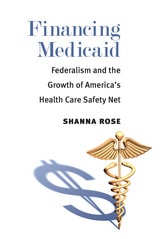
Financing Medicaid
Federalism and the Growth of America's Health Care Safety NetShanna Rose
University of Michigan Press, 2013
Conventional wisdom holds that programs for the poor are vulnerable to instability and retrenchment. Medicaid, however, has grown into the nation’s largest intergovernmental grant program, accounting for nearly half of all federal funding to state and local governments. Medicaid’s generous open-ended federal matching grants have given governors a powerful incentive to mobilize on behalf of its maintenance and expansion, using methods ranging from lobbying and negotiation to creative financing mechanisms and waivers to maximize federal financial assistance. Perceiving federal retrenchment efforts as a threat to states’ finances, governors, through the powerful National Governors’ Association, have repeatedly worked together in bipartisan fashion to defend the program against cutbacks.
Financing Medicaidengagingly intertwines theory, historical narrative, and case studies, drawing on sources including archival materials from the National Governors’ Association and gubernatorial and presidential libraries, Centers for Medicare and Medicaid Services data, the Congressional Record, and interviews.
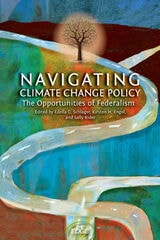
Navigating Climate Change Policy
The Opportunities of FederalismEdella C. Schlager
University of Arizona Press, 2011
Federalism—the system of government in which power is divided among a national government and state and regional governments—is well-suited to address the challenges of climate change because it permits distinctive policy responses at a variety of scales. The chapters in this book explore questions such as what are appropriate relationships between states, tribes, and the federal government as each actively pursues climate-change policies? How much leeway should states have in designing and implementing climate-change policies, and how extensively should the federal government exercise its preemption powers to constrain state activity? What climate-change strategies are states best suited to pursue, and what role, if any, will regional state-based collaborations and associations play? This book examines these questions from a variety of perspectives, blending legal and policy analyses to provide thought-provoking coverage of how governments in a federal system cooperate, coordinate, and accommodate one another to address this global problem.
Navigating Climate Change Policy is an essential resource for policymakers and judges at all levels of government who deal with questions of climate governance. It will also serve as an important addition to the curriculum on climate change and environmental policy in graduate and undergraduate courses and will be of interest to anyone concerned with how the government addresses environmental issues.
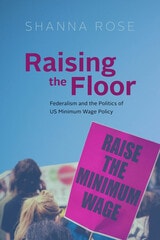
Raising the Floor
Federalism and the Politics of US Minimum Wage PolicyShanna Rose
University of Chicago Press, 2026
A rich history of the development of American minimum wage policy with lessons for today.
Despite broad popular support for robust minimum wage policy, the federal minimum wage is now worth less—in real, inflation-adjusted terms—than at any time since 1949. While some state and local governments have stepped in to fill this void, others have declined to set any minimum wage standard at all. Traversing more than 100 years of history, Raising the Floor examines how interest groups have navigated the highly decentralized American political system to shape the development of federal, state, and local minimum wage laws.
In her analysis, Shanna Rose highlights the importance of American federalism. She argues that because federalism creates multiple arenas for policy change, interest groups have sought out the sites most conducive to their goals, shifting their lobbying efforts as new obstacles and opportunities emerge. Federalism has facilitated minimum wage policymaking by fostering policy experimentation, learning, and diffusion across states and by allowing state and local governments to overcome gridlock and status-quo biases at the national level. Yet, federalism has also been an instrument for containment, enabling those opposed to minimum wage increases to litigate and preempt local-level laws.
With rich historical chapters that illuminate different phases in the development of today’s patchwork of wage standards, Raising the Floor is a deep examination of the past, present, and future of American minimum wage law.

The Dimensions of Federalism
State Governments and Pollution Control PoliciesWilliam R. Lowry
Duke University Press, 1991
The Provincial Deputation in Mexico
Harbinger of Provincial Autonomy, Independence, and FederalismBy Nettie Lee Benson
University of Texas Press, 1992
Mexico and the United States each have a constitution and a federal system of government. This fact has led many historians to assume that the Mexican system of government, established in the 1820s, is an imitation of the U.S. model. But it is not.
First published in Spanish in 1955 and now translated by the author and amplified with new material, this interpretation of the independence movement tells the true story of Mexico's transition from colonial status to federal state. Benson traces the Mexican government's beginning to events in Spain in 1808–1810, when provincial juntas, or deputations, were established to oppose Napoleon's French rule and govern the provinces of Spain and its New World dominions during the Spanish monarch's imprisonment.
It was the provincial deputation, not the United States federal system, that provided the model for the state legislative bodies that were eventually formed after Mexico won its independence from Spain in 1821. This finding—the result of years of painstaking archival research—strongly confirms the independence of Mexico's political development from U.S. influence. Its importance to a study of Mexican history cannot be overstated.