Results by title
6 books match the query 'Feeding'
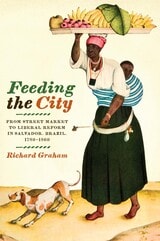
Feeding the City
From Street Market to Liberal Reform in Salvador, Brazil, 1780–1860By Richard Graham
University of Texas Press, 2010
Winner, Bolton-Johnson Prize, Conference on Latin American History, 2011
Murdo J. McLeod Book Prize, 2011
On the eastern coast of Brazil, facing westward across a wide magnificent bay, lies Salvador, a major city in the Americas at the end of the eighteenth century. Those who distributed and sold food, from the poorest street vendors to the most prosperous traders—black and white, male and female, slave and free, Brazilian, Portuguese, and African—were connected in tangled ways to each other and to practically everyone else in the city, and are the subjects of this book. Food traders formed the city's most dynamic social component during the late eighteenth and early nineteenth centuries, constantly negotiating their social place. The boatmen who brought food to the city from across the bay decisively influenced the outcome of the war for Brazilian independence from Portugal by supplying the insurgents and not the colonial army. Richard Graham here shows for the first time that, far from being a city sharply and principally divided into two groups—the rich and powerful or the hapless poor or enslaved—Salvador had a population that included a great many who lived in between and moved up and down.
The day-to-day behavior of those engaged in food marketing leads to questions about the government's role in regulating the economy and thus to notions of justice and equity, questions that directly affected both food traders and the wider consuming public. Their voices significantly shaped the debate still going on between those who support economic liberalization and those who resist it.
Feeding the Family
The Social Organization of Caring as Gendered WorkMarjorie L. DeVault
University of Chicago Press, 1991
Drawing from interviews conducted in 1982-83 in a diverse group of American households, DeVault reveals the effort and skill behind the "invisible" work of shopping, cooking, and serving meals. She then shows how this work can become oppressive for women, drawing them into social relations that construct and maintain their subordinate position in household life.
Feeding the Future
School Lunch Programs as Global Social PolicyRutledge, Jennifer Geist
Rutgers University Press, 2016
Feeding the Planet
Environmental Protection through Sustainable AgricultureKlaus Hahlbrock
Haus Publishing, 2009
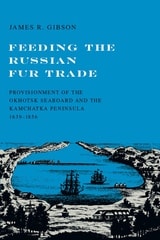
Feeding the Russian Fur Trade
Provisionment of the Okhotsk Seaboard and the Kamchatka Peninsula, 1639–1856James R. Gibson
University of Wisconsin Press, 1969
James R. Gibson offers a detailed study that is both an account of this chapter of Russian history and a full examination of the changing geography of the Okhotsk Seaboard and the Kamchatka Peninsula over the course of two centuries.
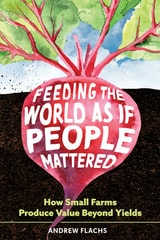
Feeding the World as if People Mattered
How Small Farms Produce Value Beyond YieldsAndrew Flachs
University of Arizona Press, 2026
The dominant view of agriculture has focused only on what we produce. It sees value in terms of capital gains or yield efficiency, masking how our global food system produces tremendous amounts of food commodities while failing to feed people, support rural communities, or enhance ecological well-being. Feeding the World as if People Mattered asks us to look more deeply and more humanely at what we perceive to be most valuable in our agricultural systems.
This book draws on fifteen years of anthropological research, taking readers to fields in South India, Eastern Europe, and North America, where people are already feeding the future amid global change. From these fields, Flachs shows us how a radical rethinking of the value of small farms and farmers is already happening. Bringing together conversations in agriculture, economics, anthropology, and the environmental humanities, Flachs deftly shows how small farms reproduce social and ecological relationships that are the only sustainable path forward.
For anyone who is curious about the food on their plate and the people who helped to get it there, Feeding the World as if People Mattered will offer a new way to find value in the food we grow and the people who grow it.