Results by title
5 books match the query 'Feminist jurisprudence'
Applications Of Feminist Legal Theory
edited by D. Kelly Weisberg
Temple University Press, 1996

In Contempt
Nineteenth-Century Women, Law, and LiteratureKristin Kalsem
The Ohio State University Press, 2012
In Contempt: Nineteenth-Century Women, Law, and Literature, by Kristin Kalsem, explores the legal advocacy performed by nineteenth-century women writers in publications of nonfiction and fiction, as well as in real-life courtrooms and in the legal forum provided by the novel form.
Recovering Subversion
Feminist Politics beyond the LawNivedita Menon
University of Illinois Press, 2004
Is the language of rights enough to foster real social and political change? Nivedita Menon explores the relationship between law and feminist politics by examining the contemporary Indian women's movement with comparisons to France and the United States. She argues that the intersection of feminist politics, law, and the state often paradoxically and severely distorts important ethical and emancipatory impulses of feminism.
Menon reviews historical challenges to the liberal notion of rights from Marxist, feminist, postcolonial, and critical legal scholars, and analyzes current Indian debates on topics including abortion, sexual violence, and Parliamentary quotas for women. Far from being a call to withdraw from the arena of law, Recovering Subversion instead urges feminists everywhere to recognize the limits of "rights discourse" and pleads for a politics that goes beyond its boundaries.
Representing Women
Law, Literature, and FeminismSusan Sage Heinzelman and Zipporah Batshaw Wiseman, eds.
Duke University Press, 1994
Beginning with an exploration of the ways in which women are represented—how they either tell or have their stories told in literature, in the law, in a courtroom—this collection demonstrates the interrelatedness of the legal and the literary. Whether considering the status of medieval women readers or assessing the effectiveness and extent of contemporary rape law reform, the essays show that power first comes with telling one’s own story, and that the degree and effect of that power are determined by the cultural significance of the forum in which the story is presented. But telling the story is not enough. One must also be aware of how the story is contained within traditional constructs or boundaries and is thus limited in its effects, as Carol Sanger’s essay on mothers and legal/sexual identity makes clear. One must also recognize how a story might perpetuate an ideological agenda that is not in the best interests of the storyteller, as Elizabeth Butler Cullingford shows in her reading of Yeats’s "Leda and the Swan" and one must know the historical context of a story and of its telling, as Anne B. Goldstein’s essay on lesbian narratives discloses.
Breaking down the boundaries between law and literature, this anthology makes evident the ways in which the effect of women’s stories has been constrained and expands the range of possibilities for those who represent women, tell women’s stories, or present women’s issues. Representing Women makes the retelling of old stories about women compelling and the telling of new ones both necessary and possible.
Contributors. Kathryn Abrams, Linda Brodkey, Rita Copeland, Elizabeth Butler Cullingford, Margaret Anne Doody, Susan B. Estrich, Michelle Fine, Anne B. Goldstein, Angela P. Harris, Susan Sage Heinzelman, Christine L. Krueger, Martha Minow, Carol Sanger, Judy Scales-Trent
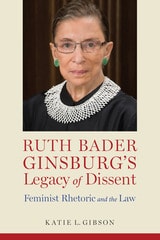
Ruth Bader Ginsburg’s Legacy of Dissent
Feminist Rhetoric and the LawKatie L. Gibson
University of Alabama Press, 2018
A rhetorical analysis of Justice Ruth Bader Ginsburg’s feminist jurisprudence.
Ruth Bader Ginsburg’s lifelong effort to reshape the language of American law has had profound consequences: she has shifted the rhetorical boundaries of jurisprudence on a wide range of fundamental issues from equal protection to reproductive rights. Beginning in the early 1970s, Ginsburg led a consequential attack on sexist law in the United States. By directly confronting the patriarchal voice of the law, she pointedly challenged an entrenched genre of legal language that silenced the voices and experiences of American women and undermined their status as equal citizens. On the United States Supreme Court, Justice Ginsburg continues to challenge the traditional scripts of legal discourse to insist on a progressive vision of the Constitution and to demand a more inclusive and democratic body of law.
This illuminating work examines Justice Ruth Bader Ginsburg’s contributions in reshaping the rhetoric of the law (specifically through the lens of watershed cases in women’s rights) and describes her rhetorical contributions—beginning with her work in the 1970s as a lawyer and an advocate for the ACLU’s Women’s Rights Project through her tenure as a Supreme Court justice. Katie L. Gibson examines Ginsburg’s rhetoric to argue that she has dramatically shifted the boundaries of legal language. Gibson draws from rhetorical theory, critical legal theory, and feminist theory to describe the law as a rhetorical genre, arguing that Ginsburg’s jurisprudence can appropriately be understood as a direct challenge to the traditional rhetoric of the law.
Ruth Bader Ginsburg stands as an incredibly important figure in late twentieth- and early twenty-first-century feminism. While a growing number of admirers celebrate Justice Ginsburg’s voice of dissent today, Ginsburg’s rhetorical legacy reveals that she has long articulated a sharp and strategic voice of judicial dissent. This study contributes to a more complete understanding of her feminist legacy by detailing the unique contributions of her legal rhetoric.