Results by title
21 books match the query 'Fertility, Human'

Birth and Fortune
The Impact of Numbers on Personal WelfareRichard A. Easterlin
University of Chicago Press, 1987
"[Easterlin] has made clear, I think unambiguously, that the baby-boom generation is economically underprivileged merely because of its size. And in showing this, he demonstrates that population size can be as restrictive as a factor as sex, race, or class on equality of opportunity in the U.S."—Jeffrey Madrick, Business Week
Contingent Lives
Fertility, Time, and Aging in West AfricaCaroline H. Bledsoe
University of Chicago Press, 2002
Using ethnographic and demographic data from a three-year study in rural Gambia, Contingent Lives explains this seemingly counterintuitive fact by juxtaposing two very different understandings of the life course: one is a linear, Western model that equates aging and the ability to reproduce with the passage of time, the other a Gambian model that views aging as contingent on the cumulative physical, social, and spiritual hardships of personal history, especially obstetric trauma. Viewing each of these two models from the perspective of the other, Caroline Bledsoe produces fresh understandings of the classical anthropological subjects of reproduction, time, and aging as culturally shaped within women's conjugal lives. Her insights will be welcomed by scholars of anthropology and demography as well as by those working in public health, development studies, gerontology, and the history of medicine.
Demography and the Economy
Edited by John B. Shoven
University of Chicago Press, 2010
Demographics is a vital field of study for understanding social and economic change and it has attracted attention in recent years as concerns have grown over the aging populations of developed nations. Demographic studies help make sense of key aspects of the economy, offering insight into trends in fertility, mortality, immigration, and labor force participation, as well as age, gender, and race specific trends in health and disability.
Demography and the Economy explores the connections between demography and economics, paying special attention to what demographic trends can reveal about the sustainability of traditional social security programs and the larger implications for economic growth. The volume brings together some of the leading scholars working at the border between the two disciplines, and it provides an eclectic overview of both fields. Contributors also offer deeper analysis of a variety of issues such as the impact of greater wealth on choices about marriage and childbearing and the effects of aging populations on housing prices, Social Security, and Medicare.

Economics of the Family
Marriage, Children, and Human CapitalEdited by Theodore W. Schultz
University of Chicago Press, 1975
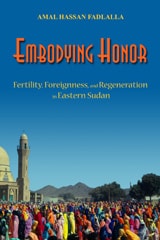
Embodying Honor
Fertility, Foreignness, and Regeneration in Eastern SudanAmal Hassan Fadlalla
University of Wisconsin Press, 2007
In Embodying Honor Amal Hassan Fadlalla finds that the female body is the locus of anxieties about foreign dangers and diseases, threats perceived to be disruptive to morality, feminine identities, and social well-being. As a “northern Sudanese” viewed as an outsider in this region of her native country, Fadlalla presents an intimate portrait and thorough analysis that offers an intriguing commentary on the very notion of what constitutes the “foreign.” Fadlalla shows how Muslim Hadendowa women manage health and reproductive suffering in their quest to become “responsible” mothers and valued members of their communities. Her historically grounded ethnography delves into women’s reproductive histories, personal narratives, and ritual logics to reveal the ways in which women challenge cultural understandings of gender, honor, and reproduction.

Female Fertility and the Body Fat Connection
Rose E. Frisch
University of Chicago Press, 2002
Rose E. Frisch explains here how, in women, a certain amount of body fat is crucial to the reproductive system and sexual maturation. Women who are too lean are infertile and cannot conceive children; young girls who are too thin have a delayed onset of their first period. Female Fertility and the Body-Fat Connection illuminates how and why a "critical fitness" level underlies a woman's reproductive health. In the process Frisch gives readers a comprehensive view of the research done to date on the relationship between body composition and fertility and also describes her own journey as a woman scientist working to advance her critical-fitness hypothesis both to the general public and the scientific community. Frisch answers the questions every woman has about the desirable weight for health and fertility and even includes tables to help women find their own best weight. She also demonstrates how important diet and exercise are for the long-term reproductive health of women, and shows what factors influence the onset of puberty in girls.
Each milestone of the reproductive life span is affected by food intake and energy output, the factors affecting the storage of fat. Female Fertility and the Body-Fat Connection is a cornerstone to understanding the health of girls and women.
Fertile Matters
The Politics of Mexican-Origin Women's ReproductionBy Elena R. Gutiérrez
University of Texas Press, 2008
While the stereotype of the persistently pregnant Mexican-origin woman is longstanding, in the past fifteen years her reproduction has been targeted as a major social problem for the United States. Due to fear-fueled news reports and public perceptions about the changing composition of the nation's racial and ethnic makeup—the so-called Latinization of America—the reproduction of Mexican immigrant women has become a central theme in contemporary U. S. politics since the early 1990s.
In this exploration, Elena R. Gutiérrez considers these public stereotypes of Mexican American and Mexican immigrant women as "hyper-fertile baby machines" who "breed like rabbits." She draws on social constructionist perspectives to examine the historical and sociopolitical evolution of these racial ideologies, and the related beliefs that Mexican-origin families are unduly large and that Mexican American and Mexican immigrant women do not use birth control.
Using the coercive sterilization of Mexican-origin women in Los Angeles as a case study, Gutiérrez opens a dialogue on the racial politics of reproduction, and how they have developed for women of Mexican origin in the United States. She illustrates how the ways we talk and think about reproduction are part of a system of racial domination that shapes social policy and affects individual women's lives.
Fertility Change in Contemporary Japan
Robert W. Hodge and Naohiro Ogawa
University of Chicago Press, 1992

Festival of the Poor
Fertility Decline and the Ideology of ClassJane C. Schneider
University of Arizona Press, 1996
By examining population changes in a single community between 1860 and 1980, the authors offer an extended review and critique of existing models of fertility decline in Europe, proposing a new interpretation that emphasizes historical context and class relations. They show how the spread of capitalism in Sicily induced an unprecedented rate of population growth, with boom-and-bust cycles creating the class experiences in which "reputational networks" came to redefine family life; how Sicilians began to control their fertility in response to class-mediated ideas about gender relations and respectable family size; and how the town's gentry, artisan, and peasant classes adopted family planning methods at different times in response to different pressures.
Jane and Peter Schneider's anthropologically oriented political-economy perspective challenges the position of Western Europe as a model for fertility decline on which every other case should converge, looking instead at the diversity of cultural ideals and practices--such as those found in Sicily--that influence the spread and form of birth control. Combining anthropological, oral historical, and archival methods in new and insightful ways, the authors' synthesis of a particular case study with a broad historical and theoretical discussion will play a major role in the ongoing debates over the history of European fertility decline and point the way toward integrating the analysis of demographic upheaval with the study of class formation and ideology.

Grandmotherhood
The Evolutionary Significance of the Second Half of Female LifeVoland, Eckart
Rutgers University Press, 2014
By the year 2030, the average life expectancy of women in industrialized countries could reach ninety—exceeding that of men by about ten years. At the present time, postmenopausal women represent more than fifteen percent of the world’s population and this figure is likely to grow.
From an evolutionary perspective, these demographic numbers pose some intriguing questions. Darwinian theory holds that a successful life is measured in terms of reproduction. How is it, then, that a woman’s lifespan can greatly exceed her childbearing and childrearing years? Is this phenomenon simply a byproduct of improved standards of living, or do older women—grandmothers in particular—play a measurable role in increasing their family members’ biological success?
Until now, these questions have not been examined in a thorough and comprehensive manner. Bringing togethertheoretical and empirical work byinternationally recognized scholars in anthropology, psychology, ethnography, and the social sciences, Grandmotherhood explores the evolutionary purpose and possibilities of female post-generative life. Students and scholars of human evolution, anthropology, and even gerontology will look to this volume as a major contribution to the current literature in evolutionary studies.
Human Fertility
Henri Leridon
University of Chicago Press, 1977
The book begins with a readable, authoritative review of human fertility in its natural state. Leridon summarizes and evaluates current knowledge, drawing together rare statistical data on physiological variables as well as demographic treatments of these data. After discussing the classical framework used by demographers, Leridon undertakes a "microdemographic" analysis in which he focuses on the individual and explicates the biological processes through which social, psychological, and economic factors affect fertility. He isolates its components—fecundability, intrauterine mortality, the physiological nonsusceptible period, and sterility—then reviews the composite effect of variation in any one component.
Leridon considers situations of controlled fertility: contraception, abortion, and sterilization. The author also presents valuable new data from his own investigations of varying risks of intrauterine mortality. Finally, he shows how the previous approaches can be complemented by the use of mathematical models.

Kinshasa in Transition
Women's Education, Employment, and FertilityDavid Shapiro and B. Oleko Tambashe
University of Chicago Press, 2003
In this book, David Shapiro and B. Oleko Tambashe trace the impact of these changes on the lives of women, and their findings add dramatically to the field's limited knowledge of African demographic trends. They find that fertility has declined significantly in Kinshasa since the 1970s, and that women's increasing access to secondary education has played a key role in this decline. Better access to education has also given women greater access to employment opportunities. And by examining the impact of such factors as economic well-being and household demographic composition on the schooling of children, Shapiro and Tambashe reveal how one generation's fertility affects the next generation's education.
This book will be a valuable guide for anyone who wants to understand the complex and ongoing social, demographic, economic, and developmental changes in contemporary sub-Saharan Africa.

Mexican American Fertility Patterns
By Frank D. Bean and Gray Swicegood
University of Texas Press, 1985
The Mexican American population is the fastest growing major racial/ethnic group in the United States. During the decade 1970–1980, the Mexican origin population increased from 4.5 million to 8.7 million persons. High fertility, not immigration, was responsible for nearly two-thirds of this growth.
Recent and historical evidence shows that women of Mexican origin or descent bear significantly more children than other white women in the United States. Mexican American Fertility Patterns clarifies the nature and magnitude of these fertility differences by analyzing patterns of childbearing both across ethnic groups and within the Mexican American population.
Using data from the 1970 and 1980 U.S. Censuses and from the 1976 Survey of Income and Education, the authors evaluate various hypotheses of cultural, social, demographic, and/or economic factors as determinants of fertility differences. Empirical analyses center on the interrelationships between fertility and generational status, language usage and proficiency, and female education. This timely report concludes that Mexican American fertility is closest to that of other whites under conditions of greater access to the opportunity structures of the society.
Misconception
Social Class and Infertility in AmericaBell, Ann V.
Rutgers University Press, 2014

Plundered Kitchens, Empty Wombs
Threatened Reproduction and Identity in the Cameroon GrassfieldsPamela Feldman-Savelsberg
University of Michigan Press, 1999
In the Cameroon grassfields, an area of high fertility, women hold a paradoxical fear of infertility. By combining symbolic, political-economic, and historical analyses, Pamela Feldman-Savelsberg traces the way reproductive threat is invoked in struggles over gender and ethnic identities. Women's fears of reproductive disorders, she finds, are an important mode of expression for their worries about much larger issues, such as rural poverty, brought about or exacerbated by political and economic changes in this century.
A lively case study of an infertile queen who flees the palace sets the stage for discussions of the ethnographic and historical setting, the symbolism of fertility and infertility, and the development and interaction of cosmopolitan and ethno-gynecologies. The book concludes with an analysis of the links between women's role in human reproduction and the divine king's role in social reproduction, both occurring in the rapidly changing context of a multiethnic African nation.
Plundered Kitchens, Empty Wombs underscores the relevance of medical anthropology to other anthropological specializations, as well as to epidemiologists, population specialists, and development planners. It should reach a broad audience in medical anthropology, public health, and women's studies.
Pamela Feldman-Savelsberg is Assistant Professor of Anthropology, Carleton College.

The Economization of Life
M. Murphy
Duke University Press, 2017

The Empty Cradle of Democracy
Sex, Abortion, and Nationalism in Modern GreeceAlexandra Halkias
Duke University Press, 2004
Halkias’s analysis combines telling fragments of contemporary Athenian culture, Greek history, media coverage of abortion and the declining birth rate, and fieldwork in Athens at an obstetrics/gynecology clinic and a family-planning center. Halkias conducted in-depth interviews with one hundred and twenty women who had had two or more abortions and observed more than four hundred gynecological exams at a state family-planning center. She reveals how intimate decisions and the public preoccupation with the low birth rate connect to nationalist ideas of race, religion, freedom, resistance, and the fraught encounter between modernity and tradition. The Empty Cradle of Democracy is a startling examination of how assumptions underlying liberal democracy are betrayed while the nation permeates the body and understandings of gender and sexuality complicate the nation-building projects of late modernity.
The Fertility Revolution
A Supply-Demand AnalysisRichard A. Easterlin and Eileen M. Crimmins
University of Chicago Press, 1985
Richard A. Easterlin and Eileen M. Crimmins present and test a fertility theory that has gained increasing attention over the last decade, a "supply-demand theory" that integrates economic and sociological approaches to fertility determination. The results of the tests, which draw on data from four developing countries—Colombia, India, Sri Lanka, and Taiwan—are highly consistent, though a number of the conclusions are likely to arouse controversy. For example, couples' motivation for fertility control appears to be the prime mover in the fertility revolution, rather than access to family planning services or unfavorable attitudes toward such services.
The interdisciplinary approach and nontechnical exposition of this study will attract a wide readership among economists, sociologists, demographers, anthropologists, statisticians, biologists, and others.
The Institutional Context of Population Change
Patterns of Fertility and Mortality across High-Income NationsFred C. Pampel
University of Chicago Press, 2001
The Institutional Context of Population Change cuts across numerous political and sociological topics, including political sociology, stratification, sex and gender, and aging. It persuasively shows the importance of public policies for understanding the demographic consequences of population change and the importance of demographic change for understanding the consequences of public policies.

The Oocyte Economy
The Changing Meaning of Human EggsCatherine Waldby
Duke University Press, 2019

Uncertain Honor
Modern Motherhood in an African CrisisJennifer Johnson-Hanks
University of Chicago Press, 2005
Combining insights from demography and cultural anthropology, Johnson-Hanks argues that Beti women delay motherhood as part of a broader attempt to assert a modern form of honor only recently made possible by formal education, Catholicism, and economic change. Through itinerant school careers and manipulations of marriage, educated Beti women now manage their status as mothers in order to coordinate major life events in the face of social and economic uncertainty.
Carefully researched and clearly written, Uncertain Honor offers an intimate look at the lives of African women trying to reconcile motherhood with new professional roles in a context of dramatic social change.