Results by title
8 books match the query 'Few'

Ain't But a Few of Us
Black Music Writers Tell Their StoryWillard Jenkins, editor
Duke University Press, 2022
Contributors
Eric Arnold, Bridget Arnwine, Angelika Beener, Playthell Benjamin, Herb Boyd, Bill Brower, Jo Ann Cheatham, Karen Chilton, Janine Coveney, Marc Crawford, Stanley Crouch, Anthony Dean-Harris, Jordannah Elizabeth, Lofton Emenari III, Bill Francis, Barbara Gardner, Farah Jasmine Griffin, Jim Harrison, Eugene Holley Jr., Haybert Houston, Robin James, Willard Jenkins, Martin Johnson, LeRoi Jones, Robin D. G. Kelley, Tammy Kernodle, Steve Monroe, Rahsaan Clark Morris, John Murph, Herbie Nichols, Don Palmer, Bill Quinn, Guthrie P. Ramsey Jr., Ron Scott, Gene Seymour, Archie Shepp, Wayne Shorter, A. B. Spellman, Rex Stewart, Greg Tate, Billy Taylor, Greg Thomas, Robin Washington, Ron Welburn, Hollie West, K. Leander Williams, Ron Wynn

Food for the Few
Neoliberal Globalism and Biotechnology in Latin AmericaEdited by Gerardo Otero
University of Texas Press, 2008
Recent decades have seen tremendous changes in Latin America's agricultural sector, resulting from a broad program of liberalization instigated under pressure from the United States, the IMF, and the World Bank. Tariffs have been lifted, agricultural markets have been opened and privatized, land reform policies have been restricted or eliminated, and the perspective has shifted radically toward exportation rather than toward the goal of feeding local citizens. Examining the impact of these transformations, the contributors to Food for the Few: Neoliberal Globalism and Biotechnology in Latin America paint a somber portrait, describing local peasant farmers who have been made responsible for protecting impossibly vast areas of biodiversity, or are forced to specialize in one genetically modified crop, or who become low-wage workers within a capitalized farm complex. Using dozens of examples such as these, the deleterious consequences are surveyed from the perspectives of experts in diverse fields, including anthropology, economics, geography, political science, and sociology.
From Kathy McAfee's "Exporting Crop Biotechnology: The Myth of Molecular Miracles," to Liz Fitting's "Importing Corn, Exporting Labor: The Neoliberal Corn Regime, GMOs, and the Erosion of Mexican Biodiversity," Food for the Few balances disturbing findings with hopeful assessments of emerging grassroots alternatives. Surveying not only the Latin American conditions that led to bankruptcy for countless farmers but also the North's practices, such as the heavy subsidies implemented to protect North American farmers, these essays represent a comprehensive, keenly informed response to a pivotal global crisis.

For the Many or the Few
The Initiative, Public Policy, and American DemocracyJohn G. Matsusaka
University of Chicago Press, 2004
Drawing upon a century of evidence, Matsusaka argues against the popular belief that initiative measures are influenced by wealthy special interest groups that neglect the majority view. Examining demographic, political, and opinion data, he demonstrates how the initiative process brings about systematic changes in tax and expenditure policies of state and local governments that are generally supported by the citizens. He concludes that, by and large, direct democracy in the form of the initiative process works for the benefit of the many rather than the few.
An unprecedented, comprehensive look at the historical, empirical, and theoretical components of how initiatives function within our representative democracy to increase political competition while avoiding the tyranny of the majority, For the Many or the Few is a most timely and definitive work.
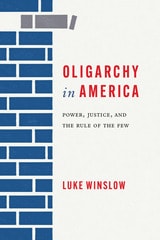
Oligarchy in America
Power, Justice, and the Rule of the FewLuke Winslow
University of Alabama Press, 2024
Roderick P. Hart Outstanding Book Award for the National Communication Association's Political Communication Division
A fascinating survey of the history of political and economic ideas in the US that have led to an increasingly entrenched ultra-rich class of oligarchs.
To an American, oligarchy is something that happens somewhere else. In Oligarchy in America, Luke Winslow reveals oligarchy’s deep intellectual roots and alarming growth in America. The book provides conceptual tools the lack of which have prevented Americans from recognizing oligarchy at home.
Winslow argues that generic labels like “billionaires” for a class of ultra-rich masks the pervasive structures that entrench their power. He introduces instead the concept of democratic oligarchy—an institutional arrangement in which the ultra-rich form a class consciously creating and leveraging state power to accumulate wealth.
Like a master class in political ideas, Winslow traces the intellectual lineage of oligarchy in the US. His lively and compulsively readable survey examines key rhetorical sources such as Herbert Spencer, Andrew Carnegie, Friedrich Hayek, Lewis Powell, Milton Friedman, Charles Koch, Donald Trump, Tucker Carlson, and others.
Oligarchy in America maps the connective web of oligarchic ideas uniting these disparate figures. By offering a lucid framework through which to view oligarchic ideas ambient in American culture, Winslow makes a vital contribution to readers and scholars of communication and rhetorical studies, public address, economics, and political science.

Portraits of a Few of the People I’ve Made Cry
StoriesChristine Sneed
University of Massachusetts Press, 2010
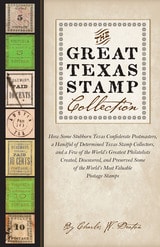
The Great Texas Stamp Collection
How Some Stubborn Texas Confederate Postmasters, a Handful of Determined Texas Stamp Collectors, and a Few of the World's Greatest Philatelists Created, Discovered, and Preserved Some of the World's Most Valuable Postage StampsBy Charles W. Deaton
University of Texas Press, 2012
Among the many difficulties the newly formed Confederate States of America endured in the summer of 1861 was the failure of its post office department to provide sufficient numbers of that item most crucial to its service: the postage stamp. Faced with the resulting din of customer complaints, a handful of industrious Texas postmasters solved the problem by simply making their own homemade stamps.
In this thoroughly researched history of these rare and highly coveted stamps, The Great Texas Stamp Collection traces their journey from creation through their rediscovery years later by local, and then international, stamp collectors—a journey that culminated in the sale of a few pieces at a recent auction in New York that fetched more than $250,000. Weaving the larger contexts of Texas and U.S. postal history together with individual tales of greed, intrigue, forgery, and discovery, Deaton’s book is rich with characters from European royalty to early stamp dealers to common criminals, while also providing detailed examinations of the stamps themselves, including a complete census of the stamps now known as the Texas Confederate Postmasters’ Provisionals.
Appealing at once to devoted philatelists, Texas and U.S. history buffs, and amateur collectors of all kinds, The Great Texas Stamp Collection offers a unique vantage point from which to view our history as well as the very nature of collecting.

The Many and the Few
A Chronicle of the Dynamic Auto WorkersHenry Kraus. With an Introduction by Neil O. Leighton, William J. Meyer, and Nan Pendrell
University of Illinois Press, 1985

Write Me a Few of Your Lines
A Blues ReaderSteven C. Tracy
University of Massachusetts Press, 1999
Among the signal achievements of African American culture is the style of music known as the blues, an art form evolved from southern black songs of the late nineteenth century. From the field hollers and steel-bodied guitar of its early days to the electric amplification of today's performers, the visceral power of the blues has long been celebrated for its creativity, spontaneity, and ingenuity. It has served as a wellspring for other forms of music, including gospel, jazz, rhythm and blues, soul, rock, and rap, and has exerted an influence on literature and the visual arts as well.
This book brings together some of the most significant writings about the blues published between 1911 and 1998. Included are selections by folklorists, anthropologists, sociologists, literary artists, musicians, critics, and aficionados. The extraordinary appeal of the blues is reflected in the range of contributors to this volume, among them Howard W. Odum, Alan Lomax, Richard Alan Waterman, Langston Hughes, Paul Oliver, Sam Charters, Janheinz Jahn, James Baldwin, Leroi Jones, Charles Keil, Jeff Todd Titon, Houston Baker, Hazel Carby, and Angela Davis. From these various perspectives emerges a new understanding of the blues: its origins in African aesthetics; the impact of slavery and Reconstruction; its early folk manifestations; and the importance of religion, style, gender, audience, protest, and the record business in its development as an art form. Further context is provided by a comprehensive introduction, section overviews, and an extensive bibliography, discography, and videography of blues materials.