Results by title
3 books match the query 'Superstition'

Bêtes Noires
Sorcery as History in the Haitian-Dominican BorderlandsLauren Derby
Duke University Press, 2025
In Bêtes Noires, Lauren Derby explores storytelling traditions among the people of Haiti and the Dominican Republic, focusing on shape-shifting spirit demons called baka/bacá. Drawing on interviews with and life stories of residents in a central Haitian-Dominican frontier town, Derby contends that bacás—hot spirits from the sorcery side of vodou/vodú that present as animals and generate wealth for their owners—are a manifestation of what Dominicans call fukú de Colón, the curse of Columbus. The dogs, pigs, cattle, and horses that Columbus brought with him are the only types of animals that bacás become. As instruments of Indigenous dispossession, these animals and their spirit demons convey a history of trauma and racialization in Dominican popular culture. In the context of slavery and beyond, bacás keep alive the promise of freedom, since shape-shifting has long enabled fugitivity. As Derby demonstrates, bacás represent a complex history of race, religion, repression, and resistance.
[more]
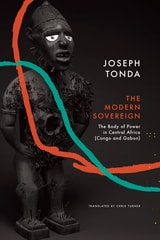
Modern Sovereign
The Body of Power in Central Africa (Congo and Gabon)Joseph Tonda
Seagull Books, 2020
The “Modern Sovereign,” a notion indebted both to Hobbes’s Leviathan and Marx’s conception of capital, refers to the power that governed the African multitudes from the earliest colonial days to the post-colonial era. It is an internalized power, responsible for the multiform violence exerted on bodies and imaginations. Joseph Tonda contends that in Central Africa—and particularly in Gabon and the Congo—the body is at the heart of political, religious, sexual, economic, and ritual power. This, he argues, is confirmed by the strong link between corporeal and political matters, and by the ostentatious display of bodies in African life. The body of power asserts itself as both matter and spirit, and it incorporates the seductive force of money, commodities, sex, and knowledge. Tonda’s incisive analysis reveals how this sovereign power is a social relation, historically constituted by the violence of the African cultural Imaginary and the realities of State, Market, and Church. It is to be understood, he asserts, through a generalized theory economic, political, and religious fetishism. By introducing this crucial critical voice from contemporary Africa into the English language, The Modern Sovereign makes a significant contribution to field of anthropology, political science, and African studies.
[more]
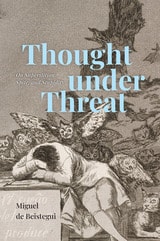
Thought under Threat
On Superstition, Spite, and StupidityMiguel de Beistegui
University of Chicago Press, 2022
Thought under Threat reveals and combats the forces diminishing the power and role of critical thinking, whether in our individual lives or collectively.
Thought under Threat is an attempt to understand the tendencies that threaten thinking from within. These tendencies have always existed. But today they are on the rise and frequently encouraged, even in our democracies. People “disagree” with science and distrust experts. Political leaders appeal to the hearts and guts of “the people,” rather than their critical faculties. Stupidity has become a right, if not a badge of honor; superstition is on the rise; and spite is a major political force. Thinking is considered “elitist.”
To see those obstacles as vices of thought, Miguel de Beistegui argues, we need to understand stupidity not as a lack of intelligence or judgment, but as the tendency to raise false problems and trivial questions. Similarly, we need to see spite not as a moral vice, but as a poison that blurs and distorts our critical faculties. Finally, superstition is best described not as a set of false beliefs, but as a system that neutralizes one’s ability to think for oneself.
For de Beistegui, thinking is intrinsically democratic and a necessary condition for the exercise of freedom. Thought under Threat shows how a training of thought itself can be used to ward off those vices, lead to productive deliberation, and, ultimately, create a thinking community.
[more]