Results by title

3 books match the query 'Field, Allyson Nadia'
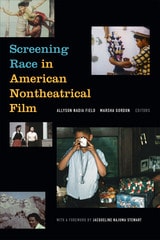
cover of Screening Race in American Nontheatrical Film

Screening Race in American Nontheatrical Film

Nadia Allyson Field and Marsha Gordon, editors

Duke University Press, 2019

Although overlooked by most narratives of American cinema history, films made for purposes outside of theatrical entertainment dominated twentieth-century motion picture production. This volume adds to the growing study of nontheatrical films by focusing on the ways filmmakers developed and audiences encountered ideas about race, identity, politics, and community outside the borders of theatrical cinema. The contributors to Screening Race in American Nontheatrical Film examine the place and role of race in educational films, home movies, industry and government films, anthropological films, and church films as well as other forms of nontheatrical filmmaking. From filmic depictions of Native Americans and films by 1920s African American religious leaders to a government educational film about the unequal treatment of Latin American immigrants, these films portrayed—for various purposes and intentions—the lives of those who were mostly excluded from the commercial films being produced in Hollywood. This volume is more than an examination of a broad swath of neglected twentieth-century filmmaking; it is a reevaluation of basic assumptions about American film culture and the place of race within it.

Contributors. Crystal Mun-hye Baik, Jasmyn R. Castro, Nadine Chan, Mark Garrett Cooper, Dino Everett, Allyson Nadia Field, Walter Forsberg, Joshua Glick, Tanya Goldman, Marsha Gordon, Noelle Griffis, Colin Gunckel, Michelle Kelley, Todd Kushigemachi, Martin L. Johnson, Caitlin McGrath, Elena Rossi-Snook, Laura Isabel Serna, Jacqueline Najuma Stewart, Dan Streible, Lauren Tilton, Noah Tsika, Travis L. Wagner, Colin Williamson
[more]
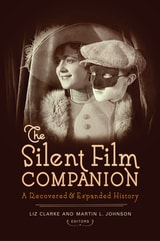
cover of The Silent Film Companion: A Recovered and Expanded History

The Silent Film Companion

A Recovered and Expanded History

Liz Clarke

Rutgers University Press, 2027

Silent film is more than just a cinema of firsts, greats, or classics. It is a cinema of experimentation, ambition, and connection. To watch a silent film is to be transported into another world. The Silent Film Companion seeks to broaden the silent film canon by focusing on compelling non-canonical films from around the globe, providing a fresh perspective and new view of silent cinema. With over fifty films discussed, this volume captures just a sliver of the many delights silent cinema has to offer. It encourages discovery, and rediscovery, of the world of silent cinema: one where the movies were still young, full of possibility, and eager to entice others to take part in a wonderful adventure. 

Films covered are from fourteen countries, including Brazil, Mexico, China, Cuba, India, Italy, and Russia, and represent a diversity of subjects. Each chapter provides historical and cultural context to the film, the filmmakers, and a concise analysis of each film. The Silent Film Companion is a must-read for students and fans of silent cinema interested in seeing a side of silent cinema that is rarely explored.
[more]
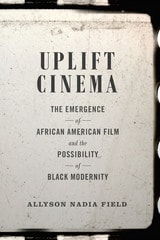
cover of Uplift Cinema: The Emergence of African American Film and the Possibility of Black Modernity

Uplift Cinema

The Emergence of African American Film and the Possibility of Black Modernity

Allyson Nadia Field

Duke University Press, 2015

In Uplift Cinema, Allyson Nadia Field recovers the significant yet forgotten legacy of African American filmmaking in the 1910s. Like the racial uplift project, this cinema emphasized economic self-sufficiency, education, and respectability as the keys to African American progress. Field discusses films made at the Tuskegee and Hampton Institutes to promote education, as well as the controversial The New Era, which was an antiracist response to D. W. Griffith's The Birth of a Nation. She also shows how Black filmmakers in New York and Chicago engaged with uplift through the promotion of Black modernity. Uplift cinema developed not just as a response to onscreen racism, but constituted an original engagement with the new medium that has had a deep and lasting significance for African American cinema. Although none of these films survived, Field's examination of archival film ephemera presents a method for studying lost films that opens up new frontiers for exploring early film culture.
[more]