Results by title

15 books match the query 'Fienup-Riordan, Ann'
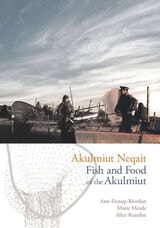
cover of Akulmiut Neqait / Fish and Food of the Akulmiut

Akulmiut Neqait / Fish and Food of the Akulmiut

Ann Fienup-Riordan, Marie Meade, and Alice Rearden

University of Alaska Press, 2019

For centuries, the Akulmiut people—a Yup’ik group—have been sustained by the annual movements of whitefish. It is a food that sustains and defines them. To this day, many Akulmiut view not only their actions in the world, but their interactions with each other, as having a direct and profound effect on these fish. Not only are fish viewed as responding to human action and intention in many contexts, but the lakes and rivers fish inhabit are likewise viewed as sentient beings, with the ability to respond both positively and negatively to those who travel there.
This bilingual book details the lives of the Akulmiut living in the lake country west of Bethel, Alaska, in the villages of Kasigluk, Nunapitchuk, and Atmautluak. Akulmiut Neqait is based in conversations recorded with the people of these villages as they talk about their uniquely Yup'ik view of the world and how it has weathered periods of immense change in southwest Alaska. While many predicted that globalization would sound the death knoll for many distinctive traditions, these conversations show that Indigenous people all over the planet have sought to appropriate the world in their own terms. For all their new connectedness, the continued relevance of traditional admonitions cannot be denied.
 
[more]
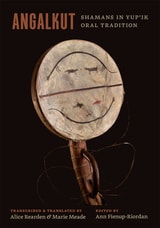
cover of Angalkut/Shamans in Yup'ik Oral Tradition

Angalkut/Shamans in Yup'ik Oral Tradition

Ann Fienup-Riordan

University of Alaska Press, 2025

Angalkut/Shamans in Yup’ik Oral Tradition collects over thirty years’ worth of shaman stories, told as part of gatherings organized by Calista Education and Culture to document Yup’ik traditional knowledge. These conversations highlight the critical role angalkut played in Yup’ik life—healing the sick, interpreting dreams and unusual experiences, requesting future abundance through masked dances and other ceremonies, protecting the lives of young children, and dealing with the dead.
 
The book begins with an English introduction that places Yup’ik oral traditions in the context of shamanism in Alaska and other parts of the Arctic. Then first-person accounts presented in the original Yup’ik with accompanying English translations discuss the importance of shamans and shamanism in general, good and bad shamans, and shamans as healers. Narratives from Nelson Island, Canineq, Kuskokwim River, Akulmiut, and Yukon River describe shamans as healers, shaman journeys and performances, shamans and masked dances requesting abundance, shamans and the dead, malicious shamans, shaman confrontations, becoming a shaman, and those who have shaman abilities today. A detailed glossary and references are also included.
 
Today, not only are these angalkut gone, but so are those who witnessed and participated in their activities. Angalkut/Shamans in Yup’ik Oral Tradition is the first book devoted exclusively to Yup’ik angalkut; never before has the variety of angalkut roles been profiled in publication, including the richness of elders’ recollections of these individuals and their roles. There is great value in the stories they left behind. This fine-grained presentation of unique, bilingual first-person narratives is an essential resource for scholars and students interested in Yup’ik heritage, Yugtun language, shaman ethnography, and Alaska Native oral traditions.
 
[more]
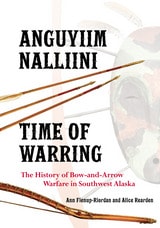
cover of Anguyiim Nalliini/Time of Warring: The History of Bow-and-Arrow Warfare in Southwest Alaska

Anguyiim Nalliini/Time of Warring

The History of Bow-and-Arrow Warfare in Southwest Alaska

Ann Fienup-Riordan and Alice Rearden

University of Alaska Press, 2016

This book draws on little-known oral histories from the Yup’ik people of southwest Alaska to detail a period of bow-and-arrow warfare that took place in the region between 1300 and 1800. The result of more than thirty years of research, discussion, and field recordings involving more than one hundred Yup’ik men and women, Anguyiim Nalliini tells a story not just of war and violence, but also of its cultural context—the origins of place names, the growth of indigenous architectural practices, the personalities of prominent warriors and leaders, and the eventual establishment of peaceful coexistence.

The book is presented in bilingual format, with facing-page translations, and it will be hailed as a landmark work in the study of Alaska Native history and anthropology.
[more]
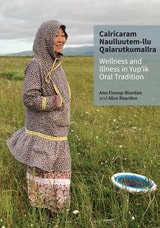
cover of Calricaram Naulluutem-llu Qanrutkumallra / Wellness and Illness in Yup'ik Oral Tradition

Calricaram Naulluutem-llu Qanrutkumallra / Wellness and Illness in Yup'ik Oral Tradition

Ann Fienup-Riordan

University of Alaska Press, 2027

Calricaram Naulluutem-llu Qanrutkumallra / Wellness and Illness in Yup’ik Oral Tradition brings together stories and information shared by more than a hundred Yup’ik tradition bearers over more than thirty years. Recorded during elder gatherings hosted by the Calista Elders Council beginning in 1997 and, since 2014, by Calista Education and Culture, the book passes on the words of wisdom that will remain enduring parts of these elders’ legacy.

Combining recent recordings with material from earlier gatherings, the narratives address various aspects of personal and community health: how people talk about sickness and health, traditional foods, qanruyutet (oral instructions) for living a healthy life, medicinal plants, medicinal uses of bodily fluids, ailments and treatments, traditional healing techniques, caring for those who are sick, mental health and mental illness, and epidemics.

Calricaram Naulluutem-llu Qanrutkumallra / Wellness and Illness in Yup’ik Oral Tradition invites readers to listen to these elders to better understand past practices and how they can contribute to a healthier future for all.
[more]
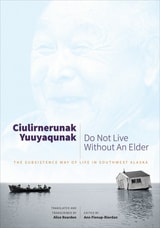
cover of Ciulirnerunak Yuuyaqunak/Do Not Live Without an Elder: The Subsistence Way of Life in Southwest Alaska

Ciulirnerunak Yuuyaqunak/Do Not Live Without an Elder

The Subsistence Way of Life in Southwest Alaska

Edited by Ann Fienup-Riordan

University of Alaska Press, 2016

In October of 2010, six men who were serving on the board of the Calista Elders Council (CEC) gathered in Anchorage with CEC staff to spend three days speaking about the subsistence way of life. The men shared stories of their early years growing up on the land and harvesting through the seasons, and the dangers they encountered there. The gathering was striking for its regional breadth, as elders came from the Bering Sea coast as well as the Yukon and Kuskokwim rivers. And while their accounts had some commonalities, they also served to demonstrate the wide range of different approaches to subsistence in different regions.
            This book gathers the men’s stories for the current generation and those to come. Taken together, they become more than simply oral histories—rather, they testify to the importance of transmitting memories and culture and of preserving knowledge of vanishing ways of life.

 
[more]
cover of Eskimo Essays: Yup'ik Lives and How We See Them

Eskimo Essays

Yup'ik Lives and How We See Them

Ann Fienup-Riordan

Rutgers University Press, 1991

Eskimo Essays introduces the reader to important aspects of the ideology and practice of the Yup’ik Eskimos of western Alaska, past and present. The essays point the way toward a fuller recognition of how Yup’ik Eskimos differ from the popular Western image of the Eskimo that was born largely without reference to Yup’ik reality. By describing the reality  of Yup’ik life, Eskimo Essays extends our understanding of Esimos in general and Yup’ik Eskimos in particular.

Ann Fienup-Riordan argues that Western observers have simultaneously naturalized Eskimos as paragons of simplicity and virtue and Western imperialism. This process has often ignored Eskimo concepts of society, history, and personhood. An original assumption of similarity to Western society has profoundly affected the current Euro-American view of Eskimo history and action. Non-natives have taken an idealized Western individual, dressed that person up in polar garb, and then assumed they understood the garment’s maker. The result is a presentation of Eskimo society that often tells us more about the meaning we seek in our own. Moreover, modern Eskimos have risen to the challenge and to some extent become what we have made them.

Bridging the gap between informed scholarships and popular concepts, Fienup-Riordan  provides a compelling and fresh presentation of Yup’ik life—cosmology, the missionary experience, attitudes toward conservation, Eskimo art, the legal system, warfare, and ceremonies.
[more]
cover of Held in Memory, Shared in Story: Teachings of the Middle Kuskokwim

Held in Memory, Shared in Story

Teachings of the Middle Kuskokwim

Ann Fienup-Riordan

University of Alaska Press, 2026

Along the winding banks of the Middle Kuskokwim River, stories live in the languages of the land. Shared from our Elders, around kitchen tables on long winter nights and beside summer campfires, these teachings carry the wisdom of the people who have called this place home for generations. Held in Memory, Shared in Story gathers these voices into a collection, a record of resilience and the deep relationship we share with world around us. This book captures the knowledge, shared in writing and orally, of our region and celebrates the storytellers, the listeners, and all who keep these traditions alive. To read these stories is to walk beside the people of the Middle Kuskokwim, to see through their eyes, to hear their laughter, and to understand that the heart of a culture lives in the stories shared across generations.
[more]
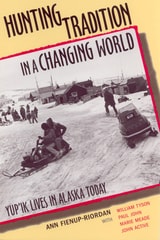
cover of Hunting Tradition in a Changing World: Yup'ik Lives in Alaska Today

Hunting Tradition in a Changing World

Yup'ik Lives in Alaska Today

Fienup-Riordan, Ann

Rutgers University Press, 2000
The Yupiit in southwestern Alaska are members of the larger family of Inuit cultures. Including more than 20,000 individuals in seventy villages, the Yupiit continue to engage in traditional hunting activities, carefully following the seasonal shifts in the environment they know so well. During the twentieth century, especially after the construction of the trans-Alaska oil pipeline, the Yup'ik people witnessed and experienced explosive cultural changes. Anthropologist Ann Fienup-Riordan explores how these subarctic hunters engage in a "hunt" for history, to make connections within their own communities and between them and the larger world. She turns to the Yupiit themselves, joining her essays with eloquent narratives by individual Yupiit, which illuminate their hunting traditions in their own words. To highlight the ongoing process of cultural negotiation, Fienup-Riordan provides vivid examples: How the Yupiit use metaphor to teach both themselves and others about their past and present lives; how they maintain their cultural identity, even while moving away from native villages; and how they worked with museums in the "Lower 48" on an exhibition of Yup'ik ceremonial masks. Ann Fienup-Riordan has published many books on Yup'ik history and oral tradition, including Eskimo Essays: Yup'ik Lives and How We See Them, The Living Tradition of Yup'ik Masks and Boundaries and Passages. She has lived with and written about the Yupiit for twenty-five years.
[more]
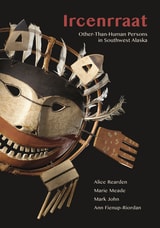
cover of Ircenrraat: Other-Than-Human Persons in Southwest Alaska

Ircenrraat

Other-Than-Human Persons in Southwest Alaska

Alice Rearden

University of Alaska Press, 2021
At Calista Education and Culture, we have been documenting Yup'ik traditional knowledge in southwest Alaska since 1998. During many of our discussions with elders, the subject of ircenrraat, the little people, would pop up. They are said to be miniature in size, and very crafty, and they exist in a different dimension with the ability to appear and disappear as they please in our world. Those who have encountered them have witnessed them hunting, fishing, and gathering together as our own people do. They have also stated that being invited to their dwellings for a day is like a year in our lifetime. We have been fortunate to have heard many stories, and we are pleased to put them together in this book. 
[more]
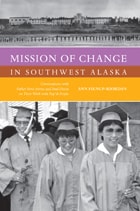
cover of Mission of Change in Southwest Alaska: Conversations with Father René Astruc and Paul Dixon on Their Work with Yup’ik People

Mission of Change in Southwest Alaska

Conversations with Father René Astruc and Paul Dixon on Their Work with Yup’ik People

Edited by Ann Fienup-Riordan

University of Alaska Press, 2012

Mission of Change is an oral history describing various types of change—political, social, cultural, and religious—as seen through the eyes of Father Astruc and Paul Dixon, non-Natives who dedicated their lives to working with the Yup’ik people. Their stories are framed by the an analytic history of regional changes, together with current anthropological theory on the nature of cultural change and the formation of cultural identity. The book presents a subtle and emotionally moving account of the region and the roles of two men, both of whom view issues from a Catholic perspective yet are closely attuned to and involved with changes in the Yup’ik community.
[more]
cover of Nunakun-gguq Ciutengqertut/They Say They Have Ears Through the Ground: Animal Essays from Southwest Alaska

Nunakun-gguq Ciutengqertut/They Say They Have Ears Through the Ground

Animal Essays from Southwest Alaska

Ann Fienup-Riordan

University of Alaska Press, 2020
Lifeways in Southwest Alaska today remains inextricably bound to the seasonal cycles of sea and land. Community members continue to hunt, fish, and make products from the life found in the rivers and sea. Based on a wealth of oral histories collected over decades of research, this book explores the ancestral relationship between Yup’ik people and the natural world of Southwest Alaska. Nunakun-gguq Ciutengqertut studies the overlapping lives of the Yup’ik with native plants, animals, and birds, and traces how these relationships transform as more Yup’ik people relocate to urban areas and with the changing environment. The book will be hailed as a milestone work in the anthropological study of contemporary Alaska.
[more]
cover of Qanemcit Amllertut/Many Stories to Tell: Tales of Humans and Animals from Southwest Alaska

Qanemcit Amllertut/Many Stories to Tell

Tales of Humans and Animals from Southwest Alaska

Edited by Ann Fienup-Riordan

University of Alaska Press, 2017

This bilingual collection shares new translations of old stories recorded over the last four decades though interviews with Yup’ik elders from throughout southwest Alaska. Some are true qulirat (traditional tales), while others are recent. Some are well known, like the adventures of the wily Raven, while others are rarely told. All are part of a great narrative tradition, shared and treasured by Yup’ik people into the present day.
This is the first region-wide collection of traditional Yup’ik tales and stories from Southwest Alaska. The elders and translators who contributed to this collection embrace the great irony of oral traditions: that the best way to keep these stories is to give them away. By retelling these stories, they hope to create a future in which the Yup’ik view of the world will be both recognized and valued.
[more]
cover of Words of the Real People: Alaska Native Literature in Translation

Words of the Real People

Alaska Native Literature in Translation

Edited by Ann Fienup-Riordan and Lawrence D. Kaplan

University of Alaska Press, 2007
Words of the Real People collects the life stories, poetry, and oral literature of the Yupik, Inupiaq, and Alutiiq peoples of Alaska, making them widely available to readers in English for the first time. Accompanied by background essays on each Native group, the literature in this collection embraces Native Alaskan life in all its rich variety. From tales of malevolent shamans to the unexpected poetry of the urban experience, and from ancient tales passed down for generations to contemporary stories being woven into a new tradition, Words of the Real People stakes out an important place for Native Alaskan literature as a vibrant, living tradition and will be essential to folklorists, anthropologists, and anyone interested in the storied past of our continent's most forbidding reaches.
[more]
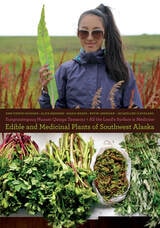
cover of Yungcautnguuq Nunam Qainga Tamarmi/All the Land's Surface is Medicine: Edible and Medicinal Plants of Southwest Alaska

Yungcautnguuq Nunam Qainga Tamarmi/All the Land's Surface is Medicine

Edible and Medicinal Plants of Southwest Alaska

Ann Fienup-Riordan

University of Alaska Press, 2020
In this book, close to one hundred men and women from all over southwest Alaska share knowledge of their homeland and the plants that grow there. They speak eloquently about time spent gathering and storing plants and plant material during snow-free months, including gathering greens during spring, picking berries each summer, harvesting tubers from the caches of tundra voles, and gathering a variety of medicinal plants. The book is intended as a guide to the identification and use of edible and medicinal plants in southwest Alaska, but also as an enduring record of what Yup’ik men and women know and value about plants and the roles plants continue to play in Yup’ik lives.
 
[more]
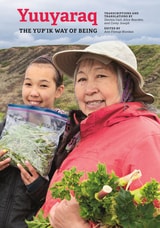
cover of Yuuyaraq: The Yup'ik Way of Being

Yuuyaraq

The Yup'ik Way of Being

Davina Carl

University of Alaska Press, 2018

This book presents stories, traditional tales, and qanruyutet (oral instructions) shared by elders from throughout southwest Alaska as part of the Yuuyaraq curriculum project. In what they say, elders provide a window into a uniquely Yup'ik view of how the world works and what it means to be a real person. And they have done so with their young people firmly in mind. Yuuyaraq embodies a way of life in which sharing is central -- sharing of food, of stories, of knowledge. Our hope is that this book carries this message forward, to audiences of all ages.
[more]