Results by title
3 books match the query 'Fin de Siècle'
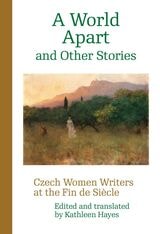
A World Apart and Other Stories
Czech Women Writers at the Fin de SiècleEdited and Translated by Kathleen Hayes
Karolinum Press, 2021
A collection of short stories by Czech women from the turn of the twentieth century.
A World Apart brings together translations of eight stories by Czech women from the turn of the twentieth century—a period of female political emancipation and impressive literary development in Czechoslovakia. Though they’re little known to an English-language public today, all of the writers featured in the book were recognized in their own day and constitute a cross-section of the literary styles of the period. Anna Maria Tilschová’s “A Sad Time” is written in a naturalist style, while Růžena Jesenská’s “A World Apart” presents themes and motifs that appealed to the Decadents. Helena Malířová’s “The Sylph” is both diaristic and satirical, whereas Růžena Svobodová’s ironical “A Great Passion,” with its rural setting and folklore motifs, calls to mind the writings of Karel Jaromír Erben. Gabriela Preissová’s short story “Eva” may be read as a celebration of folk culture, and Božena Benešová’s “Friends” is interesting for its psychological presentation of a child’s point of view and its implicit criticism of anti-Semitism. The book is accompanied by the biographies of each author and an introduction by editor and translator Kathleen Hayes.
A World Apart brings together translations of eight stories by Czech women from the turn of the twentieth century—a period of female political emancipation and impressive literary development in Czechoslovakia. Though they’re little known to an English-language public today, all of the writers featured in the book were recognized in their own day and constitute a cross-section of the literary styles of the period. Anna Maria Tilschová’s “A Sad Time” is written in a naturalist style, while Růžena Jesenská’s “A World Apart” presents themes and motifs that appealed to the Decadents. Helena Malířová’s “The Sylph” is both diaristic and satirical, whereas Růžena Svobodová’s ironical “A Great Passion,” with its rural setting and folklore motifs, calls to mind the writings of Karel Jaromír Erben. Gabriela Preissová’s short story “Eva” may be read as a celebration of folk culture, and Božena Benešová’s “Friends” is interesting for its psychological presentation of a child’s point of view and its implicit criticism of anti-Semitism. The book is accompanied by the biographies of each author and an introduction by editor and translator Kathleen Hayes.
[more]
FEMINIST REALISM AT THE FIN DE SIÈCLE
The Influence of the Late-Victorian Woman’s Press on the Development of the NovelMolly Youngkin
The Ohio State University Press, 2007
Molly Youngkin takes on a major literary problem of the turn-of-the-century: Was the transition from the Victorian novel to the modern novel enabled by antirealist or realist narrative strategies? To answer this question, Youngkin analyzes book reviews that appeared in two prominent feminist periodicals circulated during the late-Victorian era—Shafts and The Woman’s Herald.
Through reviews of the works of important male and female authors of the decade—Thomas Hardy, Sarah Grand, George Gissing, Mona Caird, George Meredith, Ménie Dowie, George Moore, and Henrietta Stannard—these periodicals developed a feminist realist aesthetic that drew on three aspects of woman’s agency (consciousness, spoken word, and action) and emphasized corresponding narrative strategies (internal perspective, dialogue, and description of characters’ actions). Still, these periodicals privileged consciousness over spoken word and action and, by doing so, encouraged authors to push the boundaries of traditional realism and anticipate the modernist aesthetic.
By acknowledging the role of the woman’s press in the development of the novel, this book revises our understanding of the transition from Victorianism to modernism, which often is characterized as antirealist. Late-Victorian authors working within the realist tradition also contributed to this transition, particularly through their engagement with feminist realism. Youngkin deftly illustrates this transition and in so doing proves that it cannot be attributed to antirealist narrative strategies alone.
[more]
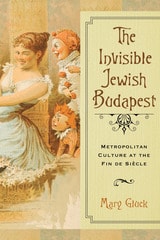
The Invisible Jewish Budapest
Metropolitan Culture at the Fin de SiècleMary Gluck
University of Wisconsin Press, 2019
Nearly a quarter of the population of Budapest at the fin de siècle was Jewish. This demographic fact appears startling primarily because of its virtual absence from canonical histories of the city.
Famed for its cosmopolitan culture and vibrant nightlife, Budapest owed much to its Jewish population. Indeed, it was Jews who helped shape the city's complex urban modernity between 1867 and 1914. Yet these contributions were often unacknowledged, leading to a metaphoric, if not literal, invisible status for many of Budapest's Jews.
In the years since, particularly between the wars, anti-Semites within and outside Budapest sought to further erase Jewish influences in the city. Appellations such as the "sinful city" and "Judapest" left a toxic inheritance that often inhibited serious conversation or scholarly research on the subject.
Into this breach strides Mary Gluck, whose goal is no less than to retrieve the lost contours of Jewish Budapest. She delves into the popular culture of the city's coffee houses, music halls, and humor magazines to uncover the enormous influence of assimilated Jews in creating modernist Budapest. She explores the paradox of this culture, which was Jewish-identified yet lacked a recognizable Jewish face. Because much of the Jewish population embraced and promoted a secular, metropolitan culture, their influence as Jews was both profound and invisible.
[more]