Results by title
5 books match the query 'Finitude'
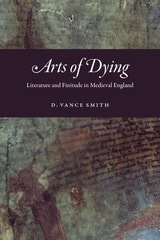
Arts of Dying
Literature and Finitude in Medieval EnglandD. Vance Smith
University of Chicago Press, 2020
Covering the emergence of English literature from the Old English to the late medieval periods, Arts of Dying argues that the problem of how to designate death produced a long tradition of literature about dying, which continues in the work of Heidegger, Blanchot, and Gillian Rose. Philosophy’s attempt to designate death’s impossibility is part of a literature that imagines a relationship with death, a literature that intensively and self-reflexively supposes that its very terms might solve the problem of the termination of life. A lyrical and elegiac exploration that combines medieval work on the philosophy of language with contemporary theorizing on death and dying, Arts of Dying is an important contribution to medieval studies, literary criticism, phenomenology, and continental philosophy.
Hope, Trust, and Forgiveness
Essays in FinitudeJohn T. Lysaker
University of Chicago Press, 2023
As ethical beings, we strive for lives that are meaningful and praiseworthy. But we are finite. We do not know, so we hope. We need, so we trust. We err, so we forgive. In this book, philosopher John T. Lysaker draws our attention to the ways in which these three capacities—hope, trust, and forgiveness—contend with human limits. Each experience is vital to human flourishing, yet each also poses significant personal and institutional challenges as well as opportunities for growth. Hope, Trust, and Forgiveness explores these challenges and opportunities and proposes ways to best meet them. In so doing, Lysaker experiments with the essay as a form and advances an improvisational perfectionism to deepen and expand our ethical horizons.
Indiscretion
Finitude and the Naming of GodThomas A. Carlson
University of Chicago Press, 1998
Combining both historical research in theology (from Pseudo-Dionysius to Aquinas to Eckhart) and contemporary philosophical analysis (from Hegel and Nietzsche to Heidegger, Derrida, and Marion), Indiscretion will interest philosophers, theologians, and other scholars concerned with the possibilities and limits of language surrounding both God and human subjectivity.
Neurotechnology and the End of Finitude
Michael Haworth
University of Minnesota Press, 2018
A bold philosophical investigation into technology and the limits of the human
A daring, original work of philosophical speculation, Neurotechnology and the End of Finitude mounts a sustained investigation into the possibility that human beings may technologically overcome the transcendental limits of possible experience and envisages what such a transition would look like. Focusing on emergent neurotechnologies, which establish a direct channel of communication between brain and machine, Michael Haworth argues that such technologies intervene at the border between interiority and exteriority, offering the promise of immediacy and the possibility of the mind directly affecting the outside world or even other minds.
Through detailed, targeted readings of Kant, Freud, Heidegger, Croce, Jung, and Derrida, Haworth explores the effect of this transformation on human creativity and our relationships with others. He pursues these questions across four distinct but interrelated spheres: the act of artistic creation and the potential for a technologically enabled coincidence of idea and object; the possibility of humanity achieving the infinite creativity that Kant attributed only to God; the relationship between the psyche and the external world in Freudian psychoanalysis and Jungian analytical psychology; and the viability and impact of techno-telepathic communication.
Addressing readers interested in contemporary continental philosophy and philosophy of technology, media and communications, and science and technology studies, Neurotechnology and the End of Finitude critically envisions a plausible posthuman future.
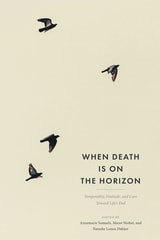
When Death Is on the Horizon
Temporality, Finitude, and Care Toward Life’s EndAnnemarie Samuels
Rutgers University Press, 2026
The urge to engage with finitude is increasingly central in our present apocalyptic time of political and ecological turmoil. Aging populations and the rapid development of advanced, but expensive, technologies to ever further postpone death pose significant healthcare challenges for societies around the world. In these times, how do people care when the end of life is near? How do they orient toward death? Do they see death as an absolute end, and if not, what sort of horizon does death present? Questioning taken for granted assumptions about end-of-life care, When Death Is on the Horizon analyzes how people approach death in a wide variety of geographical locations and social contexts. Through in-depth ethnographic case studies, it shows how people orient toward, beyond, and away from death, and how they do so within a world marked by historic and ongoing socio-political and structural inequalities.
This book is also freely available online as an open access digital edition.