Results by title
7 books match the query 'First Amendment'
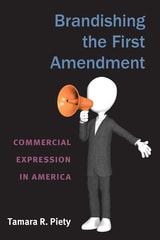
Brandishing the First Amendment
Commercial Expression in AmericaTamara R. Piety
University of Michigan Press, 2013
Over the past two decades, corporations and other commercial entities have used strategic litigation to win more expansive First Amendment protections for commercial speech—from the regulation of advertising to the role corporate interests play in the political process, most recently debated in the Supreme Court case of Citizens United v. Federal Election Commission. Tamara R. Piety, a nationally known critic of commercial and corporate speech, argues that such an expansion of First Amendment speech rights imperils public health, safety, and welfare; the reliability of commercial and consumer information; the stability of financial markets; and the global environment.
Beginning with an evaluation of commonly evoked philosophical justifications for freedom of expression, Piety determines that, while these are appropriate for the protection of an individual’s rights, they should not be applied too literally to commercial expression because the corporate person is not the moral equivalent of the human person. She then gathers evidence from public relations and marketing, behavioral economics, psychology, and cognitive studies to show how overly permissive extensions of First Amendment protections to commercial expression limit governmental power to address some of the major social, economic, and environmental challenges of our time.
“The timeliness of the topic and the provision of original positions are sure to make the book a valuable contribution that should draw much attention.”
—Kevin W. Saunders, Michigan State University
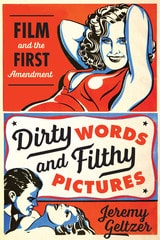
Dirty Words and Filthy Pictures
Film and the First AmendmentBy Jeremy Geltzer
University of Texas Press, 2015
From the earliest days of cinema, scandalous films such as The Kiss (1896) attracted audiences eager to see provocative images on screen. With controversial content, motion pictures challenged social norms and prevailing laws at the intersection of art and entertainment. Today, the First Amendment protects a wide range of free speech, but this wasn’t always the case. For the first fifty years, movies could be censored and banned by city and state officials charged with protecting the moral fabric of their communities. Once film was embraced under the First Amendment by the Supreme Court’s Miracle decision in 1952, new problems pushed notions of acceptable content even further.
Dirty Words & Filthy Pictures explores movies that changed the law and resulted in greater creative freedom for all. Relying on primary sources that include court decisions, contemporary periodicals, state censorship ordinances, and studio production codes, Jeremy Geltzer offers a comprehensive and fascinating history of cinema and free speech, from the earliest films of Thomas Edison to the impact of pornography and the Internet. With incisive case studies of risqué pictures, subversive foreign films, and banned B-movies, he reveals how the legal battles over film content changed long-held interpretations of the Constitution, expanded personal freedoms, and opened a new era of free speech. An important contribution to film studies and media law, Geltzer’s work presents the history of film and the First Amendment with an unprecedented level of detail.
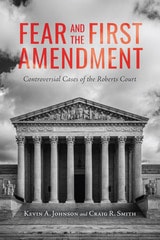
Fear and the First Amendment
Controversial Cases of the Roberts CourtKevin A. Johnson and Craig R. Smith
University of Alabama Press, 2024
DISTINGUISHED PUBLICATION AWARD FOR THE NATIONAL COMMUNICATION ASSOCIATION'S COMMUNICATION AND LAW DIVISION
The First Amendment: protected by law, threatened by fear in the Roberts Supreme Court.
In Fear and the First Amendment: Controversial Cases of the Roberts Court, Kevin A. Johnson and Craig R. Smith offer a deeply considered examination of the ways fear figures in First Amendment questions. Bringing together literature on theories of fear in rhetorical and philosophical traditions, Johnson and Smith focus on the rulings from the Roberts Court, which form a pivotal era of dramatic precedents. Each chapter analyzes one or more First Amendment cases and a variety of related fears—whether evidentiary or not—that pertain to a given case.
These cases include Morse v. Frederick, which takes up the competing fears of school administrators’ loss of authority and students’ loss of free speech rights. The authors touch on corporate funding of elections in Citizens United v. Federal Elections Commission, from the fear of corporate influence on electoral politics to corporate fears of alienating their consumers by backing political candidates. They explore religious freedom and fears of homosexuality in Christian Legal Society v. Martinez. Similarly, in Snyder v. Phelps, the authors delve further into fears of God, death, emotional distress, failing as a parent, and losing one’s reputation. Next, they investigate parents’ anxieties about violence in video games in Brown v. Entertainment Merchants Association. Finally, Johnson and Smith examine the role of fear in indecent, obscene, and graphic communication in three cases: FCC v. Fox Television Stations, Ashcroft v. American Civil Liberties Union, and United States v. Stevens.
Together these cases reveal fear to be an endemic factor in the rhetoric of First Amendment cases. This fascinating and original work will appeal to current legal practitioners and students of law, rhetoric, philosophy, and the First Amendment.
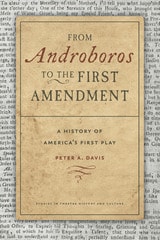
From Androboros to the First Amendment
A History of America's First PlayPeter A. Davis
University of Iowa Press, 2015
Androboros was not just the first of its kind, it was also ahead of its time in many ways, preceding the harsh political satires and farces of the later eighteenth century by some fifty years. Such plays served a small but essential role in promoting political thought among the colonists. Written by anonymous authors and passed from hand to hand, these short, crude, and often bawdy plays and dialogues were rarely acted due to their inflammatory lampoonery. Nevertheless, they provided an opportunity for disgruntled colonists to vent their grievances and promote their ideas to fellow citizens. The farces of the late eighteenth century drove home the meaning and message of the American Revolution.
Equally significant is that Androboros may have influenced a few of the key political discourses published in the 1730s, and these works in turn may well have shaped the future of the American political landscape for the next several decades and even into the modern era. But as a closet drama intended only to be read by close friends and political supporters, this play has languished as a minor footnote in American intellectual history. Scholarly research published to date has been, for the most part, inadequate and occasionally inaccurate. This study remedies that oversight, providing a full analysis as well as an annotated typescript and facsimiles of the original printing.
Literary Journalism on Trial
Masson v. New Yorker and the First AmendmentKathy Roberts Forde
University of Massachusetts Press, 2008
In November 1984, Jeffrey Masson filed a libel suit against writer Janet Malcolm and the New Yorker, claiming that Malcolm had intentionally misquoted him in a profile she wrote for the magazine about his former career as a Freud scholar and administrator of the Freud archives. Over the next twelve years the case moved up and down the federal judicial ladder, at one point reaching the U.S. Supreme Court, as lawyers and judges wrestled with questions about the representation of “truth” in journalism and, by extension, the limits of First Amendment protections of free speech. Had a successful Freudian scholar actually called himself an “intellectual gigolo” and “the greatest analyst who ever lived?" Or had a respected writer for the New Yorker knowingly placed false, self-damning words in her subject's mouth?
In Literary Journalism on Trial, Kathy Roberts Forde explores the implications of Masson v. New Yorker in the context of the history of American journalism. She shows how the case represents a watershed moment in a long debate between the advocates of traditional and literary journalism and explains how it reflects a significant intellectual project of the period: the postmodern critique of objectivity, with its insistence on the instability of language and rejection of unitary truth in human affairs. The case, Forde argues, helped widen the perceived divide between ideas of literary and traditional journalism and forced the resolution of these conflicting conceptions of truth in the constitutional arena of libel law. By embracing traditional journalism's emphasis on fact and objectivity and rejecting a broader understanding of truth, the Supreme Court turned away from the First Amendment theory articulated in previous rulings, opting to value less the free, uninhibited interchange of ideas necessary to democracy and more the “trustworthiness” of public expression. The Court's decision in this case thus had implications that reached beyond the legal realm to the values and norms expressed in the triangular relationship between American democracy, First Amendment principles, and the press.
Speech Acts and the First Amendment
Franklyn S. Haiman. Foreword by Abner J. Mikva
Southern Illinois University Press, 1993
What can a democratic society reasonably do about the perplexing problems of racial intolerance, sexual harassment, incitements to violence, and invasions of privacy? Is it possible to preserve the constitutional ideal of free expression while protecting the community from those who would trample on the rights of others?
Franklyn S. Haiman critically examines the reasoning behind recent efforts to prohibit certain forms of speech and explores the possible consequences to democracy of such moves.
Speech act theory, well known to scholars of rhetoric, communication, and language, underlies this emerging trend in judicial and legislative thinking. The idea that "words are deeds," first articulated in language philosophy by Wittgenstein and elaborated by J. L. Austin and John Searle, is being invoked by some members of the legal community to target objectionable speech. For example, speech codes on some college campuses prohibit racist, sexist, and homophobic expression, and attempts have been made through local laws to classify pornography as a form of sex discrimination. By defining certain kinds of arguably immoral symbolic behavior such as hate speech, obscenity, or portrayals of violence as acts rather than as pure speech, speech act advocates make it easier to argue that such conduct should be subject to social control through the law.
Unlike totalitarian or theocratic societies that see no difference between their concept of morality and the law, however, a democracy must make a distinction between what it regards as immoral and what it makes illegal. Haiman maintains that in the realm of symbolic behavior the line between them should be drawn as closely as possible to expression that results in the most serious, direct, immediate, and physical harm to others. Thus, he joins with former Supreme Court Justice Louis Brandeis in concluding that, absent an emergency, more speech, not enforced silence, should be the aim of a free society.
Speech Rights in America
The First Amendment, Democracy, and the MediaLaura Stein
University of Illinois Press, 2005
The First Amendment is the principle guarantor of speech rights in the United States. But the Supreme Court's interpretations of it often privilege the interests of media owners over those of the broader citizenry.
Laura Stein argues that such rulings alienate citizens from their rights, corrupt the essential workings of democracy, and prevent the First Amendment from performing its critical role as a protector of free speech. Drawing on the best of the liberal democratic tradition, Stein demonstrates that there is a significant gap between First Amendment law and the speech rights necessary to democratic communication, and proposes an alternative set of principles to guide future judicial, legislative, and cultural policy on old and new media.