Results by title
2 books match the query 'Fischer, André'
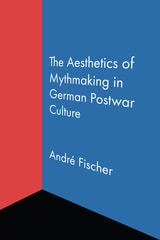
The Aesthetics of Mythmaking in German Postwar Culture
André Fischer
Northwestern University Press, 2024
Myths are a central part of our reality. But merely debunking them lets us forget why they are created in the first place and why we need them. André Fischer draws on key examples from German postwar culture, from novelists Hans Henny Jahnn and Hubert Fichte, to sculptor and performance artist Joseph Beuys, and filmmaker Werner Herzog, to show that mythmaking is an indispensable human practice in times of crisis.
Against the background of mythologies based in nineteenth-century romanticism and their ideological continuation in Nazism, fresh forms of mythmaking in the narrative, visual, and performative arts emerged as an aesthetic paradigm in postwar modernism. Boldly rewriting the cultural history of an era and setting in transition, The Aesthetics of Mythmaking in German Postwar Culture counters the predominant narrative of an exclusively rational Vergangenheitsbewältigung (“coming to terms with the past”). Far from being merely reactionary, the turn toward myth offered a dimension of existential orientation that had been neglected by other influential aesthetic paradigms of the postwar period. Fischer’s wide-ranging, transmedia account offers an inclusive perspective on myth beyond storytelling and instead develops mythopoesis as a formal strategy of modernism at large.
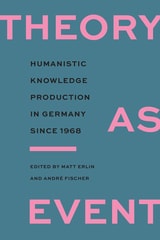
Theory as Event
Humanistic Knowledge Production in Germany Since 1968Matt Erlin, André Fischer
Northwestern University Press, 2027
Shedding new light on the actors, infrastructures, and events that shaped the development of literary and cultural theory
While theory aspires by its very nature to timeless validity, the ascendency of particular intellectual paradigms at specific historical moments depends on a complex assemblage of institutional, historical, political, material, and medial factors. Theory as Event: Humanistic Knowledge Production in Germany Since 1968 reconsiders the so-called age of theory as it took shape in the German-speaking world after 1968. In invoking the term “event,” this volume draws attention to the myriad incidents and accidents that enable the creation, diffusion, and canonization of humanistic knowledge, from public controversies and debates to the circulation of various forms of print media.
By conceptualizing theory as an event, the volume also sheds new light on the quotidian, praxeological forms of knowledge production—inconspicuous but no less important acts of research, teaching, and even administration that have shaped the intellectual landscape of the humanities, from visiting professorships and habilitation defenses to the founding of new working groups. In shifting attention from the explication of individual works to these seemingly paratextual phenomena, the contributors to this collection not only offer a fresh perspective on key moments in German intellectual history; they also model a new approach to the history of ideas.