Results by title
5 books match the query 'Fletcher, Anne'
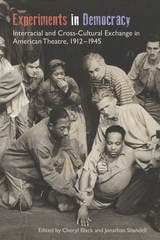
Experiments in Democracy
Interracial and Cross-Cultural Exchange in American Theatre, 1912-1945Edited by Cheryl Black and Jonathan Shandell
Southern Illinois University Press, 2016
In Experiments in Democracy, edited by Cheryl Black and Jonathan Shandell, theatre historians examine a wide range of performances—from Broadway, folk plays and dance productions to scripted political rallies and radio dramas. Contributors look at such diverse groups as the Theatre Union, La Unión Martí-Maceo, and the American Negro Theatre, as well as individual playwrights and their works, including Theodore Browne’s folk opera Natural Man, Josefina Niggli’s Soldadera, and playwright Lynn Riggs’s Cherokee Night and Green Grow the Lilacs (the basis for the musical Oklahoma!). Exploring the ways progressive artists sought to connect isolated racial and cultural groups in pursuit of a more just and democratic society, contributors take into account the blind spots, compromised methods, and unacknowledged biases at play in their practices and strategies. Essays demonstrate how the gap between the ideal of American democracy and its practice—mired in entrenched systems of white privilege, economic inequality, and social prejudice—complicated the work of these artists.
Focusing on questions of race, ethnicity, gender, and sexuality on the stage in the decades preceding the Civil Rights era, Experiments in Democracy fills an important gap in our understanding of the history of the American stage—and sheds light on these still-relevant questions in contemporary American society.
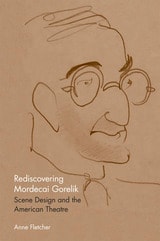
Rediscovering Mordecai Gorelik
Scene Design and the American TheatreAnne Fletcher
Southern Illinois University Press, 2009
Rediscovering Mordecai Gorelik explores the life and work of the pioneering scene designer whose career spanned decades in American theatre. Anne Fletcher’s insightful volume draws intriguing parallels and contrasts between Gorelik’s productions and the theatrical movements of the twentieth century, exposing the indelible mark he left on the stage. Through in-depth analysis of his letters, diaries, designs, and theoretical works, Fletcher examines the ways in which Gorelik’s productions can be used as a mirror to reflect the shifting dramatic landscapes of his times.
Fletcher places Gorelik against the colorful historical backdrops that surrounded him—including the avant-garde movement of the 1920s, World War II, the Cold War, and absurdism—using the designer’s career as a window into the theatre during these eras. Within these cultural contexts, Gorelik sought to blaze his own unconventional path through the realms of theatre and theory. Fletcher traces Gorelik’s tenures with such companies as the Provincetown Players, the Theatre Guild, and the Theatre Union, as well as his relationships with icons such as Bertolt Brecht, revealing how his interactions with others influenced his progressive designs and thus set the stage for major dramatic innovations. In particular, Fletcher explores Gorelik’s use of scenic metaphor: the employment of stage design techniques to subtly enhance the tone or mood of a production. Fletcher also details the designer’s written contributions to criticism and theory, including the influential volume New Theatres for Old, as well as other articles and publications.
In addition to thorough examinations of several of Gorelik’s most famous projects, Rediscovering Mordecai Gorelik contains explications of productions by such legends as John Howard Lawson, Clifford Odets, and Arthur Miller. Also included are numerous full-color and black-and-white illustrations of Gorelik’s work, most of which have never been available to the public until now. More than simply a portrait of one man, this indispensable volume is a cultural history of American theatre as seen through the career of a visionary designer and theoretician.
Theatre History Studies 2008, Vol. 28
Edited by Rhona Justice-Malloy
University of Alabama Press, 2008
Theatre History Studies is a peer-reviewed journal of theatre history and scholarship published annually since 1981 by the Mid-American Theatre Conference (MATC), a regional body devoted to theatre scholarship and practice. The conference encompasses the states of Illinois, Iowa, Nebraska, Kansas, Missouri, Minnesota, North Dakota, South Dakota, Wisconsin, Indiana, Michigan, and Ohio. The purpose of the conference is to unite persons and organizations within the region with an interest in theatre and to promote the growth and development of all forms of theatre.
Theatre History Studies 2014, Vol. 33
Theatres of WarElizabeth Reitz Mullenix
University of Alabama Press, 2014
War and theatre is a subject of increasing popularity among scholars of theatre. The essays in this special edition of Theatre History Studies brings together a unique collection of work by thirteen innovative scholars whose work explores such topics as theatre performances during war times, theatre written and performed to resist war, and theatre that fosters and promotes war.
The contributors to this volume write poignantly about nationhood and about how war—through both propaganda and protest—defines a people. The contributors also delve into numerous fascinating themes that transcend time, peoples, nations, and particular conflicts: the foundations of nationalism and the concepts of occupied and occupier, nostalgia and utopia, and patriotism and revolution.
These essays survey a march of civil and international wars spanning three centuries. Arranged chronologically, they invite comparisons between themes and trace the development of the major themes of war. Ideas manifest in the theatre of one period recall ideologies and propaganda of the past, reflect those of the present, and anticipate wars to come.
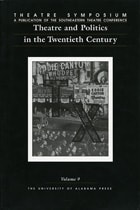
Theatre Symposium, Vol. 9
Theatre and Politics in the Twentieth CenturyJohn C. Countryman
University of Alabama Press, 2001
This collection of essays explores how drama can teach political principles and entertain at the same time.
Political commentary is possible through "variety" theatre, this volume contends. Compiled from the April 2000 Theatre Symposium held on the campus of the University of Tennessee-Knoxville, this collection of essays presents a compelling mix of theoretical and practical viewpoints from a broad diversity of scholars from around the country.
What remains to be learned about the political objectives of Brecht's Lehrstriucke? What political power is resident in the satirical humor of Dario Fo's drama? What can we learn from Mordecai Gorelik's political/artistic philosophy that might inform contemporary practice? What was the impact of political theatre on Broadway between the wars? Is Thornton Wilder's Our Town the play we've always imagined it to be, or does it challenge the politics of its time? What is the role of theatre activism in raising consciousness about gender politics? These are only some of the questions addressed by this lively, informative discussion.