Results by title
16 books match the query 'Flynt, Wayne'
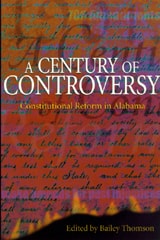
A Century of Controversy
Constitutional Reform in AlabamaH. Bailey Thomson
University of Alabama Press, 2002
A timely examination of Alabama’s severely criticized state constitution
Alabama’s present constitution, adopted in 1901, is widely viewed as the source of many, if not most, of the state’s historic difficulties and inequities. Chief among these is a poorly funded school system, an imbalanced tax system that favors special business interests, legislated racism, and unchecked urban sprawl. Many citizens believe that, after 100 years of overburdening amendments and confusing addendums, the constitution urgently needs rewriting.
With this book, Bailey Thomson has assembled the best scholarship on the constitution, its history, and its implications for the future. Historian Harvey H. Jackson III details the degree to which the 1901 document was drafted as a legal tool to ensure white supremacy at the expense of poor whites and blacks, while Joe A. Sumners illustrates how the constitution ties the hands of elected civic leaders by handing authority for local decisions to state government in Montgomery. James W. Williams Jr. explores the impact of the state constitution on the beleaguered tax system and the three principal “revenue crises” it has engendered. Thomson’s own contribution explains how, in contrast to the previous failed attempts for constitutional change by past governors who appealed to their fellow power brokers, the current reform movement arose from the grassroots level.
As citizens and politicians in Alabama review the 1901 constitution for revision, as they navigate the pitfalls and opportunities inherent in change, it is incumbent that they inform themselves adequately on the controversies that have swirled around the constitution since its adoption. The future of Alabama’s government will depend upon it, as will the fortunes of Alabama’s business interests and the well-being of every citizen in the state for years to come.
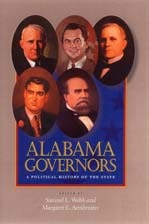
Alabama Governors
A Political History of the StateSamuel L. Webb
University of Alabama Press, 2001
The story of Alabama's governors has been often bizarre, occasionally inspiring, but never dull. Several of the state's early governors fought duels; one killed his wife's lover. A Reconstruction era-governor barricaded himself in his administrative office and refused to give it up when voters failed to reelect him. A 20th-century governor, an alumnus of Yale, married his first cousin and served as an officer in the Ku Klux Klan.
This collection of biographical essays, written by 34 noted historians and political scientists, chronicles the foibles and idiosyncrasies, in and out of office, of those who have served as the state's highest elected official. It also describes their courage; their meaningful policy initiatives; their accomplishments and failures; the complex factors that led to their actions or inaction; and the enormous consequences of their choices on the state's behalf.
Taken together, the essays provide a unified history of the state, with its recurring themes of race, federal-state relations, economic development, taxation, and education. Alabama Governors is certain to become an invaluable resource for teachers, students, librarians, journalists, and anyone interested in the colorful history and politics of the state.

Alabama Governors
A Political History of the StateSamuel L. Webb
University of Alabama Press, 2014
This collection of biographical essays, written by thirty-four noted historians and political scientists, chronicles the times, careers, challenges, leadership, and legacies of the fifty-seven men and one woman who have served as the state's highest elected official. The book is organized chronologically into six sections that cover Alabama’s years as a US territory and its early statehood, the 1840s through the Civil War and Reconstruction, the late nineteenth-century Bourbon era, twentieth-century progressive and wartime governors, the Civil Rights era and George Wallace’s period of influence, and recent chief executives in the post-Wallace era.
The political careers of these fifty-eight individuals reflect the story of Alabama itself. Taken together, these essays provide a unified history of the state, with its recurring themes of race, federal-state relations, tensions between north and south Alabama, economic development, taxation, and education.
Alabama Governors expertly delineates the decisions and challenges of the chief executives, their policy initiatives, their accomplishments and failures, and the lasting impact of their terms. The book also includes the true and sometimes scandalous anecdotes that pepper Alabama’s storied history. Several of the state's early governors fought duels; one killed his wife's lover. A Reconstruction era-governor barricaded himself in his office and refused to give it up when voters failed to reelect him. A twentieth-century governor, an alumnus of Yale, served as an officer in the Ku Klux Klan.
This entirely updated and revised edition includes enlarged and enhanced images of each governor. Published as Alabama prepares for its sixty-fourth gubernatorial election, Alabama Governors is certain to become a valuable resource for teachers, students, librarians, journalists, and anyone interested in the colorful history of Alabama politics.

Alabama in the Twentieth Century
Wayne Flynt
University of Alabama Press, 2004
An authoritative popular history that places the state in regional and national context.
Penned by one of Alabama’s most distinguished historians, this masterful work offers a sweeping yet intimate portrait of a century that reshaped both the state and the nation. With clarity, wit, and deep insight, the author traces the dramatic arc of the 20th century—from the dawn of flight and the rise of industrial power to revolutions in psychology, literature, and morality—all through the lens of Alabama’s unique experience.
Far more than a catalog of events, this book is a meditation on transformation. It captures the spirit of Alabamians as they confronted change with determination and vision, reckoning with the promises and perils of modernity. The author’s deep respect for archival sources and fellow scholars is matched by his gift for storytelling, making this an accessible and compelling read for both academics and general audiences.
With a voice honed by decades of scholarship and a heart rooted in Southern soil, the author brings history to life—illuminating how one state mirrored the nation’s evolution while forging its own path. This is essential reading for anyone seeking to understand Alabama’s place in the American story.
Alabama
The History of a Deep South StateWilliam Warren Rogers
University of Alabama Press, 1994

Alabama
The History of a Deep South State, Bicentennial EditionWilliam Warren Rogers, Robert David Ward, Leah Rawls Atkins, and Wayne Flynt
University of Alabama Press, 2018
A definitive bicentennial history of Alabama and its place in the American South.
Alabama: The History of a Deep South State, Bicentennial Edition is a comprehensive narrative account of the state from its earliest days to the present. This edition, updated to celebrate the state’s bicentennial year, offers a detailed survey of the colorful, dramatic, and often controversial turns in Alabama’s evolution. Organized chronologically and divided into three main sections—the first concluding in 1865, the second in 1920, and the third bringing the story to the present—makes clear and interprets the major events that occurred during Alabama’s history within the larger context of the South and the nation.
Once the home of aboriginal inhabitants, Alabama was claimed and occupied by a number of European nations prior to becoming a permanent part of the United States in 1819. A cotton and slave state for more than half of the nineteenth century, Alabama seceded in 1861 to join the Confederate States of America, and occupied an uneasy and uncertain place in America’s post-Civil War landscape. Alabama’s role in the twentieth century has been equally tumultuous and dramatic.
General readers as well as scholars will welcome this up-to-date and scrupulously researched history of Alabama, which examines such traditional subjects as politics, military history, economics, race, and class. It contains essential accounts devoted to Native Americans, women, and the environment, as well as detailed coverage of health, education, organized labor, civil rights, and the many cultural developments, from literature to sport, that have enriched Alabama’s history. The stories of individual leaders, from politicians to creative artists, are also highlighted. A key facet of this landmark historical narrative is the strong emphasis placed on the common everyday people of Alabama, those who have been rightly described as the “bone and sinew” of the state.
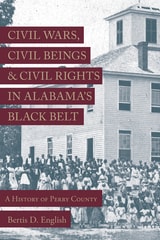
Civil Wars, Civil Beings, and Civil Rights in Alabama's Black Belt
A History of Perry CountyBertis D. English, Foreword by Wayne Flynt
University of Alabama Press, 2020
Reconstruction politics and race relations between freed blacks and the white establishment in Perry County, Alabama
In his fascinating, in-depth study, Bertis D. English analyzes why Perry County, situated in the heart of a violence-prone subregion of Alabama, enjoyed more peaceful race relations and less bloodshed than several neighboring counties. Choosing an atypical locality as central to his study, English raises questions about factors affecting ethnic disturbances in the Black Belt and elsewhere in Alabama. He also uses Perry County, which he deems an anomalous county, to caution against the tendency of some scholars to make sweeping generalizations about entire regions and subregions.
English contends Perry County was a relatively tranquil place with a set of extremely influential African American businessmen, clergy, politicians, and other leaders during Reconstruction. Together with egalitarian or opportunistic white citizens, they headed a successful campaign for black agency and biracial cooperation that few counties in Alabama matched. English also illustrates how a significant number of educational institutions, a high density of African American residents, and an unusually organized and informed African American population were essential factors in forming Perry County’s character. He likewise traces the development of religion in Perry, the nineteenth-century Baptist capital of Alabama, and the emergence of civil rights in Perry, an underemphasized center of activism during the twentieth century.
This well-researched and comprehensive volume illuminates Perry County’s history from the various perspectives of its black, interracial, and white inhabitants, amplifying their own voices in a novel way. The narrative includes rich personal details about ordinary and affluent people, both free and unfree, creating a distinctive resource that will be useful to scholars as well as a reference that will serve the needs of students and general readers.
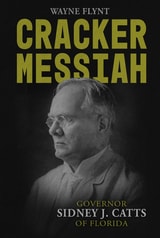
Cracker Messiah
Governor Sidney J. Catts of FloridaWayne Flynt
University of Alabama Press, 1977
The definitive biography of Sidney J. Catts—Florida’s fiery governor who fused pulpit rhetoric with populist politics in the early twentieth century.
Cracker Messiah by Wayne Flynt is a riveting portrait of Sidney J. Catts, one of the most controversial figures in Southern political history. Catts rose from Baptist pulpits and Chautauqua stages to Florida’s governor’s mansion in 1916, riding a wave of rural populism, prohibition fervor, and anti-Catholic rhetoric. His fiery oratory and outsider persona electrified “Florida crackers” at a time when industrial and urban forces were reshaping the South. Yet Catts was more than a demagogue. His administration championed progressive reforms—good roads, penal improvements, vocational education, and even women’s political participation—while his career oscillated between idealism and opportunism.
Wayne Flynt’s meticulously documented biography illuminates this complicated politician, tracing Catts’s battles with the Democratic establishment, his failed Senate bid, and his later flirtations with gambling and real estate during Florida’s boom years. Drawing on interviews, archival sources, and legislative records, Cracker Messiah illuminates the tensions between nativism and reform, faith and hypocrisy, populism and progressivism in the early twentieth-century South. This new edition will appeal to readers of Southern history, political biography, and Progressive Era studies, as well as anyone interested in the roots of American populism and the enduring complexities of cultural and political identity in the Deep South.

Duncan Upshaw Fletcher
Dixie’s Reluctant ProgressiveWayne Flynt
University of Alabama Press, 2026
A Southern senator at the crossroads of change.
Duncan Upshaw Fletcher: Dixie’s Reluctant Progressive is the definitive portrait of one of Florida’s most influential yet overlooked political figures. Serving in the U.S. Senate from 1909 to 1936, Fletcher bridged the gap between Wilsonian progressivism and Roosevelt’s New Deal, shaping landmark legislation such as the Federal Farm Loan Act, the Shipping Act, and major banking reforms. Far from a demagogue, Fletcher was a methodical, pragmatic leader who championed moderation, urban progressivism, and economic development while resisting racial and religious extremism.
Wayne Flynt’s deeply researched biography illuminates Fletcher’s paradoxical career—a Unitarian in a fundamentalist state, a reformer who later embraced conservatism, and a Southern Democrat who became a loyal New Dealer. Through vivid analysis of Florida’s turbulent political landscape, the book explores themes of coalition-building, economic modernization, and the South’s evolving role in national politics. This work will captivate readers interested in Southern history, political biography, and the roots of modern progressivism. Scholars of the New Deal, reform movements, and Florida history will find it indispensable, while general readers will appreciate its lucid style and insights into a leader whose story resonates with today’s debates over moderation, governance, and social change.
History and Hope in the Heart of Dixie
Scholarship, Activism, and Wayne Flynt in the Modern SouthEdited by Gordon E. Harvey, Richard D. Starnes and Glenn Feldman
University of Alabama Press, 2006
Exploring the history, challenges, and promise of a changing South through the legacy of Wayne Flynt.
This collection of essays on the social and political history of the modern South consider the region’s poor, racial mores and race relations, economic opportunity, Protestant activism, political coalitions and interest groups, social justice, and progressive reform. History and Hope in the Heart of Dixie illuminates the dual role of historian and public advocate in modern America. In a time when the nation’s eyes have been focused by Hurricanes Katrina and Rita onto the vulnerability and dire condition of poor people in the South, the applicability of research, teaching, and activism for this voiceless element seems all the more relevant.
Responding to the example of Wayne Flynt, whose fierce devotion to his state of Alabama and its region has not blinded his recognition of the inequities and despair that define southern life for so many, the scholars assembled in this work present contributions to the themes Flynt so passionately explored in his own work.Two seasoned observers of southern history and culture—John Shelton Reed and Dan T. Carter—offer assessments of Flynt’s influence on the history profession as a whole and on the region of the South in particular.

Keeping the Faith
Ordinary People, Extraordinary LivesWayne Flynt
University of Alabama Press, 2011

Poor but Proud
Alabama's Poor WhitesWayne Flynt
University of Alabama Press, 2001
CHOICE OUTSTANDING ACADEMIC BOOK (SPONSORED BY CHOICE MAGAZINE)
JAMES F. SULZBY BOOK AWARD (SPONSORED BY ALABAMA HISTORICAL ASSOCIATION)
ALABAMA LIBRARY AUTHOR AWARD (SPONSORED BY ALABAMA LIBRARY ASSOCIATION)
LILLIAN SMITH BOOK AWARD (SPONSORED BY SOUTHERN REGIONAL COUNCIL)
A groundbreaking history of class, culture, and resilience in the Alabama South.
First published in 1989 by The University of Alabama Press, this new paperback version will make the classic work available for general readers, bookstores, and classrooms.
Wayne Flynt addresses the life experiences of poor whites through their occupations, society, and culture. He explores their family structure, music, religion, folklore, crafts, and politics and describes their attempts to resolve their own problems through labor unions and political movements. He reveals that many of our stereotypes about poor whites are wildly exaggerated; few were derelicts or "white trash." Even though racism, emotionalism, and a penchant for violence were possible among poor whites, most bore their troubles with dignity and self-respect - working hard to eventually lift themselves out of poverty.
The phrase "poor but proud" aptly describes many white Alabamians who settled the state and persisted through time. During the antebellum years, poor whites developed a distinctive culture on the periphery of the cotton belt. As herdsmen, subsistence farmers, mill workers, and miners, they flourished in a society more renowned for its two-class division of planters and slaves. The New Deal era and the advent of World War II broke the long downward spiral of poverty and afforded new opportunities for upward mobility.
Recovering the Margins of American Religious History
The Legacy of David Edwin Harrell Jr.B. Dwain Waldrep
University of Alabama Press, 2012
Southern Religion and Christian Diversity in the Twentieth Century
Wayne Flynt, Foreword by Charles A. Israel and John Giggie
University of Alabama Press, 2016
Essays by the distinguished historian of southern religion Wayne Flynt, that illuminate the often overlooked complexity among southern Protestants.
Throughout its dramatic history, the American South has wrestled with issues such as poverty, social change, labor reform, civil rights, and party politics, and Flynt’s writing reaffirms religion as the lens through which southerners understand and attempt to answer these contentious questions. In Southern Religion and Christian Diversity in the Twentieth Century, however, Flynt gently but persuasively dispels the myth—comforting to some and dismaying to others—of religion in the South as an inert cairn of reactionary conservatism.
Flynt introduces a wealth of stories about individuals and communities of faith whose beliefs and actions map the South’s web of theological fault lines. In the early twentieth century, North Carolinian pastor Alexander McKelway became a relentless crusader against the common practice of child labor. In 1972, Rev. Dr. Ruby Kile, in a time of segregated churches led by men, took the helm of the eight-member Powderly Faith Deliverance Center in Jefferson County, Alabama and built the fledgling group into a robust congregation with more than 700 black and white worshippers. Flynt also examines the role of religion in numerous pivotal court cases, such as the US Supreme Court school prayer case Engel v. Vitale, whose majority opinion was penned by Justice Hugo Black, an Alabamian. These fascinating case studies and many more illuminate a religious landscape of far more varied texture and complexity than is commonly believed.
Southern Religion and Christian Diversity in the Twentieth Century offers much to readers and scholars interested in the South, religion, and theology. Writing with his hallmark wit, warmth, and erudition, Flynt’s Southern Religion and Christian Diversity in the Twentieth Century is a vital record of gospel-inspired southerners whose stories revivify sclerotic assumptions about the narrow conformity of southern Christians.
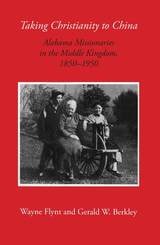
Taking Christianity to China
Alabama Missionaries in the Middle Kingdom, 1850–1950Wayne Flynt and Gerald W. Berkley
University of Alabama Press, 2017
A study of faith, cultural exchange, and the Alabama missionaries who helped shape the story of Christianity in modern China.
Beginning early in the 19th century, the American missionary movement made slow headway in China. Alabamians became part of that small beachhead. After 1900 both the money and personnel rapidly expanded, peaking in the early 1920s. By the 1930s many American denominations became confused and divided over the appropriateness of the missionary endeavor. Secular American intellectuals began to criticize missionaries as meddling do-gooders trying to impose American Evangelicalism on a proud, ancient culture.
By examining the lives of 47 Alabama missionaries who served in China between 1850 and 1950, Flynt and Berkley reach a different conclusion. Although Alabama missionaries initially fit the negative description of Americans trying to superimpose their own values and beliefs on "heathen," they quickly learned to respect Chinese civilization. The result was a new synthesis, neither entirely southern nor entirely Chinese. Although previous works focus on the failure of Christianity to change China, this book focuses on the degree to which their service in China changed Alabama missionaries. And the change was profound.
In their consideration of 47 missionaries from a single state--their call to missions, preparation for service in China, living, working, contacts back home, cultural clashes, political views, internal conflicts, and gender relations--the authors suggest that the efforts by Baptist, Methodist, and Presbyterian missionaries from Alabama were not the failure judged by many historians. In fact, the seeds sown in the hundred years before the Communist revolution in 1950 seem to be reaping a rich harvest in the declining years of the 20th century, when the number of Chinese Christians is estimated by some to be as high as one hundred million.
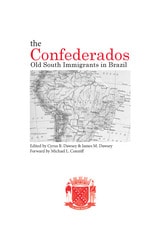
The Confederados
Old South Immigrants in BrazilCyrus B. Dawsey
University of Alabama Press, 1998
The story of exiles from the Confederate South who fled to Brazil after the US Civil War. The collection includes a previously unpublished narrative by an original settler
In the wake of the American Civil War, thousands of disillusioned Southerners sought refuge far from Reconstruction’s reach—many found it in Brazil. The Confederados is a compelling exploration of this little-known migration, tracing the journey of Confederate exiles who forged new lives in the sugarcane fields of São Paulo. Through vivid personal narratives, scholarly essays, and rare archival insights, this volume uncovers the cultural, agricultural, and religious legacy these settlers left behind.
From the harrowing voyage of Sarah Bellona Smith Ferguson to the enduring traditions of the Campo chapel, the book reveals how these Americans shaped—and were shaped by—their Brazilian surroundings. It examines their impact on education, Protestantism, and farming, and how their descendants maintain a distinct identity more than a century later.
Richly illustrated and deeply researched, The Confederados is essential reading for anyone interested in Southern history, diaspora studies, or the global echoes of the Civil War. This is not just a story of exile—it’s a testament to resilience, adaptation, and the enduring ties between two nations.